


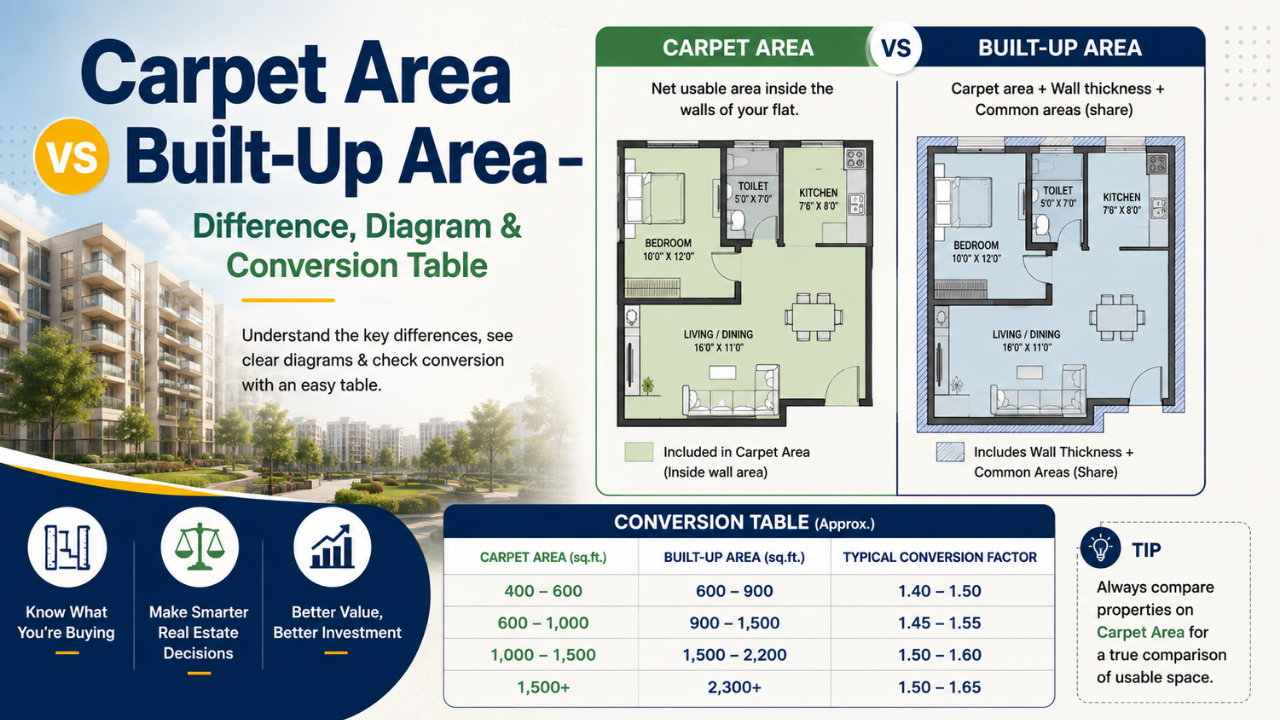
Carpet Area vs Built-Up Area: Difference, Diagram and Conversion Table
Dasadia Editorial Team · Updated August 2026
The 30-Second Answer
Carpet area is the net usable floor space inside your flat, measured within the walls and including internal partition walls. Built-up area adds the thickness of the walls and the balcony on top of that. Built-up is therefore always the larger number — but by how much is genuinely disputed. Published rules of thumb range from “built-up is 10–15% more than carpet” to “carpet is 70% of built-up”, and those two statements cannot both be true. This guide explains the difference, gives you a conversion table, and shows why you should stop using rules of thumb altogether.
Source: The Wadhwa Group · 99acres · ICICI Bank
Executive Summary — Key Takeaways
- Carpet area is defined in law under Section 2(k) of the RERA Act 2016; built-up area is not defined in the same way.
- Built-up area = carpet area + wall thickness + balcony, terrace or verandah.
- Published conversion rules conflict: some sources say built-up is 10–15% above carpet, others say carpet is only 70% of built-up.
- Those two claims imply built-up areas of 1,150 sq ft and 1,430 sq ft for the same 1,000 sq ft carpet flat.
- The gap exists because sources disagree on whether balconies, terraces, flower beds and external walls are counted.
- Standard agreement-for-sale drafting typically counts the full external wall, but only half of any wall shared with a neighbouring flat.
- Under RERA, flats must be sold and priced on carpet area — built-up is descriptive only.
- One square metre equals 10.7639 square feet, and many agreements state areas in square metres.
Source: ICICI Bank · 99acres · Confident Group · Law Insider · Kalpataru
The Difference, in One Diagram

Carpet area sits inside built-up area, which sits inside super built-up area.
The three figures are nested, not alternative. Carpet area is the innermost box — the floor you actually walk on. Wrap the walls and the balcony around it and you have built-up area. Add a proportionate share of the lobbies, lifts, staircases, corridors and amenities and you have super built-up area, the figure historically used for pricing. Every flat therefore has all three numbers simultaneously, and quoting a different one is how the same flat gets advertised at three different sizes.
Source: The Wadhwa Group · Lodha Group · Savitar Realty
Carpet Area: What Is In and What Is Out
Carpet area is the only one of the three with a statutory definition. Under Section 2(k) of the Real Estate (Regulation and Development) Act 2016 it is the net usable floor area of an apartment, measured within its walls, and it explicitly includes the area covered by internal partition walls.
Included: bedrooms, living and dining space, kitchen, bathrooms, internal passages, and in many layouts an internal staircase. Excluded: external walls, areas under service shafts, exclusive balconies and verandahs, and any exclusive open terrace.
The balcony exclusion is the one that catches buyers out most often. A flat with a generous enclosed balcony lives noticeably larger than its carpet figure suggests, while a flat with none is getting full value from every stated square foot. When comparing two flats of identical carpet area, always ask what sits outside the number.
There is also a distinction the industry draws but the statute does not: RERA carpet area versus usable carpet area. Because the legal definition counts internal partition walls, the RERA figure is marginally larger than the floor you could actually cover. A layout chopped into several small rooms therefore has more of its carpet area tied up in wall than an open-plan layout of the same nominal size. When two flats quote identical carpet areas, the one with fewer internal partitions gives you more usable floor.
Source: The Wadhwa Group · Kalpataru · 99acres · MahaRERA
Built-Up Area: What Is In and What Is Out
Built-up area — sometimes called plinth area — is the constructed footprint of your unit. The working formula is built-up area = carpet area + wall area + balcony, terrace or verandah area. It is measured to the external perimeter wall surfaces, and it absorbs the parts of your flat that are built but not usable: wall thickness, dry balconies, flower beds and utility ledges.
Unlike carpet area, built-up area has no single statutory definition, which is precisely why published figures vary. What it does have is a fairly consistent contractual convention. Standard agreement-for-sale drafting defines a unit’s built-up area as its carpet area plus the balcony area, plus the full area of external walls, plus half the area of any wall shared with a neighbouring flat or balcony. That half-wall rule is sensible — a party wall serves two flats, so each carries 50% — and it is worth checking whether your own agreement follows it.
The practical consequence: a corner or end unit with more external wall will show a larger built-up area than an identical middle unit, even though the carpet area is the same. If you are comparing built-up figures across flats in one project, that variation is real rather than an error.
Source: Confident Group · Law Insider · PropChk · Civil Practical Knowledge
Side by Side
Source: The Wadhwa Group · Kalpataru · Confident Group · PropChk
Conversion Table
Because the wall-and-balcony addition varies by layout, the honest approach is a range rather than a single multiplier. The table below converts a 1,000 sq ft carpet area at each commonly cited uplift, and gives the square-metre equivalent since many agreements state areas in metric.
One square metre equals 10.7639 square feet. To convert the other way, divide the square-foot figure by 10.7639.
Source: Confident Group · 99acres · Marathon Realty · ICICI Bank
The 70% Problem: Why the Rules of Thumb Contradict Each Other
Search this topic and you will meet two statements repeated with equal confidence. One says built-up area is roughly 10 to 15% more than carpet area. The other says carpet area is roughly 70% of built-up area. These are not compatible. If built-up is carpet plus 15%, then carpet is about 87% of built-up, not 70%. If carpet is genuinely 70% of built-up, then built-up is about 43% more than carpet — nearly three times the first estimate.
Both figures appear on major portals and lender websites, sometimes within the same article. The discrepancy is not carelessness so much as inconsistent scope. The lower estimates typically count only wall thickness. The higher ones fold in balconies, terraces, flower beds, dry balconies and full external walls — and in some cases the 70% figure has migrated across from a comparison with super built-up area, where it fits far better.
Ranges quoted across sources run from 10–15%, through 10–30%, to 20–30%, with carpet variously described as 70%, 70–75% or 70–80% of built-up. The spread is wide enough that applying any single multiplier to a real purchase is guesswork. The correct move is to stop converting. Take the carpet area from your agreement for sale, which is legally required to be stated, and use that figure alone for pricing and comparison. Treat built-up as a description of the construction, not as a number you can derive.
Source: ICICI Bank · 99acres · Confident Group · Marathon Realty · Signature Sattva · Savitar Realty
Where Each Number Is Actually Used
Knowing which figure governs which decision saves a great deal of confusion at the paperwork stage. The same flat legitimately appears at different sizes in different documents, and that is not evidence of anything going wrong — it simply means each document is measuring to the boundary that matters for its own purpose.
- Sale price and the agreement for sale: carpet area, mandatory under RERA.
- Comparing two flats: carpet area, via effective price per carpet square foot.
- Home loan valuation: lenders' technical valuers work primarily from carpet area.
- Municipal building approvals and FSI calculations: built-up area, under local development rules.
- Society maintenance charges: often apportioned on built-up or super built-up area — check the bye-laws.
- Property tax: varies by municipal corporation; several assess on carpet area.
- Interior fit-out quotations: carpet area, since that is the floor being finished.
Source: Kalpataru · Civil Practical Knowledge · BookNewProperty · Lodha Group
Which Number to Trust: Pros and Trade-offs
Both figures tell you something. Only one of them can be relied on in a negotiation.
Pros
- Carpet area is legally defined and must be stated in the agreement.
- It is the only figure on which flats compare fairly.
- A shortfall against the agreement triggers a refund right with interest.
- It maps directly to what you can furnish and use.
- Lenders' valuers work from it.
Trade-offs
- Built-up area has no equivalent statutory definition.
- Published conversion rules disagree by a factor of nearly three.
- It varies between identical flats depending on external wall length.
- It absorbs unusable space such as flower beds and dry balconies.
- It cannot legally anchor a price, yet still appears in marketing.
Source: Kalpataru · Law Insider · Confident Group
A Short Checklist
- Read the carpet area off the agreement for sale, not the brochure or the listing.
- Note whether the agreement states areas in square feet or square metres before comparing.
- Ask specifically how the agreement defines built-up area, including the party-wall treatment.
- Establish what sits outside the carpet figure — balcony, terrace, dry balcony, utility ledge.
- Never apply a percentage rule of thumb to derive one area from another for a real purchase.
- Compare shortlisted flats only on effective price per carpet square foot.
- Check the society bye-laws for whether maintenance is charged on built-up or super built-up area.
- Verify the project's registration and disclosed carpet areas on the MahaRERA portal.
Source: MahaRERA · IGR Maharashtra · RERAExam
Fact-Check Section
- Carpet area is defined under Section 2(k) of the RERA Act 2016 as net usable floor area within the walls, including internal partition walls — Wadhwa Group and Kalpataru.
- External walls, service shafts, exclusive balconies, verandahs and open terraces are excluded from carpet area — Wadhwa Group.
- Built-up area = carpet area + wall area + balcony, terrace or verandah area — Confident Group.
- Built-up area is measured to the external perimeter wall surfaces and includes dry balconies and flower beds — PropChk.
- Standard agreement drafting counts full external walls plus 50% of walls shared with an adjoining unit — Law Insider clause library.
- Published uplift estimates range from 10–15% to 20–30% over carpet area — 99acres, Confident Group and Marathon Realty.
- Published estimates of carpet as a share of built-up range from 70% to 80% — ICICI Bank, Marathon Realty and Confident Group.
- Those two sets of estimates are mutually inconsistent — a 15% uplift implies carpet is about 87% of built-up, not 70%.
- One square metre equals 10.7639 square feet.
- Under RERA, flats must be sold and priced on carpet area; built-up figures are descriptive only — Kalpataru.
Source: The Wadhwa Group · Confident Group · Law Insider · ICICI Bank · 99acres · Kalpataru
Frequently Asked Questions
Carpet area is the net usable floor space within the walls of the flat, including internal partition walls. Built-up area adds the thickness of the walls and the balcony, terrace or verandah on top of that. Built-up is always the larger figure.
That figure is widely quoted but disputed. Other equally common sources put built-up at only 10 to 15% above carpet, which would make carpet about 87% of built-up. The gap arises because sources differ on whether balconies, terraces and external walls are counted. Use the carpet area stated in your agreement rather than any percentage rule.
Add the wall area and the balcony, terrace or verandah area to the carpet area. There is no reliable fixed percentage — the uplift depends on the layout, wall thickness and how much balcony the flat has.
No. Under RERA, exclusive balconies and verandahs are excluded from carpet area. They are included in built-up area.
Yes. Section 2(k) of the RERA Act expressly includes the area covered by internal partition walls within carpet area, which is why RERA carpet area is slightly larger than the space you could physically lay a carpet on.
No. Lobbies, lifts, staircases and corridors sit in super built-up area, not built-up area. Built-up covers only your own unit’s constructed footprint.
Plinth area is another term for built-up area — the constructed footprint of the unit measured to the external wall surfaces.
Usually because of external wall length. Standard agreement drafting counts the full external wall but only half of any wall shared with a neighbouring flat, so a corner unit shows a larger built-up area than a middle unit with the same carpet area.
Carpet area. Under RERA, developers must disclose and price on carpet area, and it must be stated in the agreement for sale.
Lenders’ technical valuers work primarily from carpet area when assessing the loan-eligible value of a property.
It varies. Many societies apportion maintenance on built-up or super built-up area rather than carpet. Check the society bye-laws before assuming.
Multiply by 10.7639. To go the other way, divide the square-foot figure by 10.7639. Many agreements state areas in square metres, so check the unit before comparing figures.
Not in the way carpet area is. RERA defines carpet area under Section 2(k), but built-up area rests on convention and on how it is drafted in the individual agreement for sale.
Ask for the carpet area from the agreement for sale before doing any comparison or negotiation. Do not convert using a rule of thumb — the published multipliers disagree too widely to be safe.
Conclusion and Next Steps
Carpet area and built-up area describe the same flat at two different boundaries: the inside face of the walls, and the outside. That is the entire concept. Where it gets confusing is in the conversion, and the honest finding of this guide is that the standard conversions cannot be trusted — published rules of thumb for the same relationship differ by nearly a factor of three, because they silently count different things.
So do not convert. Take the carpet area from the agreement for sale, check whether it is stated in square feet or square metres, and calculate effective price per carpet square foot for every flat on your shortlist. Ask what sits outside that figure — balcony, terrace, utility ledge — and ask how the agreement defines built-up area if you need it for maintenance or approvals. Verify the project’s disclosures on the MahaRERA portal, and check registered transaction rates on the IGR Maharashtra portal before you negotiate.
Sources and References
- MahaRERA — Maharashtra Real Estate Regulatory Authority
- IGR Maharashtra — Department of Registration & Stamps
- The Wadhwa Group — carpet, built-up and super built-up under RERA
- Kalpataru — what is RERA carpet area, Section 2(k)
- Lodha Group — carpet area and super built-up area explained
- 99acres — carpet area meaning, inclusions and exclusions
- ICICI Bank — carpet, built-up and super built-up area
- Confident Group — built-up area meaning and calculation
- Marathon Realty — carpet, built-up and super built-up area guide
- Signature Sattva — area definitions and worked examples
- PropChk — differences between the three area types
- Law Insider — standard built-up area clauses in agreements for sale
- Savitar Realty — carpet versus built-up versus super built-up, 2026
- BookNewProperty — area types, RERA rules and loading
- Civil Practical Knowledge — area types, FSI and setback
- RERAExam — carpet area and unit conversion calculator
Disclaimer: This article is informational only. Area conventions vary between projects and agreements — verify the carpet area stated in your agreement for sale and the project’s disclosures on MahaRERA before making any decision.
Comparing carpet areas in Andheri East?
Explore 153 East by Dasadia Developers LLP — a freehold residential address in J.B. Nagar, Andheri East, close to Chakala and Western Express Highway metro stations, the highway and the airport. MahaRERA registration no. PR1180002502968. Get the brochure with floor plans and amenities, or book a site visit with our team.