


RERA Carpet Area vs Builder Carpet Area: What You're Paying For
Dasadia Editorial Team · Updated August 2026
The 30-Second Answer
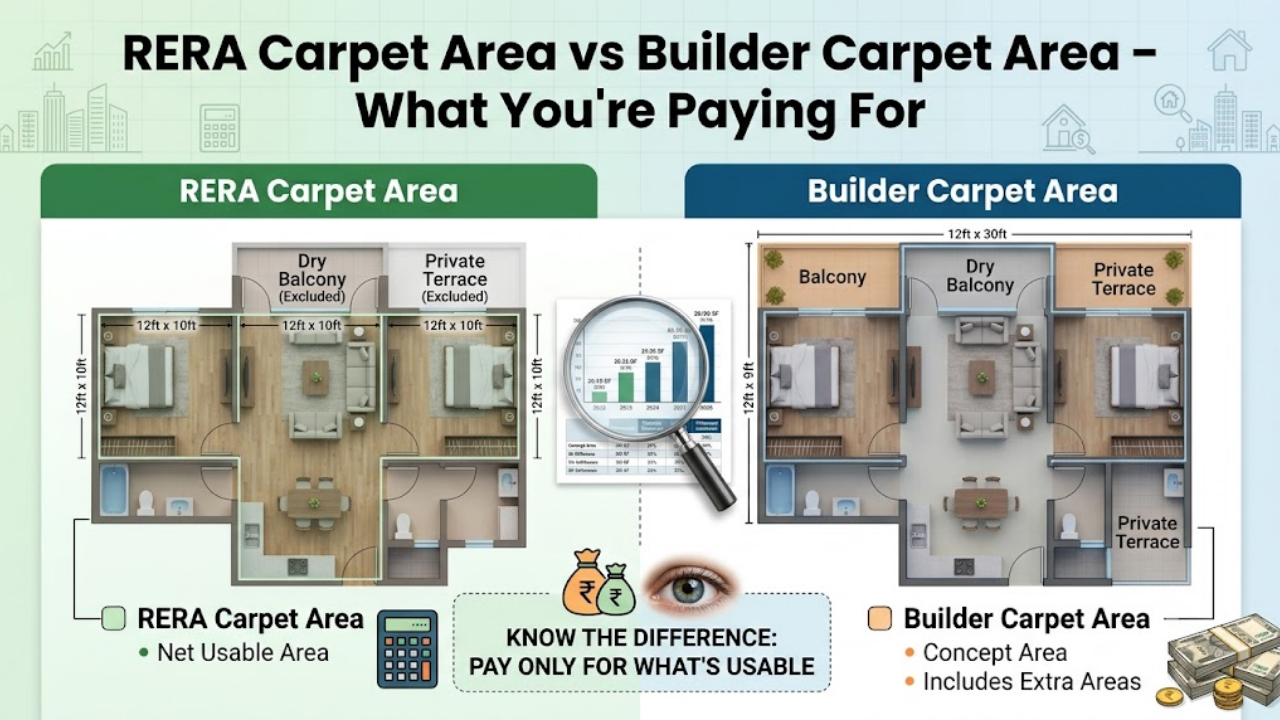
There are three different “carpet areas” in circulation for the same flat, and only one of them is enforceable. RERA carpet area, defined in Section 2(k), includes internal partition walls. Builder or MOFA carpet area, the older Maharashtra convention, excludes them, so it produces a smaller number. Broker “usable” carpet sometimes informally folds in the balcony and utility to sound larger. What governs is the figure in the executed, registered agreement for sale — not the brochure, not the allotment letter, not the draft agreement. Tribunals have said so explicitly.
Source: Kalpataru · RERAExam · The Law Suits
Executive Summary — Key Takeaways
- RERA carpet area includes internal partition walls; MOFA or builder carpet area generally excludes them.
- There is no fixed conversion percentage between the two — the difference is the measured internal wall area of that specific flat.
- The carpet area in the executed registered agreement for sale supersedes the allotment letter, the draft agreement and the brochure.
- MahaRERA's Model Agreement uses the words “variation cap of 3%” — which is a ceiling on variation, not a free allowance to under-deliver.
- A shortfall of even 10 sq ft is refundable; at ₹28,000 per sq ft that is ₹2.8 lakh.
- Refunds are due within 45 days with interest at MCLR plus 2% per annum, from the dates the excess payments were made.
- MahaRERA has held that super built-up area cannot be substituted for carpet area in pricing.
- MahaRERA has issued 1,163 recovery warrants for ₹705.62 crore and recovered ₹200.23 crore across 139 projects.
Source: Kalpataru · The Law Suits · Free Press Journal · CleverCoins · Business Standard
The Three Carpet Areas in Circulation
RERA carpet area is the only one with a statutory definition. Section 2(k) of the Real Estate (Regulation and Development) Act 2016 defines it as the net usable floor area within the walls of the apartment, expressly including the area covered by internal partition walls, and excluding external walls, service shafts, exclusive balconies and verandahs, and exclusive open terraces.
Builder or MOFA carpet area comes from the older Maharashtra Ownership Flats Act convention, which generally excludes internal wall area. Because RERA counts those walls and MOFA does not, the RERA figure for the same flat is the larger of the two. The relationship is additive rather than proportional — RERA carpet equals MOFA carpet plus the measured internal wall area — so any percentage conversion you are offered is an estimate, not a rule.
Broker or “usable” carpet area is not a legal category at all. It is a working figure used in conversation, and it cuts both ways. Sometimes it means the true layable floor, which is smaller than RERA carpet because it strips out the partition walls. Sometimes it informally includes the balcony and utility area to make a flat sound bigger. Since the same phrase is used for both, never accept a “usable carpet” figure without asking precisely what has been counted.
Source: Kalpataru · The Wadhwa Group · RERAExam · Lodha Group · BookNewProperty
Side by Side
Because the same flat produces a different number under each convention, comparing a resale quote against a new-project figure without establishing the basis is meaningless.
Source: Kalpataru · RERAExam · CleverCoins · The Wadhwa Group
Which Number Is Legally Binding
The answer is narrower than most buyers expect: the carpet area recorded in the executed and registered agreement for sale. Not the brochure, not the price sheet, not the allotment letter, and not the draft agreement.
The Maharashtra Real Estate Appellate Tribunal made this concrete in an appeal against Accord Builders. The buyer pointed to two documents showing larger areas — an allotment letter and a draft agreement for sale — and claimed compensation for the difference against what was delivered. The Tribunal rejected the claim, holding that the executed registered agreement clearly specified the carpet area and that this figure governs over other documents.
Read that in both directions, because it cuts both ways. It means a buyer cannot rely on a generous brochure number if the agreement says something smaller — so read the agreement before you sign, not after. It equally means that once a figure is in the registered agreement, a developer cannot walk it back. MahaRERA’s rulings involving Tata Housing established that the carpet area disclosed and registered is a binding commitment, that any shortfall must be compensated, and that super built-up area cannot be substituted for carpet area in pricing.
Source: The Law Suits · CleverCoins · MahaRERA
The 3% Clause Almost Everyone Misreads
This is the most valuable paragraph on the page. Clause 1(g) of MahaRERA’s Model Agreement for Sale requires the promoter to confirm the final carpet area after construction is complete and the occupancy certificate is granted, furnishing details of any changes, subject to a variation cap of 3%.
Developers routinely read that as a three per cent free allowance — as though a shortfall of two per cent costs them nothing and only anything beyond three per cent triggers a refund. That reading is wrong. The clause says “variation cap”, meaning a ceiling on how much the area may change at all, and it provides for financial adjustment in favour of whichever party benefits from the change. It is not a licence to under-deliver up to three per cent without paying for it. Accepting the developer’s interpretation would let builders make windfall gains at the buyer’s expense on every unit in a project.
The practical consequence: any shortfall is refundable, however small. A consumer case reported in 2026 concerned exactly this argument, with the developer refusing a refund on a shortfall inside three per cent. The position is that the excess amount must be refunded within 45 days, carrying interest at the marginal cost of funds-based lending rate plus 2% per annum, calculated from the respective dates on which the excess payments were made. A West Bengal appellate tribunal order reported in January 2026 upheld a refund for a shortfall of just 10 sq ft, holding that tolerance clauses cannot override statutory definitions.
Source: Free Press Journal · HomesOK · CleverCoins
What a Shortfall Is Actually Worth
Buyers dismiss small shortfalls as not worth the argument. At Mumbai rates they are worth several lakh. The table shows the refundable amount before interest.
Add interest at MCLR plus 2% per annum from the dates you made the excess payments, and the recoverable sum grows further. The ₹31,650 column reflects the Andheri East average asking rate in 2026, included as a locality reference point.
Source: Free Press Journal · Pune Realty Hub
When a “Shortfall” Is Not a Shortfall
An important caution before anyone rushes to file. MahaRERA has dismissed at least one claim where the apparent shortfall was in reality a change of measurement method rather than a loss of floor area — the flat had not shrunk, the convention used to describe it had changed.
This is precisely the trap this article exists to explain. If your allotment letter quoted a MOFA-basis carpet area and your agreement states a RERA-basis carpet area, the two numbers will differ even though nothing about the flat has changed. Comparing across conventions and calling the gap a shortfall will not survive a hearing. The Supreme Court took a related line in Experion Developers v. Himanshu Dewan in August 2023, holding that a builder’s claim of increased sale area must be tested against evidence, comparative approved plans and architect certificates rather than accepted or rejected mechanically.
So establish the basis before you build a case. Compare like with like: the RERA carpet area in the registered agreement against the RERA carpet area measured at handover, verified against approved plans and, where the sums are large, an architect’s certificate.
Source: HomesOK · RERAExam · CleverCoins
How to Enforce It
The route is a complaint against the promoter under Section 31 of the Act, filed online through the MahaRERA portal. The fee is modest and the process does not require a lawyer, though many buyers use one.
- File online through the MahaRERA portal, paying the fee by net banking, UPI or card.
- MahaRERA issues notice to the builder, who must respond through the portal within 21 days.
- Hearings are conducted largely by video call, with a link sent by email.
- A first hearing is typically scheduled within 60 to 90 days of filing.
- Straightforward, well-documented cases often conclude in two to four hearings over four to eight months.
- For carpet area shortfall the remedy is a proportionate refund with interest.
- Interest on delayed sums runs at SBI MCLR plus 2% per annum.
- Enforcement has teeth: MahaRERA has recovered ₹200.23 crore through 283 warrants across 139 projects.
Source: Pune Realty Hub · Business Standard · MahaRERA
Your Position, Honestly Assessed
Before spending months on a claim, it helps to see both sides of the ledger.
Pros
- The registered agreement figure is binding on the developer.
- Even a 10 sq ft shortfall is refundable — no minimum threshold.
- Tolerance clauses cannot override the statutory definition.
- Refund carries interest from the date of each excess payment.
- Filing is online, low-cost and does not require a lawyer.
Trade-offs
- The brochure and allotment letter give you no rights if the agreement differs.
- A convention change from MOFA to RERA basis is not a shortfall.
- Claims must be evidenced against approved plans, not asserted.
- First hearings typically take 60 to 90 days to schedule.
- Straightforward matters still commonly run four to eight months.
Source: The Law Suits · HomesOK · Pune Realty Hub · CleverCoins
Before You Accept Handover
- Read the carpet area in the executed registered agreement and treat it as the only binding figure.
- Confirm in writing whether it is stated on a RERA basis and in square feet or square metres.
- Measure the delivered carpet area and compare it against the agreement figure, not the brochure.
- Ask for the developer's final area confirmation after the occupancy certificate is granted.
- Where the sums are material, obtain an architect's certificate and the approved plans.
- Do not accept a claim that variation within 3% is free — it is a cap, not an allowance.
- Cross-check the carpet area disclosed on the project's MahaRERA listing.
- Keep dated records of every payment, since interest runs from those dates.
Source: Free Press Journal · MahaRERA · CleverCoins · IGR Maharashtra
Fact-Check Section
- RERA carpet area is defined in Section 2(k) as net usable floor area within the walls, including internal partition walls — Kalpataru and Wadhwa Group.
- RERA carpet area equals MOFA carpet area plus measured internal wall area; there is no fixed conversion percentage — RERAExam.
- MahaREAT held that the carpet area in the executed registered agreement supersedes the allotment letter and draft agreement — The Law Suits.
- MahaRERA rulings involving Tata Housing held that registered carpet area is a binding commitment and that super built-up area cannot be substituted in pricing — CleverCoins.
- Clause 1(g) of MahaRERA's Model Agreement uses the phrase “variation cap of 3%” and provides for financial adjustment in favour of the benefiting party — Free Press Journal.
- Excess amounts must be refunded within 45 days with interest at MCLR plus 2% per annum from the dates of the excess payments — Free Press Journal.
- A West Bengal appellate tribunal order reported in January 2026 upheld a refund for a 10 sq ft shortfall — HomesOK.
- The Supreme Court in Experion Developers v. Himanshu Dewan, 18 August 2023, held sale-area claims must be tested against plans and architect certificates — HomesOK.
- MahaRERA has issued 1,163 warrants for ₹705.62 crore and recovered ₹200.23 crore through 283 warrants across 139 projects — Business Standard.
- Section 31 complaints are filed online; builders must respond within 21 days and first hearings are typically 60 to 90 days out — Pune Realty Hub.
Source: Kalpataru · The Law Suits · CleverCoins · Free Press Journal · HomesOK · Business Standard · Pune Realty Hub
Frequently Asked Questions
RERA carpet area, defined in Section 2(k), includes the area covered by internal partition walls. Builder or MOFA carpet area, the older Maharashtra convention, generally excludes them. The same flat therefore measures larger on a RERA basis.
The one recorded in the executed, registered agreement for sale. Tribunals have held that this supersedes the allotment letter, the draft agreement and marketing material.
No fixed percentage exists. RERA carpet equals MOFA carpet plus the measured internal wall area of that specific flat, so the difference depends on how many partitions the layout has and how thick they are.
No. MahaRERA’s Model Agreement uses the words “variation cap of 3%” — a ceiling on permitted variation, with financial adjustment in favour of whichever party benefits. It is not a free allowance to under-deliver.
Yes. A West Bengal appellate tribunal order reported in January 2026 upheld a refund for a 10 sq ft shortfall, holding that tolerance clauses cannot override the statutory definition.
The marginal cost of funds-based lending rate plus 2% per annum, calculated from the respective dates on which the excess payments were made, with the refund due within 45 days.
An informal figure with no legal standing. It sometimes means the true layable floor, which is smaller than RERA carpet because it strips out partition walls, and sometimes it informally includes the balcony to sound larger. Always ask what has been counted.
No. RERA requires disclosure and pricing on carpet area, and MahaRERA has held that super built-up area cannot be substituted for carpet area in pricing.
The executed registered agreement governs. This is why the agreement must be read carefully before signing rather than relied upon afterwards.
Then it is not a shortfall. MahaRERA has dismissed a claim where the apparent gap was a change from one measurement convention to another rather than a loss of floor area. Establish the basis of both figures before filing.
File a Section 31 complaint against the promoter online through the MahaRERA portal. The builder must respond within 21 days, hearings are largely by video call, and a first hearing is typically scheduled within 60 to 90 days.
Straightforward, well-documented matters commonly conclude in two to four hearings over four to eight months, though timelines vary with complexity.
Yes. It has issued 1,163 recovery warrants totalling ₹705.62 crore and recovered ₹200.23 crore through 283 warrants across 139 projects.
Measure the delivered carpet area against the figure in the registered agreement, obtain the developer’s final area confirmation after the occupancy certificate, and keep dated payment records since interest runs from those dates.
Conclusion and Next Steps
The phrase “carpet area” does not mean one thing. It means at least three, and the gap between them is not fraud — it is convention, inherited from a pre-RERA framework that has never fully disappeared from Maharashtra’s paperwork. What has changed is that only one of the three carries legal weight, and it is the one written into the executed registered agreement for sale.
So do two things. Before signing, read the agreement’s carpet area figure and confirm its basis in writing — that document will outrank every brochure you were shown. Before accepting handover, measure what has been delivered and compare it against that same figure, not against anything else. If there is a genuine shortfall on a like-for-like basis, it is refundable with interest regardless of size, and the 3% clause is a cap rather than a free allowance. Verify the project’s disclosures on the MahaRERA portal and registered rates on the IGR Maharashtra portal throughout.
Sources and References
- MahaRERA — Maharashtra Real Estate Regulatory Authority
- IGR Maharashtra — Department of Registration & Stamps
- Free Press Journal — MahaRERA on carpet area shortfall and the 3% variation cap
- The Law Suits — MahaREAT: agreement for sale supersedes other documents
- CleverCoins — RERA landmark judgments 2024–25
- HomesOK — carpet area case law and tolerance clauses
- Pune Realty Hub — filing a MahaRERA complaint, 2026
- Business Standard — MahaRERA recovery of homebuyer compensation
- Kalpataru — what is RERA carpet area, Section 2(k)
- The Wadhwa Group — area definitions under RERA
- RERAExam — MOFA versus RERA carpet area conversion
- Lodha Group — carpet area and usable carpet area
- BookNewProperty — RERA carpet versus usable carpet area
- Savitar Realty — carpet, built-up and super built-up guide 2026
Disclaimer: This article is informational only and is not legal advice. Case outcomes turn on their own facts and documents — verify the carpet area stated in your agreement for sale and the project’s disclosures on MahaRERA, and take professional advice before pursuing any claim.
Looking at carpet areas in Andheri East?
Explore 153 East by Dasadia Developers LLP — a freehold residential address in J.B. Nagar, Andheri East, close to Chakala and Western Express Highway metro stations, the highway and the airport. MahaRERA registration no. PR1180002502968. Get the brochure with floor plans and amenities, or book a site visit with our team.