


Carpet Area, Built-Up Area & Super Built-Up Area: Meaning, Calculation & Key Differences
By the Dasadia Editorial Team · Updated June 2026
When you’re flat-hunting, the same home can be described in three very different sizes — and the gap between them can be 30–40% or more. A brochure might advertise a ‘1,000 sq ft’ apartment, while the space you can actually live in is closer to 650 sq ft. The difference comes down to three terms that brokers often use loosely: carpet area, built-up area and super built-up area. Misread them and you can end up paying for far less usable space than you think.
This guide explains all three in plain language: what each one means, exactly how it’s calculated, how the loading factor links them, and why — under RERA — carpet area is the only number that should drive your decision. Get these definitions straight and you’ll compare homes accurately and know precisely what you’re paying for.
Key Takeaways
- Carpet area is the net usable floor area inside your flat — the space you can actually walk on and furnish.
- Built-up area adds the thickness of walls and balconies, and is typically about 10–15% larger than carpet area.
- Super built-up (saleable) area adds a proportionate share of common areas like lobbies, lifts and amenities.
- The loading factor is the gap between super built-up and carpet area: Loading % = (Super Built-Up − Carpet) ÷ Carpet × 100.
- Loading factors usually run 25–40%, and can reach 60% in amenity-heavy projects — so the advertised size can far exceed usable space.
- Under RERA, homes must be priced and sold on carpet area, with a maximum permitted variation of 3% at possession.
What Is Carpet Area?
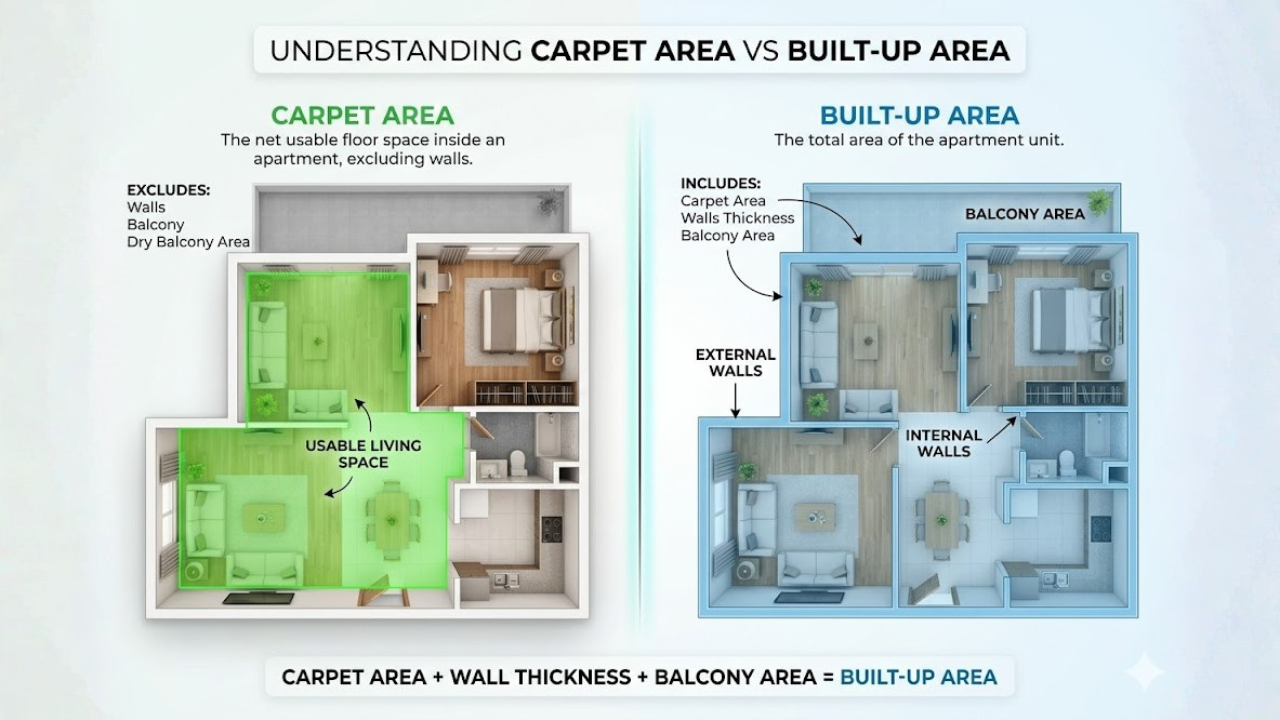
Carpet area is exactly what it sounds like — the space inside your apartment where you could lay a carpet. It is the net usable floor area covering bedrooms, the living and dining room, kitchen, bathrooms and internal passages. Under RERA, carpet area is defined as the net usable floor area of an apartment, including the internal partition walls but excluding external walls, balconies, service shafts and common areas. Because RERA includes internal wall thickness, the RERA carpet area is usually around 5% higher than the older, informal carpet-area figure. This is the single most important number for any buyer.
What Is Built-Up Area?
Built-up area is the carpet area plus the space taken up by the walls (internal and external) and your private balconies or utility areas. In other words, it is the total floor space your apartment physically occupies, walls included. As a rule of thumb, the built-up area is about 10–15% larger than the RERA carpet area, depending on the building’s design. It appears in older property documents and marketing material, but it does not carry the same legal standing as carpet area under RERA.
What Is Super Built-Up Area?
Super built-up area — also called the saleable area — is the built-up area plus your proportionate share of the building’s common spaces: lobbies, corridors, staircases, lift shafts, and amenities such as the clubhouse, gym and pool. It does not include open-to-sky features like swimming pools, compound walls, driveways or gardens. Before RERA, builders priced flats on this figure, which is why a ‘1,000 sq ft’ flat could deliver far less usable space. The extra space bundled into the super built-up area is captured by the loading factor.
Source: Brigade (saleable area) • Lodha Group
The Key Differences at a Glance
Aspect
Carpet area
Built-up area
Super built-up
What it covers
Usable space inside walls
Carpet + walls + balcony
Built-up + common areas
Internal walls
Included
Included
Included
Balcony
Excluded
Included
Included
Common areas
Excluded
Excluded
Included
Size vs carpet
Base (100%)
~10–15% more
~25–40%+ more
RERA pricing basis
Yes
No
No (legacy)
The Loading Factor: The Number That Links Them
The loading factor is the percentage by which the super built-up area exceeds the carpet area — essentially the share of common space loaded onto your flat. The formula is simple:
Loading % = (Super Built-Up Area − Carpet Area) ÷ Carpet Area × 100
For example, a flat with an 800 sq ft carpet area and a 1,200 sq ft super built-up area carries a 50% loading factor. Most residential projects fall in the 25–40% range; amenity-rich luxury projects can push past 60%. The higher the loading, the less usable space you get for the same advertised size — so always check it before comparing two homes.
A Worked Example (Illustrative)
The same 2 BHK can be described three ways. Here’s how one home looks under each label, with a 30% loading factor.
Measurement
Approx. area
Carpet area (usable space)
~700 sq ft
+ walls & balcony → Built-up area
~790 sq ft (~13% more)
+ share of common areas → Super built-up
~910 sq ft (30% loading)
Loading factor
30%
What you actually use
700 sq ft of the advertised 910
So a flat marketed as ‘910 sq ft’ offers about 700 sq ft of genuinely usable space — roughly 77% of the headline number. That’s why comparing the carpet area, not the super built-up figure, is essential.
Source: Bangur (usable ~70–80%)
How to Calculate Each Area
Keep these formulas handy when you compare flats — they let you cut through any developer’s framing.
- Carpet area = sum of all usable room areas (bedrooms + living + kitchen + bathrooms + internal passages), including internal walls.
- Built-up area = carpet area + wall thickness + balcony (about 10–15% over carpet).
- Super built-up area = built-up area + your proportionate share of common areas = Carpet × (1 + loading factor).
- Loading factor = (Super Built-Up Area − Carpet Area) ÷ Carpet Area × 100.
- True per-sq-ft price = total cost ÷ carpet area (always convert any super-built-up rate back to carpet).
Source: Sobha (formulas) • Modern Spaaces
Why Carpet Area Matters Most
Since RERA came into force, developers must disclose and price homes on carpet area, ending the old super built-up confusion. This matters for three reasons. First, transparency: you finally pay for usable space, not shared lobbies. Second, comparison: only carpet area lets you compare two projects fairly, because loading factors differ. Third, protection: RERA permits a maximum variation of just 3% in carpet area between what’s promised and what’s delivered at possession. The practical takeaway — always ask for the carpet area, and convert any quoted super-built-up rate back to a carpet-area rate before you judge value.
Source: Brigade (RERA, 3% variation) • MahaRERA
Smart Tips and Pitfalls to Avoid
A few habits ensure you’re comparing like with like and paying for real space.
Smart moves
- Always ask for the carpet area, not just the super built-up figure
- Compare projects on carpet-area rate per sq ft
- Check the loading factor before shortlisting
- Confirm the carpet area is the RERA carpet area
Pitfalls to avoid
- Judging value on the advertised super built-up size
- Ignoring a high loading factor in amenity-heavy projects
- Assuming balcony and walls count as usable carpet area
- Skipping the carpet area in the registered agreement
What This Means for You
The smartest move a buyer can make is to mentally translate every quote into one currency: carpet-area rate per square foot. Two flats can look identically priced on a super-built-up basis, yet the one with the lower loading factor gives you meaningfully more living space for the same money. Ask each developer for the carpet area, the built-up area and the loading factor in writing, and make sure the RERA carpet area is stated clearly in the agreement. Square feet on a brochure are marketing; carpet area is what you live in.
Frequently Asked Questions
What is carpet area?
Carpet area is the net usable floor area inside your apartment — bedrooms, living and dining, kitchen, bathrooms and internal passages — where you can actually place furniture. Under RERA it includes internal partition walls but excludes external walls, balconies and common areas.
What is built-up area?
Built-up area is the carpet area plus the thickness of the walls and your private balconies. It is typically about 10–15% larger than the carpet area and represents the total space your flat physically occupies.
What is super built-up area?
Super built-up area (the saleable area) is the built-up area plus your proportionate share of common spaces like lobbies, lifts, staircases and amenities. It is the figure builders historically used to price flats.
What is the difference between carpet and super built-up area?
Carpet area is the usable space inside your flat; super built-up area adds walls, balconies and a share of common areas. The difference can be 30–40% or more, which is why carpet area is the fairer basis for comparison.
What is a loading factor?
The loading factor is the percentage by which the super built-up area exceeds the carpet area: (Super Built-Up − Carpet) ÷ Carpet × 100. It represents the common space loaded onto your flat and usually ranges from 25–40%.
How do I calculate carpet area from super built-up area?
Divide the super built-up area by (1 + loading factor). For example, a 1,040 sq ft super built-up flat with a 30% loading has a carpet area of about 800 sq ft. Roughly, carpet area is 70–80% of the super built-up area.
Does RERA require pricing on carpet area?
Yes. RERA mandates that developers disclose and sell apartments based on carpet area, ending the older practice of pricing on super built-up area and bringing transparency to comparisons.
What is RERA carpet area and how is it different?
RERA carpet area is the net usable floor area including internal partition walls. Because it counts those internal walls, it is usually about 5% higher than the older informal carpet-area figure.
What is a good loading factor?
For most residential projects a loading factor of 30–40% is considered reasonable. Premium projects ideally stay below 60%; a very high loading means you pay more for shared space than usable living area.
Why is carpet area smaller than the advertised size?
Because advertisements often quote the super built-up area, which bundles in walls, balconies and a share of common areas. The usable carpet area is typically only 70–80% of that headline number.
Is the balcony included in carpet area?
No. Under RERA, balconies, terraces, verandahs and service shafts are excluded from carpet area, though they are counted in built-up and super built-up area.
How much can the actual carpet area differ from what's promised?
RERA permits a maximum variation of 3% in carpet area between what is committed and what is delivered at possession; larger shortfalls entitle the buyer to a refund or adjustment.
Conclusion & Next Steps
Carpet, built-up and super built-up areas describe the same home at three growing sizes — usable space, usable space plus walls and balcony, and everything plus a share of common areas. The loading factor is the bridge between them, and it varies enough that two equally priced flats can offer very different living space. Thanks to RERA, carpet area is now the legal basis for pricing and your best tool for comparison. Ask for the carpet area, check the loading factor, convert every rate to a carpet-area basis, and you’ll always know exactly what you’re buying.
Fact Check: Key Facts Verified
- RERA carpet area = net usable floor area including internal partition walls, excluding external walls, balconies and common areas (RERA / MahaRERA).
- Built-up area is typically ~10–15% larger than carpet area (Sonawane / Wadhwa).
- Super built-up (saleable) area = built-up area + proportionate common areas (Brigade / Lodha).
- Loading factor = (Super Built-Up − Carpet) ÷ Carpet × 100; commonly 25–40%, up to 60% (Brigade / Aurorealty).
- RERA mandates pricing on carpet area, with a maximum 3% variation at possession (Brigade Group).
- RERA carpet area is usually ~5% higher than the older informal carpet-area figure (Modern Spaaces / Sobha).
Sources & References
- MahaRERA — carpet area definition (official)
- Brigade Group — carpet, built-up & super built-up
- Sobha — complete guide & formulas
- Lodha Group — carpet & super built-up calculation
- Modern Spaaces — RERA carpet area & loading factor
- Sonawane Group — built-up vs carpet vs super built-up
- Constera Realty — loading factor formula
- Bangur — measurement & pricing impact
- Wadhwa Group — RERA rules & easy calculations
- Aurorealty — carpet vs super built-up FAQs
This article is for informational purposes only. Definitions, formulas, loading-factor ranges and RERA provisions are summarised from publicly available sources as of June 2026 and may vary by project and over time. Always confirm the exact RERA carpet area, built-up area and loading factor for any specific home in the registered agreement and on the MahaRERA portal, and consult a qualified professional before any decision.
Explore 153 East by Dasadia Developers LLP
Want a home where the carpet area is clear and the layouts are efficient? Explore 153 East by Dasadia Developers LLP — a RERA-registered address in J.B. Nagar, Andheri (East) offering 1, 2, 3 & 4 BHK residences with curated amenities, moments from the metro, the Western Express Highway and both airport terminals. Get the brochure with floor plans, carpet areas and amenity details.