


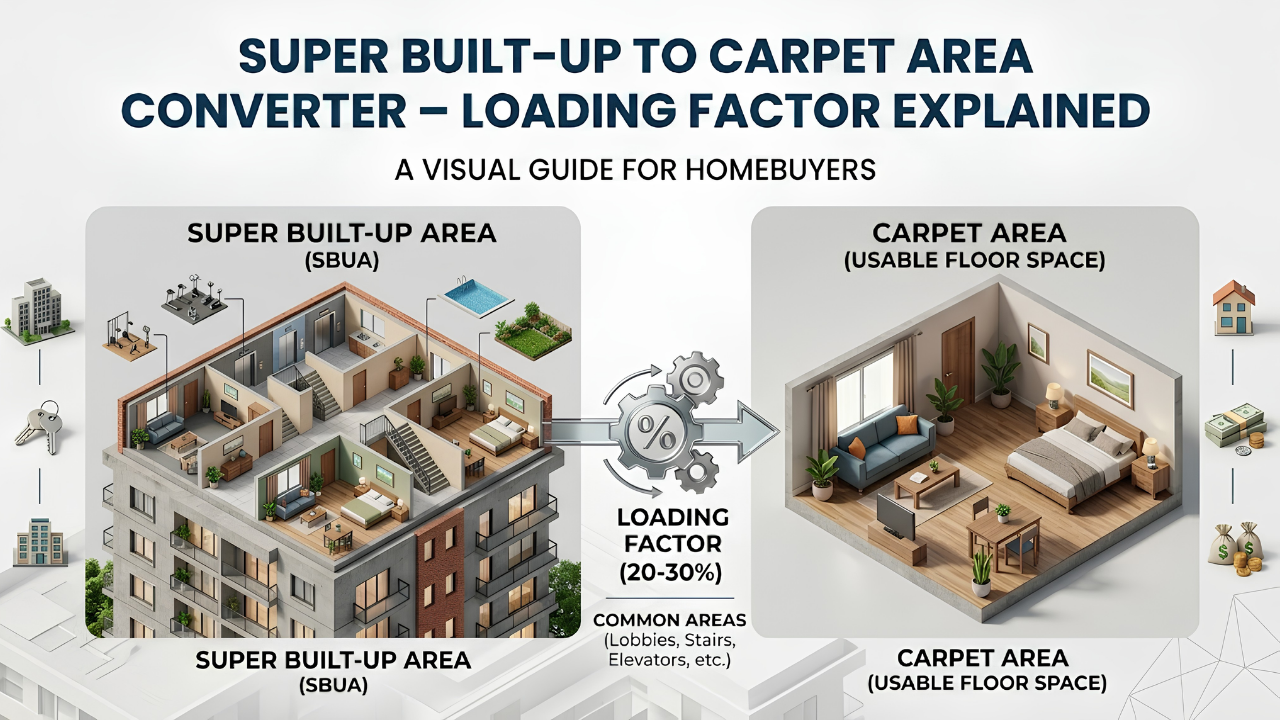
Super Built-Up to Carpet Area Converter: Loading Factor Explained
Dasadia Editorial Team · Updated August 2026
The 30-Second Answer
To convert super built-up area to carpet area, divide by one plus the loading factor: Carpet = SBUA ÷ (1 + Loading). At 40% loading, a 1,400 sq ft advertised flat has 1,000 sq ft carpet. The catch is that loading is rarely disclosed, so you usually have to derive it yourself — and the tables below let you do that by reading across rather than doing arithmetic. In the Mumbai Metropolitan Region the average loading was 43% in early 2025, so if you have no other information, that is the sensible starting assumption for this market.
Source: BookNewProperty · 99acres · Zee Business
Key Takeaways for Super Built-Up to Carpet Area
- Carpet = SBUA ÷ (1 + Loading). SBUA = Carpet × (1 + Loading). Loading % = (SBUA − Carpet) ÷ Carpet × 100.
- Divide by one plus the loading — do not subtract the loading percentage from the SBUA figure. That is the most common conversion error.
- MMR averaged 43% loading in Q1 2025, the highest of India's top seven cities.
- A flat advertised at ₹10,000 per sq ft on SBUA costs ₹14,300 per carpet sq ft at 43% loading.
- Loading is set project-wide, not per unit — it is not something an individual buyer negotiates down.
- Registered projects disclose carpet areas on the MahaRERA portal, which is the free way to verify a developer's figure.
- MahaRERA registration is required where project land exceeds 500 sq m or there are more than eight apartments across phases.
- Apply loading to carpet area, never to built-up area — mixing the two inflates the result.
Source: BookNewProperty · Zee Business · Kalpataru · Lodha Group · Adani Realty
The Three Formulas
Everything on this page comes from three lines of arithmetic, each answering a different question.
Converting an advertised size down to carpet: Carpet Area = SBUA ÷ (1 + Loading Factor). A brochure quotes 1,430 sq ft and you have established loading of 43%: 1,430 ÷ 1.43 = 1,000 sq ft carpet.
Converting carpet up to the advertised size: SBUA = Carpet Area × (1 + Loading Factor). Your agreement states 700 sq ft carpet and the project runs 40% loading: 700 × 1.40 = 980 sq ft SBUA.
Deriving the loading factor: Loading % = (SBUA − Carpet) ÷ Carpet × 100. You have both figures — 980 sq ft advertised, 700 sq ft in the agreement: (980 − 700) ÷ 700 × 100 = 40%.
One warning before the tables. The loading percentage is expressed as a share of carpet area, not as a share of the advertised size. Subtracting 40% from 1,400 sq ft gives 840 sq ft, which is wrong; dividing 1,400 by 1.40 gives 1,000 sq ft, which is right. That single mistake understates carpet area by about 16% at typical Mumbai loading levels, and it is the error most commonly made by buyers doing the sum in their heads.
Source: BookNewProperty · 99acres · NoBroker · RERAExam
Converter: Super Built-Up to Carpet Area
Find your advertised size in the left column and read across to the loading factor that applies. Figures are carpet area in square feet, rounded.
The 43% column reflects the Mumbai Metropolitan Region average recorded in Q1 2025. Use it as a default only when the project’s actual loading is unknown.
Source: Zee Business · BookNewProperty · 99acres
Reverse Converter: Carpet to Super Built-Up Area
Working the other way — you have the carpet area from the agreement and want to know what the same flat would be advertised as.
Source: BookNewProperty · 99acres · NoBroker
What You Are Really Paying Per Usable Square Foot
This is the table that changes decisions. A headline rate quoted on super built-up area is not the price of the space you live in. Read across from the advertised rate to see the effective cost per carpet square foot.
Two flats quoted at the same rate per square foot are not priced the same if their loading differs. At 30% versus 50% loading, the effective cost per usable foot differs by roughly 15% — on a two-crore purchase, that is a difference of around thirty lakh in what you get for your money.
Source: Kalpataru · Zee Business · BookNewProperty
How to Find the Loading Factor When Nobody Will Tell You
Loading percentages are almost never printed in brochures, and asking directly often produces a vague answer. Four practical routes, in order of reliability.
1. Derive it from two documents. The agreement for sale must state carpet area; the brochure or listing states the advertised size. Put both into the loading formula and you have the number, whether or not anyone volunteers it. This is the most reliable method because both figures are already in writing.
2. Pull it from the MahaRERA listing. Registered projects disclose carpet areas, building details by apartment type, approved plans, carpet area statements and draft agreements on the portal. Compare the disclosed carpet figure against the marketed size for the same unit type.
3. Work backwards from the price. If you have the total consideration and the advertised rate per square foot, you can recover the SBUA, then apply method one. This is useful when a broker quotes a rate and a total but is evasive about areas.
4. Ask, and treat the answer as data. A developer confident in a well-amenitised project will state the loading readily. Reluctance to answer a straightforward arithmetic question is itself informative, and worth weighing alongside everything else you know about the project.
Whichever route you take, get the figure in writing rather than verbally. A loading percentage quoted across a sales desk is not something you can rely on later; a carpet area written into the agreement for sale is. If the two disagree once the paperwork arrives, the agreement governs — and under Section 14(2) of the RERA Act, a delivered carpet area that falls short of the agreement obliges the promoter to refund the excess with interest.
Source: Lodha Group · Piramal Realty · L&T Realty · MahaRERA · Savitar Realty
What Loading Is — and What It Is Not
Loading is project-wide, not per unit. Two flats of the same carpet area in the same tower carry the same loading, because the common areas are apportioned proportionately. This matters because it means loading is not a negotiating lever in the way price is — you cannot ask for a lower loading factor, only for a lower price.
Loading is also not automatically a penalty. It funds the lobbies you walk through, the lifts you use and the amenities you may have chosen the project for. A development with a real clubhouse, pool and generous circulation legitimately carries higher loading than a bare-bones building. The problem is proportionality, not the concept: RERA requires carpet area disclosure, but as ANAROCK’s research head has pointed out, no law currently caps the loading factor. Nothing prevents a project with modest common areas from applying the same percentage as one with a full amenity deck.
And loading is not a one-off cost. Society maintenance is frequently apportioned on built-up or super built-up area rather than carpet, so a higher loading factor can mean a permanently higher monthly outgoing as well as a higher purchase price. Check the society bye-laws or the draft agreement for the basis of apportionment before you assume the impact ends at registration.
So the test is not “is the loading high?” but “does what I can see justify it?” Derive the number, then walk the common areas and decide whether they account for it.
Source: Business Standard · Zee Business · Kalpataru · Kalpataru
Five Conversion Mistakes to Avoid
- Subtracting the loading percentage from SBUA instead of dividing by one plus the loading — understates carpet by about 16% at 43%.
- Applying the loading factor to built-up area rather than carpet area, which compounds two different uplifts.
- Comparing an advertised rate on SBUA against a rate quoted on carpet — always convert both to carpet before comparing.
- Assuming a national or city average applies to a specific project rather than deriving that project's own figure.
- Mixing units — many agreements state areas in square metres, so check before comparing. One square metre equals 10.7639 square feet.
Source: BookNewProperty · RERAExam · The Wadhwa Group
A Short Verification Checklist
- Get the carpet area in writing from the agreement for sale, not the brochure.
- Get the advertised SBUA in writing from the listing or price sheet.
- Derive the loading factor yourself using both figures.
- Convert the advertised rate to effective price per carpet square foot.
- Cross-check the disclosed carpet area on the MahaRERA project listing.
- Confirm whether areas are stated in square feet or square metres.
- Walk the common areas and judge whether they justify the loading.
- Compare every shortlisted flat on effective price per carpet square foot alone.
Source: MahaRERA · IGR Maharashtra · L&T Realty · RERAExam
Fact-Check Section
- Carpet = SBUA ÷ (1 + Loading Factor); SBUA = Carpet × (1 + Loading Factor) — BookNewProperty and 99acres.
- Loading % = (SBUA − Carpet) ÷ Carpet × 100 — NoBroker.
- MMR recorded the highest average loading among India's top seven cities at 43% in Q1 2025 — ANAROCK Research via Zee Business.
- RERA mandates carpet area disclosure but no law currently caps the loading factor — Dr Prashant Thakur, ANAROCK.
- MahaRERA project listings expose approved plans, carpet area statements, draft agreements and apartment-type details — L&T Realty and Piramal Realty.
- MahaRERA registration applies where project land exceeds 500 sq m or the project has more than eight apartments across phases — Adani Realty.
- MahaRERA residential registration fees are calculated per square metre of carpet area — HomeFirst.
- One square metre equals 10.7639 square feet.
Source: BookNewProperty · NoBroker · Zee Business · Business Standard · L&T Realty · Adani Realty · HomeFirst
Frequently Asked Questions
Divide the super built-up area by one plus the loading factor. At 40% loading, 1,400 sq ft SBUA becomes 1,400 ÷ 1.40 = 1,000 sq ft carpet.
No, and this is the most common error. Subtracting 40% from 1,400 sq ft gives 840 sq ft, but the correct answer is 1,000 sq ft. Loading is expressed as a share of carpet area, not of the advertised size.
Loading % = (Super Built-Up Area − Carpet Area) ÷ Carpet Area × 100. If SBUA is 980 sq ft and carpet is 700 sq ft, loading is 40%.
For the Mumbai Metropolitan Region, 43% is the reasonable default — that was the regional average in Q1 2025. But treat it as a placeholder and derive the project’s own figure before making any decision.
Take the carpet area from the agreement for sale and the advertised size from the listing, then apply the loading formula. You can also cross-check the disclosed carpet area on the project’s MahaRERA listing.
No. Loading is set project-wide and apportioned proportionately across units, so it is the same for every flat of a given carpet area in the building. Price is negotiable; loading is not.
Not necessarily. It funds lobbies, lifts, corridors and amenities. The question is proportionality — whether the common areas you can actually see justify the percentage being charged.
No. RERA requires developers to disclose and price on carpet area, but no law currently caps how much loading a project may apply.
Substantially. A flat advertised at ₹20,000 per sq ft on SBUA costs ₹28,600 per carpet sq ft at 43% loading and ₹26,000 at 30%. Always convert before comparing two properties.
No. Loading is calculated on carpet area. Applying it to built-up area compounds two separate uplifts and inflates the result.
On the MahaRERA portal. Registered projects publish carpet areas, building details by apartment type, approved plans, carpet area statements and draft agreements.
Those where the project land exceeds 500 square metres, or where there are more than eight apartments across all phases. Smaller projects are exempt from registration.
Multiply square metres by 10.7639 to get square feet, or divide square feet by 10.7639 to get square metres. Check which unit your agreement uses before comparing figures.
Under Section 14(2) of the RERA Act, the promoter must refund the excess amount with interest, commonly within 45 days. Keep the agreement’s stated carpet area as your reference point.
Conclusion and Next Steps
Converting super built-up area to carpet area is one line of arithmetic, but it is arithmetic that most buyers either skip or get wrong. Divide by one plus the loading factor — never subtract — and the advertised size resolves into the floor you will actually live on. Then take the further step that almost nobody takes: convert the advertised rate into effective price per carpet square foot, and compare only on that.
Two documents will give you everything you need: the agreement for sale, which must state the carpet area, and the listing or price sheet, which states the advertised size. Put both into the loading formula, cross-check the carpet figure against the project’s MahaRERA listing, and verify registered transaction rates for the building on the IGR Maharashtra portal before you negotiate.
Sources and References
- MahaRERA — Maharashtra Real Estate Regulatory Authority
- IGR Maharashtra — Department of Registration & Stamps
- Zee Business — ANAROCK loading factor data by city, Q1 2025
- Business Standard — ANAROCK commentary on loading and RERA
- BookNewProperty — conversion formulas and loading percentages
- 99acres — super built-up area meaning and calculation
- NoBroker — super built-up versus carpet area calculation guide
- Kalpataru — what is loading factor in real estate
- Kalpataru — what is RERA carpet area
- Lodha Group — how to check MahaRERA project details
- Piramal Realty — how to check RERA details of a project
- L&T Realty — MahaRERA project search and disclosed documents
- Adani Realty — MahaRERA registration thresholds and glossary
- HomeFirst — MahaRERA registration, fees and disclosures
- Savitar Realty — carpet, built-up and super built-up guide 2026
- The Wadhwa Group — area definitions under RERA
- RERAExam — carpet area and loading calculator
Disclaimer: This article is informational only. The conversion tables are illustrative and rounded — verify the carpet area stated in your agreement for sale and the project’s disclosures on MahaRERA before making any decision.
Checking carpet areas in Andheri East?
Explore 153 East by Dasadia Developers LLP — a freehold residential address in J.B. Nagar, Andheri East, close to Chakala and Western Express Highway metro stations, the highway and the airport. MahaRERA registration no. PR1180002502968. Get the brochure with floor plans and amenities, or book a site visit with our team.