


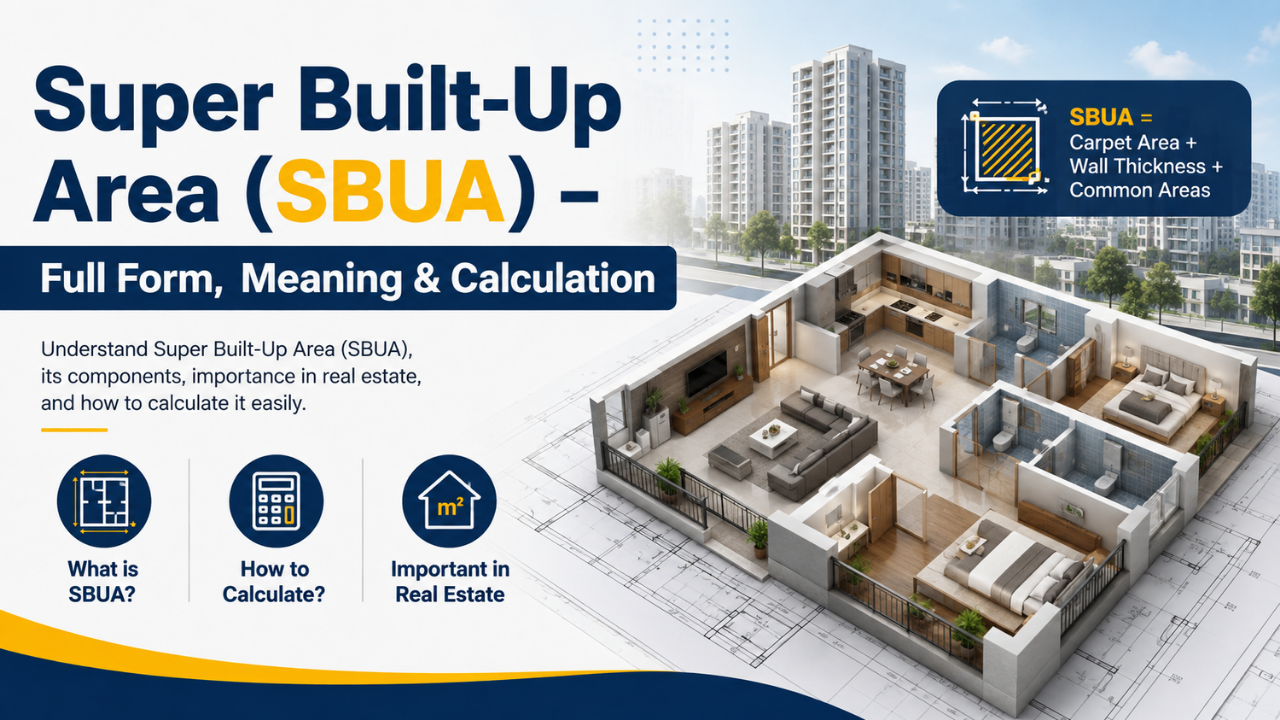
Super Built-Up Area (SBUA): Full Form, Meaning and Calculation
Dasadia Editorial Team · Updated August 2026
The 30-Second Answer
SBUA stands for Super Built-Up Area. It is the built-up area of your flat plus a proportionate share of every common space in the project — lobbies, lifts, staircases, corridors, clubhouse, gym, pool. It is also called the saleable area, because it is the figure developers have historically priced on. The formula is SBUA = Carpet Area × (1 + Loading Factor). In the Mumbai Metropolitan Region the average loading factor reached 43% in early 2025, meaning a buyer paying for 1,000 sq ft receives roughly 700 sq ft of usable space.
Source: 99acres · BookNewProperty · Zee Business
Executive Summary — Key Takeaways
- SBUA is the full form of Super Built-Up Area, also known as saleable area.
- SBUA equals built-up area plus a proportionate share of all common areas and amenities.
- The loading factor is the gap between carpet area and SBUA, expressed as a percentage of carpet area.
- Across India's top seven cities the average loading factor hit 40% in Q1 2025, up from 31% in 2019.
- MMR carries the highest loading of the seven at 43%; Chennai the lowest at 36%.
- Bengaluru saw the sharpest rise, from 30% in 2019 to 41% in Q1 2025.
- RERA requires developers to disclose and price on carpet area — but no law currently caps the loading factor.
- Industry commentary treats loading below roughly 31% as efficient; above 40% deserves scrutiny.
Source: Zee Business · Investment Guru India · Business Standard · Savitar Realty · Kalpataru
What SBUA Includes — and What It Does Not
Super built-up area is constructed in two stages. First, the built-up area of your flat: carpet area plus the thickness of the walls plus the balcony. Then a proportionate share of the building’s common areas is added on top, distributed across all units in the project.
That share typically covers entrance lobbies, lift shafts, staircases, fire escapes and connecting corridors. In amenity-rich developments it also absorbs the clubhouse, gymnasium, swimming pool, security cabin, landscaped areas and parking lobbies. Because the allocation is proportionate rather than itemised, two flats of identical carpet area in the same project will carry near-identical loading regardless of which floor they sit on.
Parking is the common point of confusion. Open and stilt parking is generally not part of SBUA — it is usually sold separately as a parking slot right. However, basement driveways and common circulation areas often are included. Balconies, which RERA excludes from carpet area, are counted inside SBUA. That asymmetry is worth remembering: the same balcony is invisible in one number and priced in the other.
Source: Kalpataru · 99acres · NoBroker · BookNewProperty · Savitar Realty
The Three Area Types Compared
RERA carpet area is defined under Section 2(k) of the Real Estate (Regulation and Development) Act 2016 and excludes external walls, service shafts, exclusive balconies, verandahs and open terraces.
Source: The Wadhwa Group · Lodha Group · 99acres · Kalpataru
How to Calculate SBUA
Three formulas do all the work, and each answers a different question.
Going forward from carpet area: SBUA = Carpet Area × (1 + Loading Factor). A flat with 1,000 sq ft carpet in a project with 30% loading has an SBUA of 1,000 × 1.30 = 1,300 sq ft.
Working backwards from an advertised figure: Carpet Area = SBUA ÷ (1 + Loading Factor). If a listing quotes 1,300 sq ft and you establish that loading is 30%, the carpet area is 1,300 ÷ 1.30 = 1,000 sq ft.
Deriving the loading factor itself: Loading % = (SBUA − Carpet Area) ÷ Carpet Area × 100. If SBUA is 1,000 sq ft and carpet is 700 sq ft, loading is 300 ÷ 700 × 100, which is approximately 43%.
The third formula is the one buyers actually need, because loading factors are rarely advertised. You will usually have both the carpet area from the agreement and the SBUA from the brochure — derive the percentage yourself rather than asking for it and hoping for a straight answer. Alternatively, build up from first principles: built-up area equals carpet plus wall thickness plus balcony, and SBUA equals built-up plus your proportionate share of common areas.
Source: BookNewProperty · 99acres · NoBroker · NoBroker
What Loading Does to the Numbers
The table below takes a flat of 1,000 sq ft carpet area and shows what it becomes at different loading levels — and what that does to the real cost per usable square foot at an advertised rate of ₹10,000 per sq ft on SBUA.
The right-hand column is the point of the whole exercise. A headline rate quoted on SBUA is not the price of the space you live in. At 43% loading, a property advertised at ₹6,000 per sq ft actually costs closer to ₹8,571 per usable square foot — and on a high-value purchase that gap compounds into a very large number.
Source: Kalpataru · BookNewProperty · Zee Business
Loading Factors Across India's Major Cities
The direction is uniform and the pace is not trivial. Across the top seven cities the average loading factor rose from 31% in 2019 to 40% in the first quarter of 2025. MMR carries the highest of the seven; Bengaluru posted the sharpest rise over the seven-year window. Chennai sits lowest at 36%, which research attributes to a city-specific buyer profile that prefers paying for usable space inside the home over shared amenities outside it.
Source: Zee Business · Investment Guru India · Business Standard
Why Loading Keeps Rising — and the Legal Gap
The driver is demand, not deception. Buyers increasingly want clubhouses, gyms, pools, co-working lounges and generous lobbies, and every one of those has to be paid for by someone. Because they sit outside the flat, they are recovered through the loading factor. A project with a genuine amenity deck at 43% loading is not doing anything improper — it is charging for what it built.
The problem is the absence of a ceiling. As ANAROCK’s research head Dr Prashant Thakur has noted, RERA requires developers to state the carpet area provided to homebuyers, but no law currently limits the loading factor in projects. So while the disclosure problem is largely solved, the proportionality problem is not. Nothing stops a project with modest common areas from applying the same loading as one with a full amenity campus.
That is why the only defence available to a buyer is arithmetic. Derive the loading percentage, then ask what it is actually buying. If a project carries 45% loading and has a pool, a clubhouse and wide double-loaded corridors, the number is explicable. If it carries 45% loading and has a lift lobby and a security cabin, you are subsidising something that does not exist. Industry commentary treats loading below roughly 31% as efficient and anything beyond 40% as worth challenging directly.
Source: Business Standard · Zee Business · Savitar Realty · Kalpataru
Is SBUA Still Legal After RERA?
Yes — but its role has changed. The Real Estate (Regulation and Development) Act 2016 made carpet area the mandatory basis for disclosure and pricing. Registered projects must state carpet area in advertisements, brochures and the agreement for sale, and if the delivered carpet area falls short of what the agreement promised, the promoter is obliged to refund the excess with interest, commonly within 45 days.
What RERA did not do was outlaw SBUA. Developers still quote it in marketing material, brokers still use it in conversation, and older documents are full of it. It remains a legitimate descriptive figure — it genuinely tells you how much building your money is buying a share of. It is simply no longer the number on which a price can be legally anchored, and it is no longer the number you should be comparing flats on.
The practical rule: treat SBUA as context and carpet area as the contract. If a rate is quoted to you on SBUA, convert it before comparing anything. And if a developer or agent is reluctant to state the loading factor when asked, treat that reluctance as information in itself.
Source: Kalpataru · The Wadhwa Group · BookNewProperty · MahaRERA
Paying for SBUA: Pros and Trade-offs
Loading is not automatically a bad thing. What matters is proportionality.
Pros
- Higher loading can fund genuine amenities you will use.
- Wider lobbies, corridors and lift banks improve daily living.
- Well-planned common areas support long-term resale appeal.
- SBUA gives a fair sense of the total built envelope you share.
- Amenity-rich projects often command stronger rental demand.
Trade-offs
- Loading above 40% means under 71% of what you pay for is usable.
- No law currently caps the loading factor in projects.
- Advertised per-sq-ft rates on SBUA understate real cost per usable foot.
- Loading percentages are rarely disclosed prominently — you must derive them.
- Two projects at identical loading may deliver very different amenities.
Source: Kalpataru · Business Standard · Zee Business
A Buyer's Checklist
- Get the carpet area from the agreement for sale, not the brochure headline.
- Derive the loading factor yourself using (SBUA − carpet) ÷ carpet × 100.
- Calculate effective price per carpet square foot and compare shortlisted flats only on that.
- Ask specifically what the loading is paying for and walk the common areas to verify.
- Confirm whether parking is inside or outside the SBUA calculation.
- Check how balconies are treated — excluded from carpet, included in SBUA.
- Benchmark the loading against your city average rather than against the project next door.
- Verify the project's registration and disclosed carpet areas on the MahaRERA portal.
Source: MahaRERA · IGR Maharashtra · RERAExam · Piramal Realty
Fact-Check Section
- SBUA stands for super built-up area, also called saleable area — 99acres and NoBroker.
- SBUA equals built-up area plus a proportionate share of common areas including lobbies, lifts, staircases, corridors and amenities — Kalpataru.
- SBUA = Carpet Area × (1 + Loading Factor); Loading % = (SBUA − Carpet) ÷ Carpet × 100 — BookNewProperty and 99acres.
- Built-up area = carpet area + wall thickness + balcony area — NoBroker.
- Average loading across India's top seven cities reached 40% in Q1 2025, up from 31% in 2019 — ANAROCK Research.
- MMR recorded the highest loading at 43% in Q1 2025, rising from 33% in 2019 and 39% in 2022 — ANAROCK Research.
- Chennai recorded the lowest at 36% in Q1 2025; Bengaluru saw the sharpest rise, 30% to 41% — ANAROCK Research.
- No law currently limits the loading factor in projects, though RERA mandates carpet area disclosure — Dr Prashant Thakur, ANAROCK.
- At 43% loading, a property advertised at ₹6,000 per sq ft costs roughly ₹8,571 per usable sq ft — Kalpataru.
- Open and stilt parking is generally excluded from SBUA and sold separately — BookNewProperty.
Source: 99acres · Kalpataru · BookNewProperty · Zee Business · Business Standard
Frequently Asked Questions
SBUA stands for Super Built-Up Area. It is also referred to as the saleable area, because it is the figure developers have traditionally priced flats on.
It is your flat’s built-up area — carpet plus walls plus balcony — plus a proportionate share of every common space in the project, such as lobbies, lifts, staircases, corridors, clubhouse and pool.
SBUA = Carpet Area × (1 + Loading Factor). A 1,000 sq ft carpet flat in a project with 30% loading has an SBUA of 1,300 sq ft. Alternatively, add your proportionate share of common areas to the built-up area.
Divide SBUA by one plus the loading factor. At 40% loading, a 1,400 sq ft SBUA figure corresponds to 1,000 sq ft carpet.
The difference between super built-up area and carpet area, expressed as a percentage of carpet area. If SBUA is 1,300 sq ft and carpet is 1,000 sq ft, loading is 30%.
Industry commentary treats loading below roughly 31% as efficient. Anything above 40% is high and warrants a direct question about what the loading is funding.
Around 40% across the top seven cities as of Q1 2025, up from 31% in 2019. MMR is highest at 43% and Chennai lowest at 36%.
MMR combines high land costs, high-density construction and strong demand for amenities, which together push more of the built envelope into shared space. Its average rose from 33% in 2019 to 43% in Q1 2025.
No. RERA made carpet area the mandatory basis for disclosure and pricing, but it did not prohibit developers from also quoting SBUA in marketing material. It simply cannot be the legal basis for the price.
No. RERA requires carpet area disclosure, but no law currently caps how much loading a project may apply. That is why deriving and questioning the percentage yourself matters.
Generally no. Open and stilt parking is usually sold separately as a parking slot right, though basement driveways and common circulation areas are often included.
Yes. Balconies are excluded from RERA carpet area but included in built-up and super built-up area.
Because their loading factors differ. A 1,400 sq ft SBUA at 40% loading gives 1,000 sq ft carpet; the same 1,400 sq ft at 30% loading gives about 1,077 sq ft.
Divide the total price by the RERA carpet area for each to get effective price per carpet square foot. That single figure strips out loading differences and is the only fair basis for comparison.
Conclusion and Next Steps
Super built-up area is not a trick, but it is easily misread. It describes the total built envelope your money buys a share of, which is genuinely useful information. What it does not describe is the space you will live in, and the gap between the two has widened steadily — from 31% across India’s major cities in 2019 to 40% by early 2025, and 43% in the Mumbai region.
The discipline is straightforward. Take the carpet area from the agreement, derive the loading factor, calculate the effective price per carpet square foot, and only then compare. Ask what the loading is funding and go and look at it. Verify the project’s disclosures on the MahaRERA portal and check registered transaction rates on the IGR Maharashtra portal before you negotiate. Four numbers and one walk-through will tell you more than any brochure.
Sources and References
- MahaRERA — Maharashtra Real Estate Regulatory Authority
- IGR Maharashtra — Department of Registration & Stamps
- ANAROCK Research — Indian Residential Market Annual Update
- Zee Business — ANAROCK loading factor data by city, Q1 2025
- Investment Guru India — average flat loading hits 40% in top cities
- Business Standard — ANAROCK commentary on loading and RERA
- Kalpataru — what is loading factor in real estate
- Kalpataru — what is RERA carpet area
- 99acres — super built-up area meaning and calculation
- NoBroker — super built-up area versus carpet area calculation guide
- NoBroker — carpet area calculation and loading formulas
- BookNewProperty — carpet versus super built-up, RERA rules and loading
- Savitar Realty — carpet, built-up and super built-up guide 2026
- The Wadhwa Group — area definitions under RERA
- Lodha Group — carpet area and super built-up area explained
- Piramal Realty — RERA carpet area and loading factor
- RERAExam — carpet area and loading calculator
Disclaimer: This article is informational only. Loading factors, area conventions and market averages vary by project and change over time — verify the carpet area stated in your agreement and the project’s disclosures on MahaRERA before making any decision.
Comparing carpet areas in Andheri East?
Explore 153 East by Dasadia Developers LLP — a freehold residential address in J.B. Nagar, Andheri East, close to Chakala and Western Express Highway metro stations, the highway and the airport. MahaRERA registration no. PR1180002502968. Get the brochure with floor plans and amenities, or book a site visit with our team.