


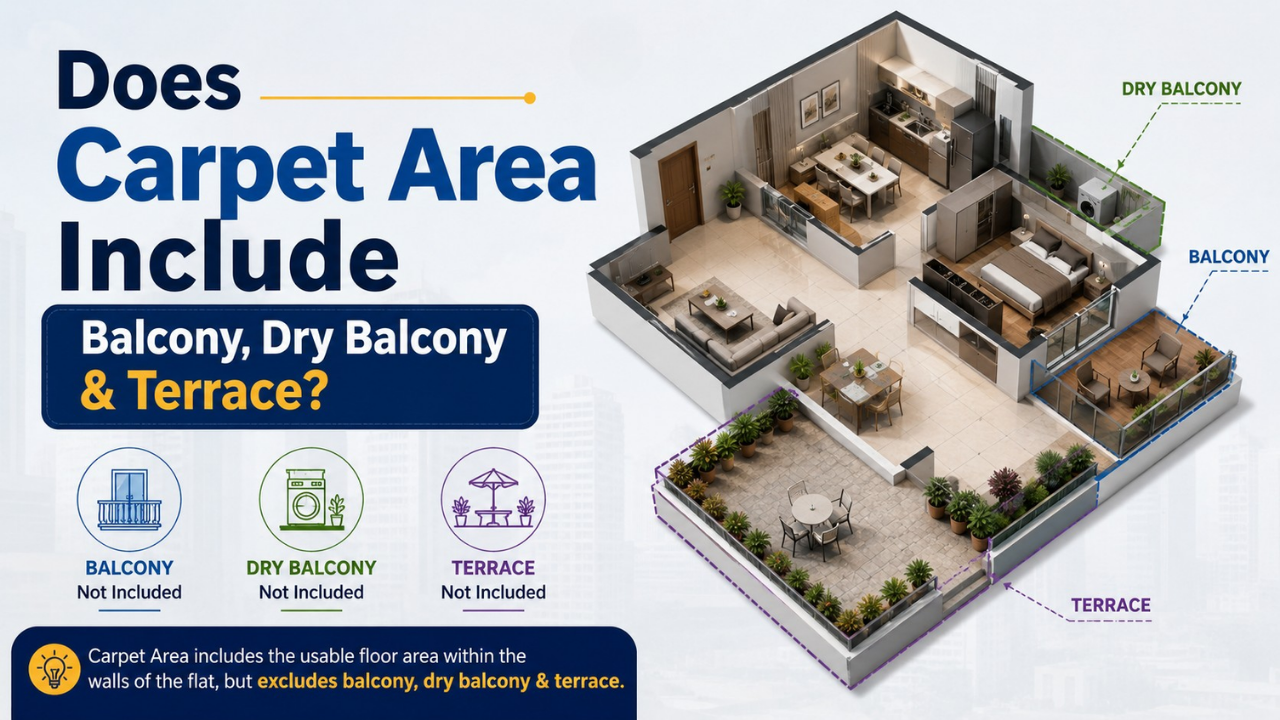
Does Carpet Area Include Balcony, Dry Balcony and Terrace?
Dasadia Editorial Team · Updated August 2026
The 30-Second Answer
No, none of them. Section 2(k) of the RERA Act 2016 excludes exclusive balcony, verandah and open terrace area from carpet area, and MahaRERA has issued a circular confirming that this holds even where those spaces are exclusive to your flat. Dry balconies sit outside too, for a separate technical reason. But here’s the part almost every guide misses: excluded from carpet area does not mean free of charge. MahaRERA’s Model Agreement has separate price lines for exclusive balcony, verandah and open terrace. So whether you pay for them is decided by your agreement, not by the definition.
Source: RERA Act 2016 (PDF) · 99acres · MahaRERA Model Agreement (PDF)
Executive Summary, Key Takeaways
- Section 2(k) excludes external walls, service shafts, exclusive balcony or verandah area and exclusive open terrace area from carpet area.
- Internal partition walls are included. They are the one thing counted in your favour.
- MahaRERA's circular confirms balcony, verandah and terrace stay outside carpet area even when exclusive to the flat.
- The Act's Explanation hinges on the word "exclusive", space meant for the exclusive use of the allottee and appurtenant to the flat.
- MahaRERA's Model Agreement carries separate price lines for exclusive balcony or verandah and exclusive open terrace.
- Dry balconies, flower beds and chajjas are built at a level difference from the floor, which keeps them outside built-up area.
- Since 2012 Maharashtra has counted balconies, flower beds, voids and niches within FSI, offset by compensatory fungible FSI charged at a premium.
- Per-square-foot rates appeared to rise after the carpet area circular because the denominator shrank: total flat prices were largely unchanged.
What the Law Actually Says
Section 2(k) of the Real Estate (Regulation and Development) Act 2016 defines carpet area as the net usable floor area of an apartment. It excludes four things: the area covered by external walls, areas under service shafts, exclusive balcony or verandah area, and exclusive open terrace area. It includes one thing that works in the buyer’s favour, the area covered by the internal partition walls of the apartment.
The Act then adds an Explanation defining the excluded spaces. An exclusive balcony or verandah area means the balcony or verandah appurtenant to the net usable floor area of the apartment and meant for the exclusive use of the allottee. An exclusive open terrace area is defined in exactly parallel terms. Both definitions turn on two conditions: the space must be appurtenant to the flat, and it must be for the allottee’s exclusive use.
Maharashtra reinforced this at state level. MahaRERA issued Circular No. 4 dated 14 June 2017 clarifying carpet area calculation and the meaning of internal and external partition walls. A subsequent circular directed developers to exclude balcony, verandah and terrace when preparing sale agreements, expressly stating that this applies even where the space is exclusive to the flat owner.
Source: RERA Act 2016 (PDF) · RERA Act text · Kadva Corp · 99acres · Purple Realtors · SCC Online
What Counts and What Does Not
Source: RERA Act 2016 (PDF) · Indian Kanoon · Kadva Corp
Why the Word "Exclusive" Matters
The Act doesn’t just exclude “balconies” and “terraces”. It excludes exclusive balcony, verandah and open terrace area, and defines that as space appurtenant to the flat and meant for the allottee’s exclusive use. That qualifier matters.
If a terrace is exclusive to your flat, it falls outside your carpet area but is yours to use, and your agreement should say so and price it one way or the other. If a terrace is not exclusive, shared with other flats, or accessible to the building generally, it isn’t an exclusive open terrace at all. It is a common area, a separate legal category under the Act with different consequences: it belongs to the association of allottees, it cannot be sold to you as an appurtenance, and you should not be paying a price line for it.
So when a plan shows a large terrace, the question to put in writing isn’t whether it is in the carpet area. It isn’t. The question is whether it is exclusive and whether the agreement grants it to you as an appurtenance.
Source: RERA Act 2016 (PDF) · RERA Act text · SCC Online · MahaRERA
Excluded From Carpet Area Does Not Mean Free
This is the misunderstanding that costs buyers money. Because the balcony is outside carpet area, buyers assume they aren’t paying for it. Whether you are paying is a separate question, and it is answered in the price schedule of your agreement.
MahaRERA’s Model Agreement for Sale sets out the consideration in a schedule that derives the rate per square foot from the carpet area, and then carries separate line items for exclusive balcony or verandah and for exclusive open terrace. In practice those lines are completed in one of a few ways, marked as included in the total price stated above, marked as attracting no separate charges, or marked not applicable. Which box is ticked on your agreement determines whether a balcony has been priced into the headline figure, charged on top, or given at no cost.
Two instructions follow. Read the price schedule, not just the carpet area clause, they answer different questions. And if a balcony or terrace carries a separate charge, ask what rate applies to it. A balcony charged at the same rate as enclosed living space is a very different proposition from one charged at a discount.
Source: MahaRERA Model Agreement (PDF) · Law Insider · MahaRERA
Dry Balconies and the Level-Difference Rule
The dry balcony is a Maharashtra speciality. The small service ledge off the kitchen used for a washing machine, drying clothes or utility storage. Buyers often ask why it is a step down from the kitchen floor. The answer is regulatory rather than architectural.
Under Maharashtra’s development control regulations, built-up area covers a building on all floors except areas specifically excluded. Chajjas, flower beds and dry balconies are specified to be provided at a level difference from the floor, being intended for ventilation, light and weather protection rather than habitable use. Sitting at a different level, they fall outside the built-up area definition. The step isn’t a design flourish; it is what keeps the space outside the calculation.
A related provision covers ordinary balconies: the regulations have permitted a portion not exceeding roughly ten per cent of the flat’s carpet area to sit at floor level and be enclosed without consuming FSI. That is why some flats have an enclosed balcony flush with the living room while the dry balcony is stepped down.
Source: Indian Kanoon · Studio Matrx · Society Redevelopment Mumbai
The FSI Backstory: Why Balconies Became a Battleground
None of this is accidental. Before 2012, balconies, flower beds, terraces, voids and niches were not counted in FSI in Mumbai, which meant developers could build them without consuming their permitted floor space. And then charge buyers for every square foot of that space at full rate. Commentary from the period estimated that developers were building roughly thirty to forty per cent more area as free-of-FSI space, sold on as super built-up or saleable area.
In January 2012 the Government of Maharashtra amended the Development Control Rules to bring balconies, flower beds, terraces, voids and niches within the FSI calculation, and offset that with Compensatory Fungible FSI, up to 35% for residential development, charged at a premium linked to Ready Reckoner rates. Under DCPR 2034, which governs Greater Mumbai, a share of FSI can still be taken as fungible balconies, lobbies and voids on payment of premium. Outside MCGM limits, Thane, Navi Mumbai, Pune and the rest of the state, the UDCPR applies instead and the numbers differ.
The point for a buyer is that balcony area is no longer free to build, so it is no longer free to give away. That is why the price schedule matters.
Why Per-Square-Foot Rates Appeared to Jump
When MahaRERA standardised carpet area calculation, a widely reported consequence was that per-square-foot rates would rise in some areas while total apartment prices remained broadly unchanged. Buyers who watched a familiar project’s advertised rate climb concluded that prices had gone up. In most cases they had not.
The arithmetic is simple. Removing the balcony from the denominator raises the rate per square foot without changing the price. The same flat, the same money, a smaller and more honest area figure. That was the intent: to end selling on built-up and super built-up measurements. The lesson for today’s buyer is to be sceptical of any rate comparison that spans the change, and of any resale quote where the basis of the area is unstated.
Source: 99acres · Purple Realtors · SCC Online
Buying a Flat With a Large Balcony: Pros and Trade-offs
Balcony area is neither a bonus nor a trap by default. It depends on how it has been priced.
Pros
- Usable space that does not inflate your carpet area figure.
- Often charged at a lower rate than enclosed floor area, or not at all.
- Improves light, ventilation and liveability in dense locations.
- A dry balcony keeps utility functions out of the kitchen.
- An exclusive terrace, properly granted in the agreement, is a real appurtenance.
Trade-offs
- May carry a separate price line: read the schedule, not the headline.
- Excluded from carpet area, so it doesn't support your resale carpet figure.
- A terrace that isn't exclusive is a common area you should not be paying for.
- Enclosing a balcony later may breach the sanctioned plan.
- Balcony area now consumes FSI, so developers price it deliberately.
What to Check in Your Agreement
- Find the carpet area clause and confirm it follows the Section 2(k) definition.
- Find the price schedule separately and read the exclusive balcony or verandah line.
- Read the exclusive open terrace line and note whether it is charged, included or not applicable.
- If a terrace is shown, confirm in writing whether it is exclusive and granted as an appurtenance.
- Ask what rate has been applied to any separately charged balcony or terrace area.
- Check the sanctioned plan for whether a balcony is shown enclosed or open.
- Note the level difference on dry balconies and flower beds. It is deliberate.
- Cross-check the disclosed carpet area on the project's MahaRERA listing.
Source: MahaRERA Model Agreement (PDF) · MahaRERA · Indian Kanoon · IGR Maharashtra
Fact-Check Section
- Section 2(k) of the RERA Act 2016 excludes external walls, service shafts, exclusive balcony or verandah area and exclusive open terrace area from carpet area, RERA Act text.
- Internal partition walls are expressly included in carpet area, RERA Act text.
- The Act's Explanation defines exclusive balcony, verandah and open terrace as appurtenant to the flat and meant for the allottee's exclusive use, RERA Act text.
- MahaRERA's circular states balcony, verandah and terrace cannot be included in carpet area even when exclusive to the flat, 99acres and Purple Realtors.
- MahaRERA Circular No. 4 dated 14 June 2017 clarified carpet area calculation and the meaning of internal and external partition walls, Kadva Corp.
- MahaRERA's Model Agreement for Sale carries separate price lines for exclusive balcony or verandah and exclusive open terrace, MahaRERA model agreement and Law Insider clause library.
- Chajjas, flower beds and dry balconies are provided at a level difference from the floor and fall outside built-up area, Indian Kanoon.
- Maharashtra's regulations permitted a balcony portion up to about 10% of carpet area to be at floor level and enclosed without consuming FSI, Indian Kanoon.
- From January 2012, balconies, flower beds, terraces, voids and niches were brought within FSI, offset by up to 35% compensatory fungible FSI for residential development at a premium, RKS Associate and Mahasewa.
- DCPR 2034 applies to Greater Mumbai; the UDCPR applies elsewhere in Maharashtra, Society Redevelopment Mumbai.
Frequently Asked Questions
No. Section 2(k) of the RERA Act expressly excludes exclusive balcony or verandah area from carpet area, and MahaRERA has confirmed this applies even where the balcony is exclusive to your flat.
No. Dry balconies are built at a level difference from the floor, which places them outside the built-up area definition under Maharashtra’s development control regulations, and they are not part of the net usable floor area.
No. Exclusive open terrace area is expressly excluded by Section 2(k). A terrace that is not exclusive to your flat is a common area, which is a different legal category again.
No. Flower beds are provided below floor level for light and ventilation and fall outside both carpet area and built-up area.
Possibly. Exclusion from carpet area and exclusion from the price are two different things. MahaRERA’s Model Agreement carries separate price lines for exclusive balcony or verandah and exclusive open terrace, so check the price schedule of your own agreement.
Because the level difference is what keeps it outside the built-up area calculation. It is a regulatory requirement, not a design choice.
No. MahaRERA directed developers to exclude balcony, verandah and terrace when preparing sale agreements, in order to bring uniformity across the state.
An exclusive terrace is appurtenant to your flat and meant for your exclusive use, and should be granted as such in the agreement. A shared or building-accessible terrace is a common area belonging to the association of allottees, and you should not be charged a price line for it.
Yes. Internal partition walls are expressly included by Section 2(k). External walls aren’t.
No. Areas under service shafts are expressly excluded.
Enclosing a balcony can depart from the sanctioned plan and may require approval. Check the sanctioned plan and the society’s rules before making any change, since unauthorised enclosure can create problems at resale.
Because the area figure shrank, not because prices rose. Removing balcony area from the denominator raises the rate per square foot while the total price of the flat stays broadly the same.
Yes, since the 2012 amendments. Balconies, flower beds, terraces, voids and niches were brought within FSI, offset by compensatory fungible FSI charged at a premium. Under DCPR 2034 a share of FSI can still be taken as fungible balconies and voids on payment of premium.
The RERA carpet area definition applies nationally and the MahaRERA circulars apply across Maharashtra. DCPR 2034, however, governs only Greater Mumbai: elsewhere in the state the UDCPR applies and the permissible numbers differ.
Conclusion and Next Steps
The definitional answer is settled and simple: balcony, dry balcony, verandah, terrace, flower bed, chajja, shaft and external wall are all outside carpet area. Only the floor inside your flat, plus the internal partition walls, counts. MahaRERA has confirmed this even for spaces exclusive to your flat, and no developer may draft around it.
The commercial answer is where the work is. Exclusion from the area figure says nothing about exclusion from the price, and those two questions live in different parts of your agreement. Read the carpet area clause, then read the price schedule, and establish for each balcony and terrace whether it is charged, included or free, and at what rate. Where a terrace is shown, confirm in writing that it is exclusive and granted as an appurtenance. Verify the project’s disclosed carpet areas on the MahaRERA portal and registered rates on the IGR Maharashtra portal before you commit.
Sources and References
- MahaRERA — Maharashtra Real Estate Regulatory Authority
- RERA Act 2016 — full text, Section 2(k) and Explanation (PDF)
- MahaRERA — Model Form of Agreement for Sale (PDF)
- IGR Maharashtra — Department of Registration & Stamps
- RERA Act text — Section 2(k) definition and Explanation
- 99acres — MahaRERA circular excluding verandah, balcony and terrace
- Purple Realtors — carpet area circular and its pricing effect
- SCC Online — MahaRERA on carpet area under MOFA and RERA
- Kadva Corp — MahaRERA Circular No. 4 dated 14 June 2017
- Indian Kanoon — level-difference treatment of chajjas, flower beds and dry balconies
- Redevelopment of Housing Society — fungible FSI and free-of-FSI space
- RKS Associate — 2012 DCR amendments bringing balconies into FSI
- Mahasewa — fungible FSI explained
- Society Redevelopment Mumbai — DCPR 2034 and UDCPR scope
- Studio Matrx — FSI computation and balcony allowances
- Law Insider — agreement price-schedule clauses for balcony and terrace
Disclaimer: This article is informational only and is not legal advice. Regulations differ between Greater Mumbai and the rest of Maharashtra and are amended from time to time, verify the carpet area and price schedule in your agreement for sale and the project’s disclosures on MahaRERA before making any decision.
Reviewing floor plans in Andheri East?
Explore 153 East by Dasadia Developers LLP a freehold residential address in J.B. Nagar, Andheri East, close to Chakala and Western Express Highway metro stations, the highway and the airport. MahaRERA registration no. PR1180002502968. Get the brochure with floor plans and amenities, or book a site visit with our team.