


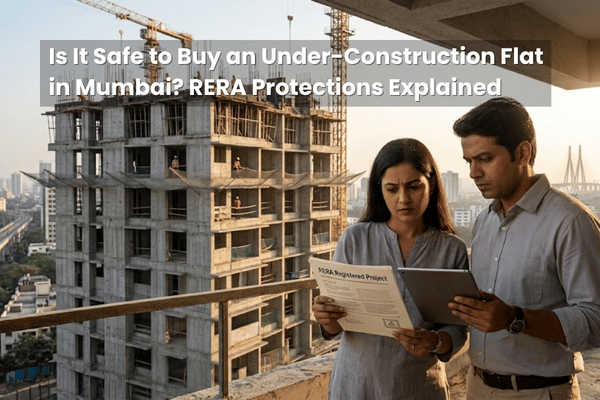
Is It Safe to Buy an Under-Construction Flat in Mumbai? RERA Protections Explained
Dasadia Editorial Team · Updated July 2026
Buying a flat that doesn’t exist yet, on the promise it will be built, understandably makes buyers nervous — and for years in Mumbai, that nervousness was justified. Then came RERA. Since 2017, the Real Estate Act and Maharashtra’s regulator, MahaRERA, have rebuilt the rules around under-construction homes, ring-fencing your money and holding developers to account. This guide explains exactly how RERA protects an under-construction buyer in 2026, how to verify a project yourself, the risks that remain, and — ultimately — whether it is safe to buy.
Key takeaways
- Buying under-construction in Mumbai is far safer than before RERA — provided the project is MahaRERA-registered and the developer is credible.
- 70% of your money must sit in a project-specific escrow account, usable only for that project's land and construction.
- You pay for actual carpet area, not super built-up; a shortfall over 3% must be refunded.
- A developer cannot take more than 10% of the price before a registered Agreement for Sale is signed.
- Late possession entitles you to interest (around SBI's benchmark plus 2%), or a refund with interest.
- Structural defects are the developer's responsibility for five years after possession, fixed free within 30 days.
- You can verify any project — registration, approvals, progress and litigation — yourself on the MahaRERA portal.
- RERA reduces risk but does not remove it, so due diligence and a credible developer still matter.
Source: MahaRERA · Sunteck Realty
The short answer: is it safe?
The short answer: yes, buying an under-construction flat in Mumbai is much safer than it used to be — provided you buy a MahaRERA-registered project from a credible developer and do your own checks. Before 2017, buyers handed over money and hoped; delays, fund diversion and vanishing projects were common. The Real Estate Act changed that, and Maharashtra’s regulator, MahaRERA, is among the strongest in the country, with a public portal, escrowed funds and time-bound complaint resolution. It is not a blanket guarantee — RERA reduces risk rather than removing it — but an informed buyer who uses the portal and verifies before signing faces far lower risk today than at any time before. The rest of this guide shows you exactly which protections apply and how to check them for yourself.
Source: Nayeghar · Commoner Law
What is RERA and MahaRERA?
RERA is the Real Estate (Regulation and Development) Act of 2016, a central law that brought India’s property sector under a regulator for the first time. In Maharashtra it is enforced by MahaRERA, the state authority, through a public online portal where every eligible project must be registered and its details disclosed. The effect has been transformative: in 2025 alone MahaRERA registered over 4,000 new projects and resolved nearly 7,000 complaints, and its systems now digitally verify a project’s approvals with the local planning authority before registration — largely ending the old practice of launching on forged or half-approved plans, with that verification now spanning hundreds of planning authorities across the state. A 2026 upgrade, informally called RERA 2.0, added AI-driven monitoring and mandatory QR codes on every advertisement. Registration is compulsory for any project on more than 500 square metres or with more than eight units.
Source: MahaRERA · Commoner Law
How RERA protects under-construction buyers
RERA turns the old ‘trust the builder’ model into a set of enforceable rights. These are the core protections you get when you buy a registered under-construction flat.
Source: Sunteck Realty · Commoner Law
The protections that matter most, in detail
A few of these do the heavy lifting, so they are worth understanding. The 70% escrow rule is the financial backbone: 70% of every rupee you pay must sit in a project-specific bank account and can only be withdrawn for that project’s land and construction, in stages certified by an architect, engineer and chartered accountant — which is what stops a builder using your money to fund a different project. The carpet-area rule means you pay only for usable space within your walls, not inflated ‘super built-up’ figures, and if the final carpet area shrinks by more than 3%, the builder must refund the difference. The 10% rule bars a developer from taking more than 10% of the price before a written, registered Agreement for Sale is signed. And on delays, if the developer misses the registered possession date, you are entitled to monthly interest for the delay — at around SBI’s benchmark rate plus 2% — or you can walk away and reclaim your money with interest. Structural defects, meanwhile, remain the developer’s responsibility for five full years after possession. Beyond these, developers must keep a committed possession date on the portal, upload quarterly progress reports, and cannot make major changes to the sanctioned layout without the written consent of two-thirds of buyers — and even the agents selling the project must be RERA-registered.
Source: Commoner Law · Nayeghar
RERA 2.0: the 2026 upgrades
RERA has not stood still. In March 2026, an upgraded enforcement framework — informally called RERA 2.0 — was layered on top of the 2016 law to close the gaps that let some developers delay, under-deliver and drag out tribunal cases. The core rules, including the 70% escrow, remain; what changed is teeth and transparency. Since late 2025, every property advertisement in the state must carry a QR code linking straight to the project’s MahaRERA profile, so a buyer can check the source in seconds. MahaRERA has added AI-driven monitoring of quarterly progress, and now publishes ‘recovery warrants’ where the government has moved to seize a defaulting developer’s assets. A new standard operating procedure requires ordered compensation to be paid to buyers within 60 days, parking must be allotted within the buyer’s own wing, and complainants can choose a physical or virtual hearing. Together these upgrades make the system faster and harder to game.
Source: Nayeghar · thepropertist
How to verify a project on the MahaRERA portal
The single most important habit is to verify a project yourself before paying anything. It takes minutes on your phone, and since late 2025 you can also simply scan the QR code printed on any advertisement, which should open the project’s official profile directly.
- Go to the official MahaRERA portal and open 'Search Project Registration'.
- Search by project name, promoter name, district or the RERA number — Mumbai numbers begin with P5190.
- Open the project to check its registration status, possession date, approvals and uploaded title documents.
- Read the Quarterly Progress Reports — the physical construction should match the funds withdrawn.
- Open the litigation and complaints tab; a clean record shows 'No', while 'recovery warrants' are a serious red flag.
- Confirm the status is not 'Lapsed' or suspended, and that the carpet area matches your agreement exactly.
Source: thepropertist · MahaRERA
Risks that remain and red flags to avoid
RERA is a powerful shield, but not a suit of armour. Keep these limits and warning signs in mind — none should scare you off a good project, but each is worth a moment’s check.
- RERA is a transparency tool, not a guarantee — a registered project can still be delayed, so a credible developer still matters.
- Small projects can be exempt — those on 500 sq m or less and with eight or fewer units may fall outside RERA.
- RERA does not directly regulate resale between private parties, only new and ongoing projects.
- Defects that appear after the five-year liability window are not covered.
- A mismatch between construction progress and escrow withdrawals signals a financial flight risk.
- A 'lapsed' or suspended registration, or a missing QR code on the advertisement, is a clear warning sign.
Source: Nayeghar · Commoner Law
Your buyer's due-diligence checklist
Pair RERA’s protections with your own checks, and the risk of an under-construction purchase falls sharply. Run through these before you commit — ten minutes of checking now can save years of trouble later.
- Verify the MahaRERA registration number on the portal before paying any booking amount.
- Check the developer's track record — past delivery, delays and any litigation on the dashboard.
- Read the registered Agreement for Sale, confirming the carpet area, possession date and payment schedule.
- Ensure you are not asked for more than 10% before that agreement is signed and registered.
- Confirm the land title, approvals and Commencement Certificate are uploaded and in order.
- Engage a property lawyer to review the paperwork, and keep records of every payment made.
Source: Sunteck Realty · thepropertist
The bottom line
So, is it safe to buy under-construction in Mumbai? For a MahaRERA-registered project from a developer with a clean track record, and with your own due diligence done, yes — reasonably so. The Act gives you real, enforceable protections: your money is escrowed, you pay for genuine carpet area, the possession date is committed, delays carry penalties, and structural defects are the builder’s problem for five years. What RERA cannot do is choose the project for you or eliminate every risk, so the responsibility that remains is yours: verify the registration on the portal, check the developer’s history and litigation, read the registered agreement, and never pay a rupee into an unregistered ‘pre-launch’. Do that, and an under-construction flat in Mumbai today is a far safer proposition than it has ever been. Treat RERA as your floor, not your ceiling: it sets the rules of the game, but a good developer and a careful buyer are what turn a safe framework into a safe purchase.
Frequently asked questions
Yes, much safer than before, provided the project is MahaRERA-registered, the developer has a clean track record, and you verify everything on the portal before paying. RERA reduces risk substantially but does not remove it entirely.
The Maharashtra Real Estate Regulatory Authority — the state body that enforces the Real Estate Act of 2016 through a public portal, registering projects, disclosing their details and protecting buyers.
Developers must keep 70% of the money collected from buyers in a project-specific account, used only for that project’s land and construction, with withdrawals certified in stages by an architect, engineer and chartered accountant — preventing fund diversion.
Yes, strongly: mandatory registration, escrowed funds, carpet-area pricing, a committed possession date, delay penalties, five-year defect liability, and online grievance redressal are all enforceable rights.
You are entitled to monthly interest for the delay — around SBI’s benchmark rate plus 2% — or you can cancel and reclaim your money with interest, by filing a complaint on the MahaRERA portal.
You pay only for the usable area within your walls, not super built-up area. If the final carpet area shrinks by more than 3%, the builder must refund or adjust the price accordingly.
No more than 10% of the property’s price before a written Agreement for Sale is signed and registered. Being asked for more before that is a red flag.
Five years from possession. Structural defects, seepage or poor workmanship must be fixed by the developer free of charge, typically within 30 days of your complaint.
Visit the MahaRERA portal, search by project name or RERA number, and check the registration status, possession date, approvals, quarterly progress and any litigation before booking. Mumbai RERA numbers begin with P5190.
No. Only projects on more than 500 square metres or with more than eight units must register. Smaller projects can be exempt, so check the specific project carefully.
Yes, directly on the MahaRERA portal without a lawyer, for a fee of about ₹5,000. Complaints are usually resolved in 60 to 90 days, with appeals to the Real Estate Appellate Tribunal.
Not directly. RERA regulates new and ongoing projects; resale between private parties relies on title verification, society NOC and standard due diligence.
Verified — key facts
- MahaRERA registration is mandatory for projects on more than 500 sq m or with more than 8 units; unregistered projects cannot be advertised or sold (MahaRERA / Order 62/2024).
- 70% escrow: 70% of buyer funds ring-fenced for the project's land and construction, withdrawn in certified stages (Section 4(2)(l)).
- Carpet-area pricing; a shortfall over 3% requires a refund/adjustment; a 10% advance cap applies before a registered Agreement for Sale (Section 13).
- Delay: refund with interest or continued interest (≈ SBI MCLR + 2%) on late possession (Section 18).
- Five-year structural defect liability, fixed free within 30 days (Section 14(3)); plan changes need two-thirds buyer consent (Section 14(2)).
- Complaints filed online (≈ ₹5,000), resolved in ≈ 60-90 days; appeals to the Real Estate Appellate Tribunal; 2026 SOP requires compensation within 60 days.
- RERA 2.0 (March 2026) added AI monitoring and mandatory QR codes on ads; MahaRERA registered 4,282 projects and disposed 6,945 complaints in 2025.
Disclaimer: This article is for informational purposes only and is not legal advice. RERA provisions, thresholds, penalty rates and procedures are indicative, can change, and depend on the specific project and circumstances; the statutory references are for general guidance. Always verify a project’s MahaRERA registration and details on the official portal, and consult a qualified property lawyer, before booking or making any payment.
Exploring a home in Andheri East?
Explore 153 East by Dasadia Developers LLP — a freehold, MahaRERA-registered residential address in J.B. Nagar, Andheri East, minutes from the metro, Western Express Highway and the airport. MahaRERA registration no. PR1180002502968. Get the brochure with floor plans, pricing and amenities, or book a site visit with our team.