


Home Loan EMI Calculator & Formula Explained (with Examples)
Dasadia Editorial Team · Updated July 2026
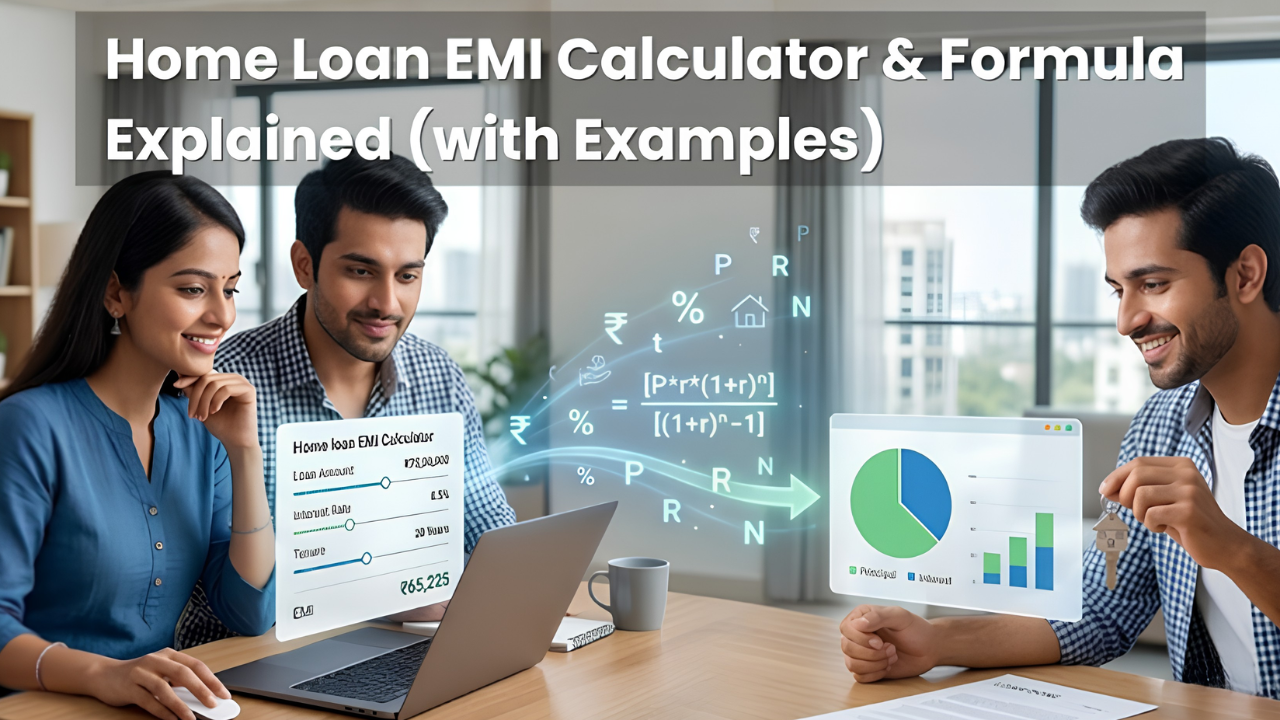
Your EMI is the single number that decides whether a home loan is comfortable or a stretch — yet few buyers know how it is worked out. It isn’t magic: one formula turns your loan amount, interest rate and tenure into a fixed monthly payment. This guide explains that formula in plain English, walks through a worked example step by step, and shows how your EMI splits into principal and interest over the life of the loan.
Key takeaways
- EMI stands for Equated Monthly Instalment — a fixed monthly payment that covers both interest and principal.
- The formula is EMI = [P × r × (1 + r)ⁿ] ÷ [(1 + r)ⁿ − 1], where P is the loan, r the monthly rate and n the number of months.
- A ₹50 lakh loan at 8.5% over 20 years works out to an EMI of about ₹43,391 — and roughly ₹54.1 lakh of total interest.
- As a quick shortcut, the EMI is about ₹868 per ₹1 lakh borrowed at 8.5% over 20 years.
- Early EMIs are mostly interest: in year one of that loan, about ₹4.21 lakh is interest and only ₹1 lakh reduces the principal.
- A longer tenure lowers the EMI but sharply raises total interest; a higher rate raises both.
- Home loans use reducing-balance interest — a 'flat' rate of the same number costs far more, so always compare like with like.
- Prepaying early is powerful: a single ₹5 lakh prepayment in year two of that loan can save about ₹14.6 lakh in interest and cut nearly four years.
Source: Paisabazaar · RBI
What is an EMI, and what makes it up?
EMI stands for Equated Monthly Instalment — the fixed amount you pay a lender every month until the loan is cleared. Each instalment is made up of two parts: interest on the outstanding loan, and a repayment of the principal itself. The total stays the same every month for the whole tenure (on a fixed or unchanged floating rate), which makes budgeting predictable. What changes, quietly, is the mix inside it: early on, most of the EMI is interest and only a little chips away at the principal, and that balance gradually flips as the loan runs down.
Source: BankBazaar · RBI
The home loan EMI formula
Every EMI calculator, whatever the bank, runs the same standard formula:
EMI = [P × r × (1 + r)n] ÷ [(1 + r)n − 1]
Three inputs drive it:
- P — the principal, or the loan amount you borrow.
- r — the monthly interest rate: the annual rate divided by 12 and then by 100 (so 8.5% a year becomes 0.00708).
- n — the number of monthly instalments: the tenure in years multiplied by 12 (so 20 years is 240).
Source: BankBazaar · Paisabazaar
How to calculate EMI: a step-by-step example
Take a ₹50 lakh home loan at 8.5% per annum over 20 years, and plug the numbers in. The principal is ₹50,00,000; the monthly rate is 8.5 ÷ 12 ÷ 100 = 0.00708; and the number of instalments is 20 × 12 = 240. Raising (1 + r) to the 240th power gives about 5.441. Feed those into the formula and it returns a monthly EMI of about ₹43,391. Over the full 240 months you repay roughly ₹1.04 crore, which means about ₹54.1 lakh of that total is interest on a ₹50 lakh loan. Put differently, you repay more than double the amount borrowed over 20 years once interest is counted — which is exactly why the rate and tenure you choose matter as much as the loan size itself.
- Inputs: P = ₹50,00,000; r = 0.00708; n = 240.
- Compute the power: (1.00708)²⁴⁰ ≈ 5.441.
- EMI = [50,00,000 × 0.00708 × 5.441] ÷ [5.441 − 1] ≈ ₹43,391.
- Total repaid ≈ ₹1.04 crore; total interest ≈ ₹54.1 lakh.
Source: BankBazaar · Paisabazaar
EMI per ₹1 lakh: a quick reference
You don’t need the full formula for a fast estimate. Because the EMI scales directly with the loan amount, you can read the EMI per ₹1 lakh borrowed from the table below and multiply by your loan size in lakh. For example, at 8.5% over 20 years the figure is about ₹868 per lakh, so a ₹50 lakh loan is roughly 50 × 868 = ₹43,400 a month — matching the worked example above.
Source: Paisabazaar · BankBazaar
How principal and interest split over the loan
Although the EMI stays fixed — about ₹5.21 lakh a year on our example — the split inside it shifts dramatically. Interest is charged on the outstanding balance, which is highest at the start, so early instalments are mostly interest and barely touch the principal. As the balance falls, more of each EMI goes to principal. The table below tracks that shift across the ₹50 lakh, 8.5%, 20-year loan, and it explains why prepaying early saves so much: you are attacking the balance while the interest share is largest.
Source: RBI · BankBazaar
What changes your EMI: principal, rate and tenure
Three levers move your EMI. A larger principal raises it proportionally. A higher interest rate raises it too — on our ₹50 lakh loan, each one-percentage-point rise adds roughly ₹1,600 a month, so 8.5% costs about ₹43,391 while 9.5% costs about ₹46,607. Tenure works the other way: a longer loan lowers the EMI but, because you pay interest for longer, raises the total interest sharply. The table shows that trade-off — the EMI falls from about ₹61,993 over 10 years to ₹38,446 over 30, while total interest more than triples.
Source: Paisabazaar · BankBazaar
Reducing balance vs flat interest rate
This distinction catches many borrowers out. Home loans use a reducing-balance method: interest is charged only on the outstanding principal, which falls every month, so the interest portion of your EMI shrinks over time. A flat rate, by contrast, charges interest on the full original loan for the entire tenure — so the same headline number costs far more. On our ₹50 lakh, 20-year loan, a reducing-balance 8.5% gives an EMI of about ₹43,391 and ₹54.1 lakh of interest, whereas a flat 8.5% would mean an EMI of about ₹56,250 and ₹85 lakh of interest — around 1.6 times as much. Always confirm you are comparing reducing-balance rates, and treat any flat rate as much higher than it looks.
Source: RBI · BankBazaar
How prepayment reduces your EMI or tenure
Because interest is front-loaded, prepaying a lump sum early is one of the most effective ways to save. When you prepay, you can either keep the EMI the same and shorten the tenure, or keep the tenure and lower the EMI — cutting the tenure usually saves more interest. On our ₹50 lakh, 8.5%, 20-year loan, a single ₹5 lakh prepayment in year two, keeping the EMI unchanged, trims the tenure from 20 years to about 16.25 and saves roughly ₹14.6 lakh in interest. Floating-rate home loans carry no prepayment penalty for individual borrowers, so channelling bonuses or windfalls into early prepayment is often the best return on your money.
Source: RBI · Paisabazaar
Using an online EMI calculator
An online EMI calculator simply runs this formula for you: enter the loan amount, interest rate and tenure, and it returns the monthly EMI, the total interest and, usually, a full month-by-month amortisation schedule. Use one to test scenarios before you borrow — nudge the tenure up or down to see the EMI-versus-interest trade-off, try different rates to gauge your sensitivity, and add a prepayment to see the saving. Pair it with an eligibility calculator, which works backwards from your income and existing EMIs to the loan a bank will actually sanction, and you have a realistic picture before you apply. When you use one, glance at the amortisation schedule as well as the headline EMI — it reveals how little of your early payments reduce the principal, which is invaluable for planning prepayments.
Source: BankBazaar · HDFC Bank
The bottom line
Your EMI is just three inputs — principal, monthly rate and number of months — run through one standard formula. Knowing how it works lets you see past the headline number: a longer tenure eases the monthly payment but costs far more in interest, a flat rate is dearer than it looks, and early prepayment can save lakhs. Model your own loan with a calculator, compare reducing-balance rates like with like, and keep the EMI within a comfortable share of your income before you commit.
Frequently asked questions
EMI = [P × r × (1 + r)ⁿ] ÷ [(1 + r)ⁿ − 1], where P is the principal (loan amount), r is the monthly interest rate (annual rate ÷ 12 ÷ 100) and n is the number of monthly instalments (tenure in years × 12).
At 8.5% over 20 years it is about ₹43,391 a month, with roughly ₹54.1 lakh of total interest. A longer tenure lowers the EMI but raises total interest; a higher rate raises both.
Equated Monthly Instalment — a fixed monthly payment covering both interest on the outstanding loan and repayment of the principal, paid every month until the loan is cleared.
At 8.5%, roughly ₹1,240 per lakh over 10 years, ₹868 over 20 years and ₹769 over 30 years. Multiply the per-lakh figure by your loan amount in lakh for a quick estimate.
Interest is charged on the outstanding balance, which is highest at the start, so early instalments are mostly interest. As the balance falls, a growing share of each EMI repays principal — the reason prepaying early saves the most.
Yes, but at a cost. A longer tenure lowers the monthly EMI, yet because you pay interest for more years, the total interest rises sharply — for example, from about ₹24 lakh over 10 years to ₹88 lakh over 30 on a ₹50 lakh loan.
Reducing-balance interest is charged only on the outstanding principal, which falls monthly, so the true cost is lower. A flat rate charges interest on the full original loan throughout, making the same headline number far more expensive — often close to double in effect.
A prepayment reduces the principal, so you can either shorten the tenure (keeping the EMI) or lower the EMI (keeping the tenure). Prepaying early saves the most interest, and floating-rate home loans carry no prepayment penalty for individuals.
On a floating-rate loan, a rate change usually adjusts either your EMI or your remaining tenure. On a ₹50 lakh, 20-year loan, each one-percentage-point rise adds roughly ₹1,600 to the monthly EMI.
In 2026, home loan rates start around 7.10% per annum for a CIBIL score of 750 or more, with most offers between roughly 8.35% and 8.75%. Calculators commonly model 8.5% as a mid-point.
Under the old tax regime, the principal portion qualifies under Section 80C (up to ₹1.5 lakh a year) and the interest portion under Section 24(b) (up to ₹2 lakh for a self-occupied home). The new default regime restricts most of these.
Yes — it runs the exact formula above, so the EMI it shows is precise for the inputs you enter. The actual sanction still depends on your income, credit profile and the lender’s final rate and tenure.
Verified — key facts
- EMI formula: EMI = [P × r × (1 + r)ⁿ] ÷ [(1 + r)ⁿ − 1] (P = principal, r = monthly rate, n = months).
- ₹50 lakh @ 8.5% / 20 years: EMI ≈ ₹43,391; total interest ≈ ₹54.1 lakh; total repaid ≈ ₹1.04 crore (computed).
- EMI per ₹1 lakh @ 8.5%: ≈ ₹1,240 (10-yr), ₹868 (20-yr), ₹769 (30-yr) (computed).
- Same loan by tenure @ 8.5%: EMI ₹61,993 (10-yr) to ₹38,446 (30-yr); total interest ₹24.4 lakh to ₹88.4 lakh (computed).
- Flat 8.5% vs reducing 8.5% on the same loan: interest ≈ ₹85 lakh vs ₹54.1 lakh — about 1.6× (computed).
- A ₹5 lakh prepayment in year 2 (EMI kept): ≈ ₹14.6 lakh interest saved, tenure cut to ≈ 16.25 years (computed).
- Home loan rates 2026: from ≈ 7.10% p.a. (CIBIL 750+); RBI repo rate 5.25% (RBI / Paisabazaar).
Disclaimer: This article is for informational purposes only and is not financial advice. EMI, interest and prepayment figures are indicative estimates computed with the standard reducing-balance formula at the stated assumptions (for example, ₹50 lakh at 8.5% over 20 years) and will differ with your actual loan amount, rate, tenure and lender. Verify all figures with your bank and a qualified professional before making any decision.
Planning a home purchase in Andheri East?
Explore 153 East by Dasadia Developers LLP — a freehold residential address in J.B. Nagar, Andheri East, minutes from the metro, Western Express Highway and the airport. MahaRERA registration no. PR1180002502968. Get the brochure with floor plans, pricing and amenities, or book a site visit with our team.