


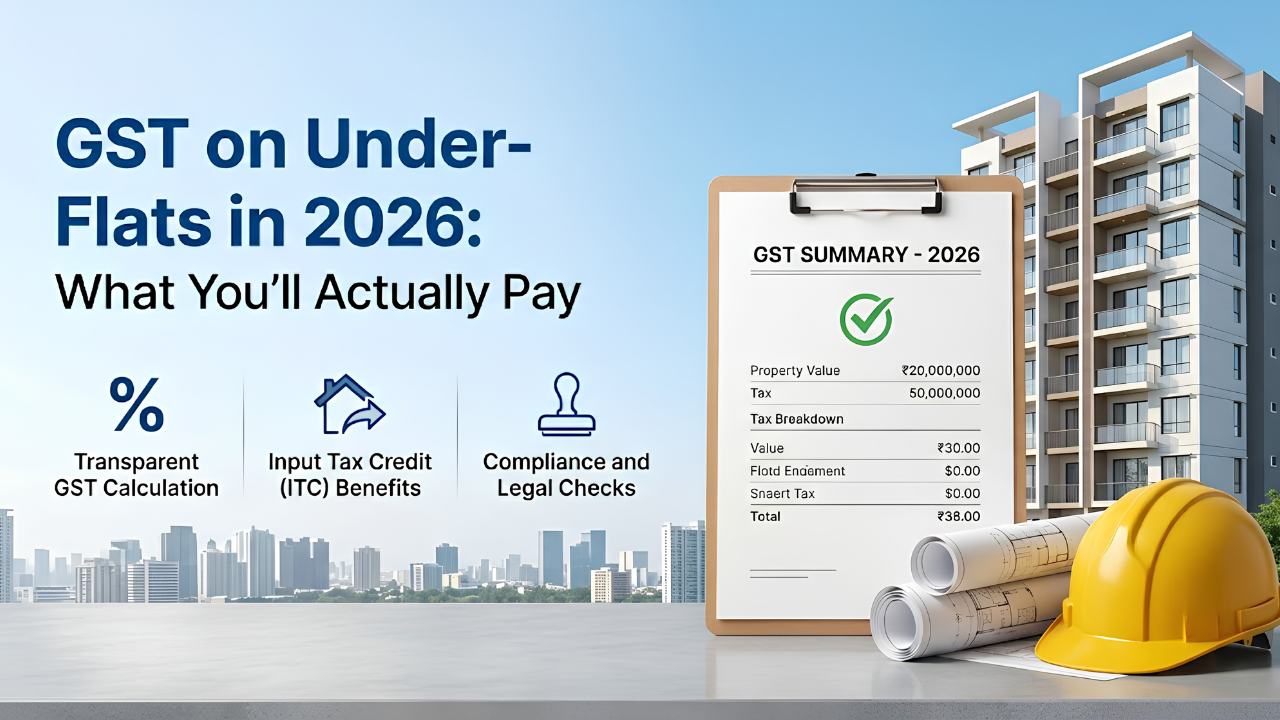
GST on Under-Construction Flats in 2026: What You'll Actually Pay
Dasadia Editorial Team · Updated July 2026
GST is one of the most misunderstood costs in an Indian home purchase — and one of the most avoidable. The rules are simpler than they seem: you pay GST only on an under-construction flat bought from a builder, and nothing at all on a ready or resale home. But the rate, what it is charged on, and the extras people forget can add lakhs to your bill. This 2026 guide sets out exactly what GST you will actually pay on an under-construction flat, with current rates and worked examples, so there are no surprises at booking.
Key takeaways
- GST applies only to under-construction flats bought from a builder — ready-to-move and resale flats carry none.
- The 2026 rates are 5% for standard flats and 1% for affordable housing, both without Input Tax Credit.
- These rates are unchanged since 2019 and stayed the same under GST 2.0 in September 2025.
- The 5% and 1% figures already include the one-third land deduction — you apply them to the full agreement value.
- There is no ITC to claim back, so the GST you pay is a straight cost, priced into the flat.
- GST also applies, at the same rate, to parking, club membership and amenity charges billed with the flat.
- In Mumbai the 1% affordable rate rarely applies, as most flats exceed the ₹45 lakh cap.
- Compare total outlay — base price plus GST plus stamp duty — against a ready flat, not the GST line alone.
Source: Tax Garden · HomeFirst
When does GST apply?
The single rule that governs everything is this: GST applies only to under-construction property sold by a builder. Buy a flat while it is still being built, and you pay GST on it; buy one that is complete and has its Occupancy or Completion Certificate, and you pay none. The logic is legal — an under-construction sale is treated as a ‘supply of construction service’, which is taxable, whereas a completed flat is immovable property, which sits outside GST altogether. The same exemption covers resale flats bought from an existing owner and the purchase of bare land. So the biggest single lever on your GST bill is simply what stage of property you buy: under-construction attracts it, ready-to-move and resale do not.
Source: Vakilsearch · thepropertist
GST rates on under-construction flats in 2026
For an under-construction home, the rate depends on whether it qualifies as ‘affordable’ housing. The structure has been stable since April 2019, and — importantly for 2026 — the GST 2.0 rate revision of September 2025 left residential property rates untouched at 1% and 5%. Here is the full picture.
Source: HomeFirst · Tax Garden
What counts as 'affordable' — and why it rarely helps in Mumbai
To pay the concessional 1% rate rather than 5%, a flat must meet both of two conditions at once: an agreement value of ₹45 lakh or less, and a carpet area within 60 square metres in metro cities or 90 square metres elsewhere. Miss either — too large, or too expensive — and the standard 5% applies. The 1% rate is automatic where a flat qualifies, with no separate application needed. There is, however, an honest catch for Mumbai buyers: with even a modest 1 BHK in most of the city priced well above ₹45 lakh, the affordable rate applies to very few Mumbai transactions. It is far more relevant in peripheral pockets like Virar, Vasai, Badlapur or Karjat, where both the price and size thresholds can realistically be met.
Source: thepropertist · Tax Garden
What you pay it on: the abated rate, no ITC, and the extras
Three things about the 5% rate catch buyers out. First, it is already the abated rate: the law allows a one-third deduction for the land value, but the 1% and 5% figures already build that in, so you simply apply 5% to the full agreement value on your cost sheet — there is no further land deduction for you to claim. Second, there is no Input Tax Credit for residential buyers under this regime, so the GST you pay is a straight cost with nothing to offset it against; the builder cannot pass on the tax paid on cement and steel, and instead prices it into the base. Third, GST is not limited to the bare flat: any charge that is part of the same agreement — covered parking, club membership, preferential-location and amenity charges — is taxed at the same rate as the flat. One useful consequence: because GST is charged on the agreement value, negotiating the price down reduces your GST proportionally.
Source: Tax Garden · thepropertist
What you'll actually pay: worked examples
With the rate settled, the arithmetic is simple — GST is your flat’s agreement value multiplied by 1% or 5%. The table shows what that means in rupees across common price points.
The full tax picture: GST, stamp duty, registration and TDS
GST is only one line in your total tax bill, so it helps to see it alongside the others. On an under-construction flat in Mumbai you will typically pay 5% GST (or 1% if affordable), plus stamp duty — 6% for men and 5% for women, including the 1% metro cess — plus registration at 1%, capped at ₹30,000. Separately, if the property costs more than ₹50 lakh, you must deduct 1% TDS from the payment to the seller and deposit it with the government, filing Form 26QB — a step that is not a GST charge but tends to arrive at the same time. Crucially, stamp duty and registration are state levies that apply whether the flat is under-construction or ready; GST is the one major charge that a ready-to-move or resale purchase escapes entirely. Adding them all up is the only way to know your true cost of acquisition.
Source: Tax Garden · Razorpay
How GST changes the under-construction vs ready maths
It is tempting to see the 5% GST as a reason to avoid under-construction altogether, but that misreads the maths. GST rarely exists in isolation: under-construction flats often carry a lower base price than an equivalent ready one, and that discount frequently more than offsets the 1-5% tax. The right comparison is always total outlay — base price plus GST plus stamp duty — for the under-construction flat against the total outlay for the ready alternative, not the GST line on its own. There is also a timing nuance worth knowing: if a project receives its Occupancy Certificate before your agreement is executed and registered, GST may not apply to the transaction at all, since the flat is then treated as complete. In short, weigh the whole cost, not the tax label.
Source: HomeFirst · thepropertist
What GST does not apply to
It is as useful to know where GST stops as where it starts. None of the following attract it.
- Ready-to-move flats that already have an Occupancy or Completion Certificate — no GST at all.
- Resale or second-hand flats bought from an existing owner rather than a builder.
- The purchase of a plot or bare land, with no construction service involved.
- Stamp duty and registration charges, which are separate state levies, not GST.
- Your monthly home-loan EMI itself, though some bank processing fees do carry GST.
- A flat where the Occupancy Certificate is received before your agreement is executed and registered.
Source: Vakilsearch · thepropertist
The bottom line
GST on a home comes down to one question: is the flat under construction, or complete? An under-construction flat from a builder carries 5% GST, or 1% if it meets the affordable-housing test; a ready-to-move flat with its Occupancy Certificate, and any resale flat, carries none. Beyond the headline rate, remember that the 5% already includes the land abatement, that there is no credit to claim it back, and that parking and amenities are taxed alongside the flat. Add GST to your stamp duty, registration and TDS to see the real cost, and always compare total outlay against a ready alternative rather than fixating on the tax. Get that right, and GST becomes a predictable line in your budget, not a nasty surprise at booking.
Frequently asked questions
5% of the agreement value for standard residential flats, and 1% for affordable housing — both without Input Tax Credit. The rates have been unchanged since 2019 and stayed the same under GST 2.0 in September 2025.
No. A completed flat with an Occupancy or Completion Certificate carries no GST, as it is treated as immovable property outside GST. Resale flats and bare land are also exempt.
A flat must meet both conditions: an agreement value of ₹45 lakh or less, and a carpet area up to 60 square metres in metros (including the Mumbai region) or 90 square metres in non-metros. Miss either, and 5% applies.
Rarely. Most Mumbai flats exceed the ₹45 lakh cap, so the 1% rate mainly helps buyers in peripheral areas like Virar, Vasai, Badlapur or Karjat.
No. A one-third deduction for land is already built into the 1% and 5% rates, so you apply the rate to the full agreement value — there is no further land deduction to claim.
No. For residential property under the 1% and 5% rates, ITC is not available to the buyer or the builder, so the GST you pay is a straight cost. Commercial property at 12% is different.
Yes. Any charge that is part of the same agreement — covered parking, club membership, preferential-location and amenity charges — is taxed at the same rate as the flat.
Multiply the agreement value by the applicable rate. A ₹1 crore non-affordable flat attracts ₹5 lakh at 5%; a ₹45 lakh affordable flat attracts ₹45,000 at 1%.
Yes. Stamp duty (6% for men, 5% for women in Mumbai) and registration (1%, capped at ₹30,000) are state levies that apply regardless of construction stage; GST is a central tax on under-construction flats only.
The buyer bears the GST as part of the price; the builder collects it and remits it to the government.
Yes, by buying a ready-to-move flat with an Occupancy Certificate or a resale flat — both are GST-exempt. Meeting the affordable-housing criteria reduces the rate from 5% to 1%.
Not necessarily. Under-construction flats often have a lower base price that offsets the GST. Always compare total outlay — base price plus GST plus stamp duty — rather than the GST alone.
Verified — key facts
- GST 2026 on under-construction residential: 5% (standard) / 1% (affordable), both without Input Tax Credit; ready-to-move (with OC/CC), resale and bare land are exempt (CGST Act, Schedule III; Notification 03/2019).
- Rates effective since April 1, 2019; GST 2.0 (effective 22 September 2025) left residential property rates unchanged at 1% and 5%.
- Affordable = agreement value ≤ ₹45 lakh AND carpet area ≤ 60 sqm in metros (incl. the MMR) / ≤ 90 sqm in non-metros; both conditions are required.
- The 1% and 5% rates are already the abated rates (one-third land deduction built in), applied to the full agreement value; there is no ITC to offset.
- GST also applies, at the same rate, to parking, club membership, preferential-location and amenity charges billed with the flat.
- Full Mumbai tax picture on under-construction: 5%/1% GST + stamp duty 6% (men)/5% (women, incl. 1% metro cess) + registration 1% (capped ₹30,000); plus 1% TDS on property over ₹50 lakh (Section 194-IA).
- Commercial under-construction property: 12% with ITC for registered businesses; if the OC is received before the agreement is registered, GST may not apply.
Disclaimer: This article is for informational purposes only and is not tax or financial advice. GST rates, the affordable-housing definition, thresholds and related levies are indicative, set by government policy, and can change; they vary by property type, value and location. The worked examples are illustrative. Always confirm the current rates and your specific liability with a qualified chartered accountant or tax professional, and check your builder’s GST invoice, before making any payment.
Buying an under-construction home in Andheri East?
Explore 153 East by Dasadia Developers LLP — a freehold, MahaRERA-registered residential address in J.B. Nagar, Andheri East, minutes from the metro, Western Express Highway and the airport. MahaRERA registration no. PR1180002502968. Get the brochure with floor plans, pricing and amenities, or book a site visit with our team.