


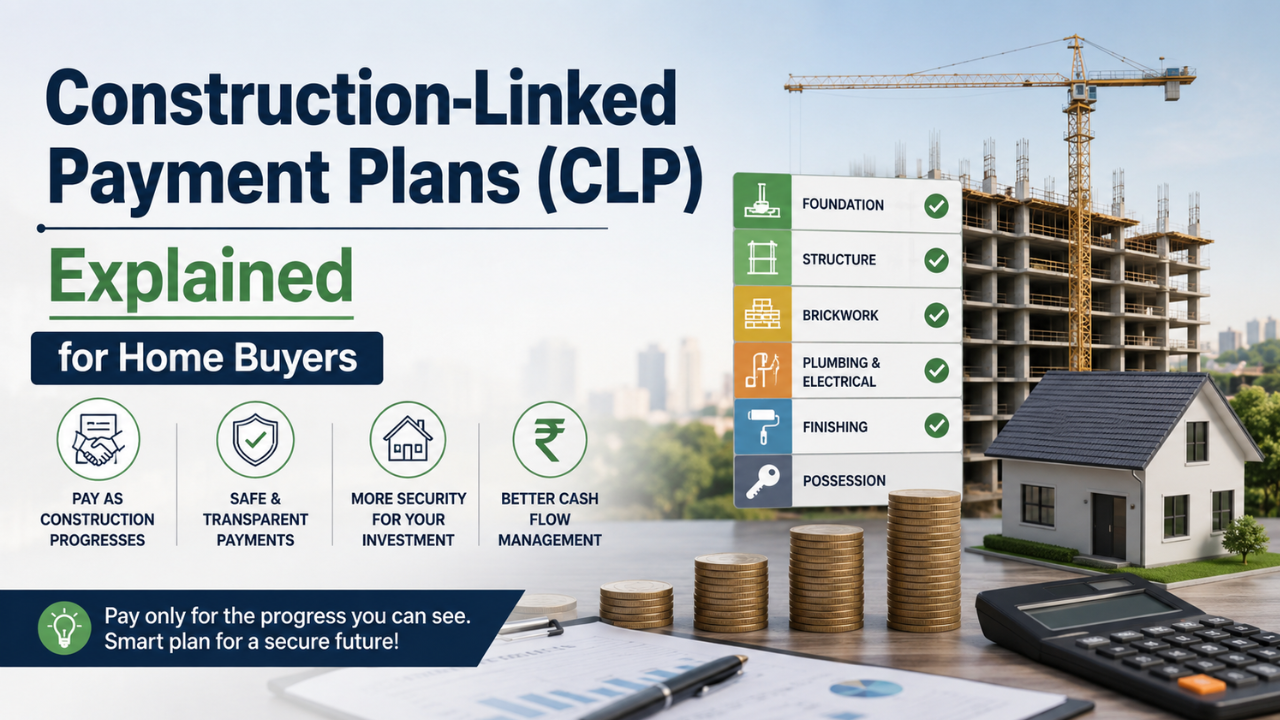
Construction-Linked Payment Plans (CLP) Explained for Home Buyers
Dasadia Editorial Team · Updated July 2026
When you buy an under-construction home, how you pay for it matters almost as much as what you pay. Of the several payment structures developers offer, the Construction-Linked Payment Plan is the one most buyers end up choosing — and, under RERA, the safest. It ties your money to real progress on the ground rather than to a promise or a calendar. This guide explains what a CLP is, how it works, how it compares with other plans, how your home loan fits in, and what to check before you sign.
Key takeaways
- A Construction-Linked Payment Plan (CLP) ties your payments to construction milestones, not to a lump sum or a calendar.
- You pay a booking amount (typically 10-15%), then release instalments as each stage is completed.
- It is the most common and, under RERA, the safest payment structure for an under-construction home.
- Your money flows out only as real work appears, limiting your exposure if a project stalls.
- On a home loan, the bank disburses in tranches and you pay pre-EMI — interest only on the amount drawn.
- RERA reinforces a CLP through its 70% escrow rule and stage-linked, certified withdrawals.
- The trade-offs: a CLP rarely carries a discount, and you pay pre-EMI interest through the build.
- Avoid subvention 'no EMI till possession' schemes, which regulators have heavily curbed.
Source: Business Standard · NoBroker
What is a Construction-Linked Payment Plan?
A Construction-Linked Payment Plan — CLP for short — is a way of paying for an under-construction home in stages tied to the building’s progress, rather than all at once. Instead of a single lump sum or a fixed calendar of payments, you pay a booking amount and then release further instalments only as the developer completes defined construction milestones: the foundation, each floor slab, the brickwork, the finishing, and finally possession. It is the most common and, under RERA, the safest of the payment structures for a new project, because your money flows out only as real work appears on the ground. For a ₹2 crore flat, a CLP would typically mean 10-15% on booking, then staged payments across roughly three to four years of construction. In other words, you are paying for the home as it is built, keeping your outlay in step with the progress you can actually see.
Source: thepropertist · Business Standard
How a CLP works: paying by milestone
The mechanics are straightforward: the developer issues a demand at each completed stage, and you — or your bank, if you have a loan — release the corresponding payment. The exact split varies by project and is set out in the cost sheet you sign, but a typical schedule looks something like the one below. The percentages are illustrative, for a project built floor by floor. Note that the booking amount is paid from your own funds, while a home loan typically funds the milestone payments that follow.
Source: thepropertist · Moneylife
CLP vs other payment plans
A CLP is one of several structures a developer may offer, and it helps to see where it sits. Down-payment and flexi plans can be cheaper but demand more money early; possession-linked plans push most of the payment to the end; and subvention schemes — the ‘no EMI till possession’ offers — have been heavily curbed by regulators after buyers were left paying for stalled homes. The table compares the main options.
Source: Business Standard · NoBroker
The pros and cons of a CLP
For most buyers of an under-construction home the balance favours a CLP, but it is worth weighing both sides.
The advantages
- You pay largely as construction progresses, so your money tracks real work on the ground.
- If the project is delayed, your payments are delayed too, limiting your early exposure.
- You can physically verify each milestone before releasing the next payment.
- Payments are spread over three to four years, easing cash flow versus a large upfront sum.
- On a home loan, only the disbursed amount accrues interest, so your outgo rises gradually.
The trade-offs
- Unlike a down-payment or flexi plan, a CLP rarely comes with a price discount.
- You usually pay pre-EMI interest through the construction period, often while also paying rent.
- A long or delayed build means a longer pre-EMI phase and a higher total interest cost.
- Your capital is committed to the project, and a delay can defer your rental income and tax benefits.
- You must track the milestones and keep funds ready for each demand.
Source: NoBroker · thepropertist
How your home loan works with a CLP
If you are funding the purchase with a home loan, the CLP shapes how the loan is disbursed. Rather than releasing the whole sanctioned amount at once, the bank disburses it in tranches, paying the developer at each milestone in step with the payment plan. Because interest is charged only on the amount actually disbursed, your outgo during construction is a ‘pre-EMI’ — interest alone on the drawn portion, with no principal — and it rises gradually as more of the loan is released. The full EMI, covering both principal and interest, begins once the property is complete and possession is handed over. The trade-off to plan for is that a long construction period means a longer pre-EMI phase, and if you are also paying rent, you carry both at once — so budget for the overlap and factor that interest into the true cost of the home.
Source: thepropertist · Moneylife
A worked example: payments and pre-EMI
A quick illustration makes it concrete. Imagine a ₹2 crore flat bought on a CLP with a home loan. You pay roughly ₹20-30 lakh as the booking amount from your own funds, and the bank sanctions the rest. As the developer completes the foundation, then each floor, then the finishing, it raises a demand at every stage, and the bank releases that tranche — say, another ₹25-30 lakh at foundation, and so on up the building. Your pre-EMI at the start is small, because only a slice of the loan has been drawn; by the time the upper floors are up and most of the loan is disbursed, the pre-EMI is close to a full interest payment. Only when you take possession does the principal-plus-interest EMI begin. The lesson: your cash outflow is gentle early and builds steadily, which is what makes a CLP manageable — but the longer the build runs, the more pre-EMI interest you pay along the way.
Source: thepropertist · Moneylife
How RERA reinforces the CLP
A CLP is not just a developer’s convenience — it dovetails with the protections RERA already gives you, which is why experts recommend it in the current regulated market. RERA requires a developer to hold 70% of buyers’ money in a project-specific escrow account and to withdraw it only in stages, each certified by an architect, engineer and chartered accountant against actual construction. In effect, the law institutionalises the same construction-linked discipline that a CLP applies to your own payments, so the two reinforce each other. RERA also bars a developer from taking more than 10% of the price before a registered Agreement for Sale is signed — which is one reason a CLP’s modest booking amount is both normal and compliant. Paired with a RERA-registered project, a CLP keeps your money tracking real progress on both sides. This alignment is a big part of why the delayed-project horror stories of old have become far less common than in the pre-RERA years.
Source: MahaRERA · Business Standard
What to check before you sign
A CLP is only as good as its fine print. Run through these before you commit.
- Read the cost sheet carefully — confirm exactly when each payment falls due and how much.
- Check that milestones are clearly and verifiably defined, not vague or open to interpretation.
- Verify the project's MahaRERA registration and the developer's track record before booking.
- Ensure you are not asked for more than 10% before a registered Agreement for Sale.
- Understand your pre-EMI terms and how the loan tranches map to the construction milestones.
- Don't choose on discount alone — a saving is worthless if the project stalls or is delayed.
The bottom line
A Construction-Linked Payment Plan is, for most buyers of an under-construction home, the sensible default: it ties your money to visible progress, limits your exposure if a project slips, and sits naturally alongside RERA’s staged, escrow-backed safeguards. The price you pay for that safety is the absence of a discount and a pre-EMI bill during construction — a fair trade for most, though a cash-rich buyer chasing the lowest price might still weigh a down-payment plan. Whichever you choose, read the payment schedule line by line, verify the project on MahaRERA, and judge the developer on delivery, not just on the deal. Get those right, and a CLP turns the daunting business of paying for an unfinished home into a manageable, milestone-by-milestone journey. Paid the right way, the wait for an under-construction home need not mean carrying undue risk.
Frequently asked questions
A plan where you pay for an under-construction home in stages tied to construction milestones — booking, foundation, each floor, finishing, possession — rather than all upfront. It is the most common and, under RERA, the safest structure.
CLP stands for Construction-Linked Payment Plan, sometimes also called a Construction-Linked Plan.
You pay a booking amount (typically 10-15%), then release further instalments as the developer completes defined stages. If you have a loan, the bank disburses to the developer at each milestone on your behalf.
Generally yes. Your payments track real construction progress, so less is at risk if the project stalls or is delayed. A down-payment plan is cheaper but leaves you far more exposed to the developer’s performance.
During construction, you pay interest only on the loan amount disbursed so far, with no principal — this is the pre-EMI. The full EMI, covering both principal and interest, begins after possession.
Often, yes. A CLP rarely carries a discount, and a long construction period means more pre-EMI interest, so the total can exceed a heavily discounted upfront plan.
In a CLP you pay by milestone; in a subvention scheme the builder promises to pay your interest until possession. Subvention has been heavily curbed by regulators, as buyers were left liable when builders defaulted.
A flexi plan is a hybrid — roughly a third upfront, a third linked to milestones, and a third at possession — often with a small discount but a heavier early outlay than a CLP.
RERA requires 70% of your money to be escrowed and withdrawn only in certified stages against construction, which mirrors and reinforces the construction-linked discipline of a CLP.
Typically 10-15% of the property price. Under RERA, a developer cannot take more than 10% before a registered Agreement for Sale is signed.
The payment schedule and milestone definitions in the cost sheet, the project’s MahaRERA registration, the developer’s track record, your pre-EMI terms, and how the loan tranches map to milestones.
It depends on your cash, risk tolerance and the developer’s credibility. A CLP suits most buyers of under-construction homes; a down-payment plan suits cash-rich buyers chasing a discount; a possession-linked plan suits those wanting to pay closer to move-in.
Verified — key facts
- Construction-Linked Payment Plan (CLP): payments tied to construction milestones — booking, foundation, floor slabs, finishing, possession — spread over roughly 3-4 years (Business Standard / ANAROCK).
- Typical CLP: 10-15% booking, then staged payments of 15-20% at foundation, plinth, floor completion and finishing (ANAROCK).
- Pre-EMI: during construction, only interest on the disbursed loan amount is paid; the full EMI (principal + interest) begins after possession (industry sources).
- CLP is regarded as the safest, most transparent plan under RERA; experts recommend CLP or possession-linked plans and advise avoiding subvention (Cyril Amarchand Mangaldas / Business Standard).
- Alternatives: down-payment (80-90% upfront, small discount, higher risk), flexi (about a third each), possession-linked (bulk near handover), time-linked (fixed dates), subvention ('no EMI till possession', heavily curbed by the RBI).
- RERA reinforces a CLP: 70% escrow, stage-linked certified withdrawals, and no more than 10% before a registered Agreement for Sale.
- Main CLP trade-offs: usually no discount, and pre-EMI interest during construction that grows with any delay.
Sources & references
Disclaimer: This article is for informational purposes only and is not financial advice. Payment-plan structures, percentages, pre-EMI terms and regulatory positions are indicative, can change, and vary by developer, project and lender; the milestone schedule shown is illustrative only. Always read the cost sheet and Agreement for Sale in full, verify the project on the official MahaRERA portal, and consult a qualified professional, before choosing a plan or making any payment.
Buying an under-construction home in Andheri East?
Explore 153 East by Dasadia Developers LLP — a freehold, MahaRERA-registered residential address in J.B. Nagar, Andheri East, minutes from the metro, Western Express Highway and the airport. MahaRERA registration no. PR1180002502968. Get the brochure with floor plans, pricing, payment details and amenities, or book a site visit with our team.