


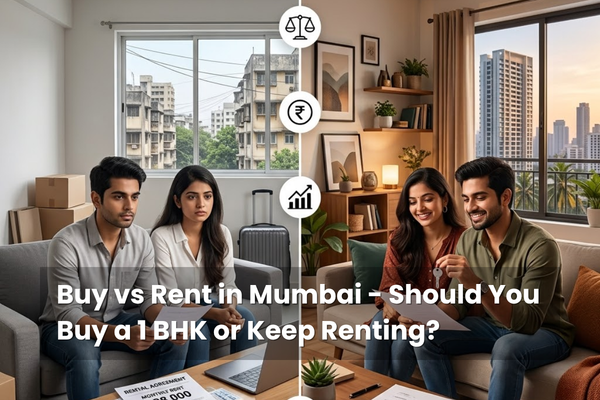
Buy vs Rent in Mumbai: Should You Buy a 1 BHK or Keep Renting?
Dasadia Editorial Team · Updated July 2026
It is the question every Mumbai renter eventually asks: keep paying rent, or buy a 1 BHK of your own? The honest answer is that it depends — on how long you will stay, the price-to-rent ratio in your area, and whether you would actually invest the money you save by renting. Mumbai is an expensive, appreciation-driven market with modest rental yields, which changes the maths. This guide lays out both sides with real numbers, so you can decide for your own situation rather than follow a slogan. ‘Rent is money down the drain’ and ‘always buy’ are both too simple for a market like Mumbai.
Key takeaways
- There is no universal answer — it turns on your hold period, the price-to-rent ratio and your investing discipline.
- Mumbai's price-to-rent ratio runs roughly 24–31, above the ~20 level that usually favours renting on pure cost.
- On a ₹1 crore 1 BHK, buying costs about ₹70,000 a month (EMI plus upkeep) and ~₹31 lakh upfront, versus around ₹35,000 rent.
- The 5% rule: if annual rent is under ~5% of the price, renting is usually cheaper — about ₹41,667 a month on a ₹1 crore flat.
- Buying generally beats renting once you stay 7–10 years or more, because upfront duties and fees (~6–8%) take years to recover.
- Rent typically rises 5–8% a year while an EMI stays fixed, so the longer you hold, the more ownership pays off.
- A renter who invests the down payment and monthly difference can build comparable wealth, so discipline matters as much as the market.
- Buying also brings stability, control and tax relief (80C and 24(b) under the old regime); renting brings flexibility and liquidity.
Source: Hisabhkaro · Global Property Guide
The monthly math: buying vs renting a 1 BHK
Start with a like-for-like comparison. Take a ₹1 crore 1 BHK in a well-connected Mumbai suburb, bought with a ₹75 lakh loan at 8.5% over 20 years, against renting a similar flat for about ₹35,000 a month. The EMI alone is roughly ₹65,000, and once you add maintenance and property tax, the monthly cost of owning is close to ₹70,000 — around ₹35,000 more than renting, on top of the ₹31 lakh you need upfront for the down payment and stamp duty. The trade-off is clear: buying costs far more each month and locks up a large sum, but every EMI builds equity, while rent buys only a month of shelter. Renters do recover their deposit, and salaried tenants can offset part of their rent through the HRA tax exemption — both worth factoring in when you compare the true net cost of each path.
Source: Paisabazaar · IGR Maharashtra
The price-to-rent ratio and the 5% rule
Two quick tests cut through the noise. The price-to-rent ratio divides the property’s price by its annual rent: below 15 favours buying, 15–20 is neutral, and above 20 tilts towards renting. Our example flat — ₹1 crore against ₹4.2 lakh of annual rent — gives a ratio of about 24, and Mumbai as a whole sits around 24–31, among the highest in India. The 5% rule is a parallel check: annual ownership costs (loan interest, maintenance, and the opportunity cost of your down payment) come to roughly 5% of the property’s value, so if you can rent an equivalent home for less than that, renting is mathematically cheaper. On a ₹1 crore flat that threshold is about ₹41,667 a month — comfortably above the ₹35,000 our example rents for. On pure cost, then, Mumbai’s numbers lean towards renting; the case for buying rests on what those simple ratios leave out.
Source: Hisabhkaro · Global Property Guide
The opportunity cost of your down payment
The biggest thing the monthly comparison hides is what your money could earn elsewhere. Buying our ₹1 crore flat means committing ₹31 lakh upfront and about ₹35,000 a month more than renting. A renter who instead invests that ₹31 lakh, and the monthly difference, at a long-run equity return of around 11% could build a portfolio worth roughly ₹1.6 crore over ten years. The buyer, meanwhile, would hold about ₹1.44 crore of home equity if the flat appreciates 7% a year. The two land in a similar range — and which comes out ahead swings entirely on the assumptions: a higher appreciation rate or a lower investment return tips it towards buying, and the reverse tips it towards renting. This is precisely why there is no one-size answer; model your own figures with a rent-versus-buy calculator before you decide. One practical middle path many buyers take is to rent while markets look expensive and their savings grow, then buy once the down payment is larger and the horizon is clearer.
Source: Hisabhkaro · Paisabazaar
Hold period: why time decides it
If one factor settles the question, it is how long you will stay. Buying carries heavy one-time costs — stamp duty, registration and fees add up to roughly 6–8% of the price and are never recovered — so it takes years of avoided rent for ownership to pull ahead. In a high-priced market like Mumbai, that break-even often sits around seven to ten years; buy and sell inside three or four, and renting almost always wins once transaction costs are counted. Time also works on rent: an EMI is fixed for the life of the loan, while rent typically climbs 5–8% a year and roughly doubles every twelve years, so the longer you own, the larger the rent you are avoiding. That is why a couple who will stay a decade often benefits from buying, while someone likely to switch jobs or cities soon is usually better off renting and staying nimble. Short, uncertain horizon: rent. Long, settled one: buying increasingly makes sense.
Source: Hisabhkaro · RBI
Buying vs renting: the trade-offs
Beyond the maths, the two options suit different lives. Buying rewards stability and the long term; renting rewards flexibility and liquidity. Neither is simply ‘better’ — each buys a different kind of freedom: buying, the freedom of a place that is permanently yours; renting, the freedom to pick up and move. The table below sets the main trade-offs side by side.
Source: Income Tax Department · Hisabhkaro
Buy if — and rent if
Numbers aside, the decision is also about how you want to live. Run your own situation against the two checklists below — the more items that ring true on one side, the clearer your answer. Most people find they lean firmly one way once they are honest about their plans and their finances.
Buy a 1 BHK if
- You plan to stay put for at least seven to ten years, so the upfront costs are worth it.
- Your income is stable and the EMI sits comfortably under about 40% of your take-home.
- You value stability, control and the freedom to renovate your own home.
- You want the forced savings a loan enforces and are not a naturally disciplined investor.
- You are buying in a well-connected, high-demand micro-market with deep resale liquidity.
Keep renting if
- Your job or life is mobile, or you might move cities within a few years.
- You would rather keep your capital liquid and invest the difference for potentially higher returns.
- Prices in your target area sit at a high price-to-rent ratio, well above 20.
- You want to live in a premium locality you could not afford to buy in.
- You are still building your down payment, credit score or income stability.
Source: Hisabhkaro · Global Property Guide
The bottom line
In Mumbai’s high-priced, low-yield market, the pure monthly maths often favours renting and investing the difference — but that lead is narrow and hinges on your discipline to actually invest, and on how property and markets perform. Buying wins on the things numbers capture poorly: stability, control, a fixed cost against ever-rising rents, and equity you build simply by living somewhere. The deciding factors are your hold period and your income stability. If you will stay seven to ten years or more, can carry the EMI comfortably, and want a place to settle, buying a 1 BHK is a sound long-term move. If your horizon is short or your finances are still firming up, renting — and investing steadily — is the smarter, lower-risk path. Whichever you choose, base it on the numbers and your own plans rather than social pressure or a fear of missing out; both paths can end well when the decision genuinely fits your life.
Frequently asked questions
It depends on your hold period, the price-to-rent ratio and your investing discipline. Over seven to ten years or more, buying usually wins; for shorter horizons or high-price areas, renting and investing the difference often edges ahead.
Roughly 24 to 31 across the city — above the ~20 level that generally favours renting on pure cost. Mumbai is an appreciation-driven, low-yield market, so rents are modest relative to prices.
On a ₹1 crore 1 BHK, buying runs about ₹70,000 a month (EMI plus maintenance and tax) with ~₹31 lakh upfront, versus around ₹35,000 rent plus a deposit.
If the annual rent on an equivalent home is less than about 5% of its price, renting is usually cheaper. On a ₹1 crore flat that threshold is roughly ₹41,667 a month.
Generally at least seven to ten years. Stamp duty, registration and fees run about 6–8% of the price and are non-recoverable, so it takes years of avoided rent to offset them.
About 2–4% on average — 2–3% in prime South Mumbai, 3–5% in mid-suburbs like Andheri, and 4–7% in outer Thane and Navi Mumbai. Compact 1 BHKs tend to yield more than larger flats.
Not necessarily. Rent buys flexibility and frees up capital. If you invest the down payment and the monthly difference, renting can build wealth comparable to owning, especially in a high-price market.
Yes. An EMI is fixed for the loan’s life, while rent typically rises 5–8% a year and roughly doubles every twelve years — so the longer you stay, the more ownership’s fixed cost pays off.
Under the old tax regime, up to ₹1.5 lakh a year on principal (Section 80C) and ₹2 lakh on interest (Section 24(b)) for a self-occupied home. Renting offers no equivalent, though salaried tenants can claim HRA.
It is the most accessible entry point, with strong rental demand and resale depth in job-hub suburbs. Just weigh the price-to-rent ratio and how long you plan to stay before committing.
No. If the EMI would exceed about 40% of your take-home or leave no buffer for emergencies, renting while you build income and savings is the safer path.
Yes — some professionals buy in a lower-priced tier-2 city, where the price-to-rent ratio is 10–18, and rent in Mumbai for work. This keeps career flexibility while owning an appreciating asset.
Verified — key facts
- Mumbai price-to-rent ratio ≈ 24–31 (above ~20, which favours renting financially); an appreciation-driven, low-yield market.
- Mumbai rental yields ≈ 2–4% (2–3% prime, 3–5% mid-suburbs, 4–7% outer); 1 BHKs tend to out-yield larger flats.
- ₹1 crore 1 BHK: buying ≈ ₹70,000/month (EMI + upkeep) + ≈ ₹31 lakh upfront; renting a similar flat ≈ ₹35,000/month (computed / market).
- 5% rule threshold on a ₹1 crore flat ≈ ₹41,667/month; rent below this favours renting.
- Buying generally beats renting beyond a ~7–10-year hold; upfront duties and fees are ~6–8% and non-recoverable.
- Rent typically rises 5–8% a year (doubling in ~12 years at 6%), while an EMI stays fixed.
- Tax (old regime): up to ₹1.5 lakh principal (80C) + ₹2 lakh interest (24(b)) for a self-occupied home.
Disclaimer: This article is for informational purposes only and is not financial advice. The buy-versus-rent figures are indicative and computed at stated assumptions (for example, a ₹1 crore 1 BHK, a ₹75 lakh loan at 8.5%, ₹35,000 rent, 7% appreciation and an 11% investment return); real outcomes vary widely with prices, rents, interest rates, market returns and your own circumstances. Model your own numbers and consult a qualified financial advisor before making any decision.
Decided to buy a 1 BHK in Andheri East?
If you have weighed it up and buying is the right move for you, explore 153 East by Dasadia Developers LLP — a freehold residential address in J.B. Nagar, Andheri East, minutes from the metro, Western Express Highway and the airport. MahaRERA registration no. PR1180002502968. Get the brochure with floor plans, pricing and amenities, or book a site visit with our team.