


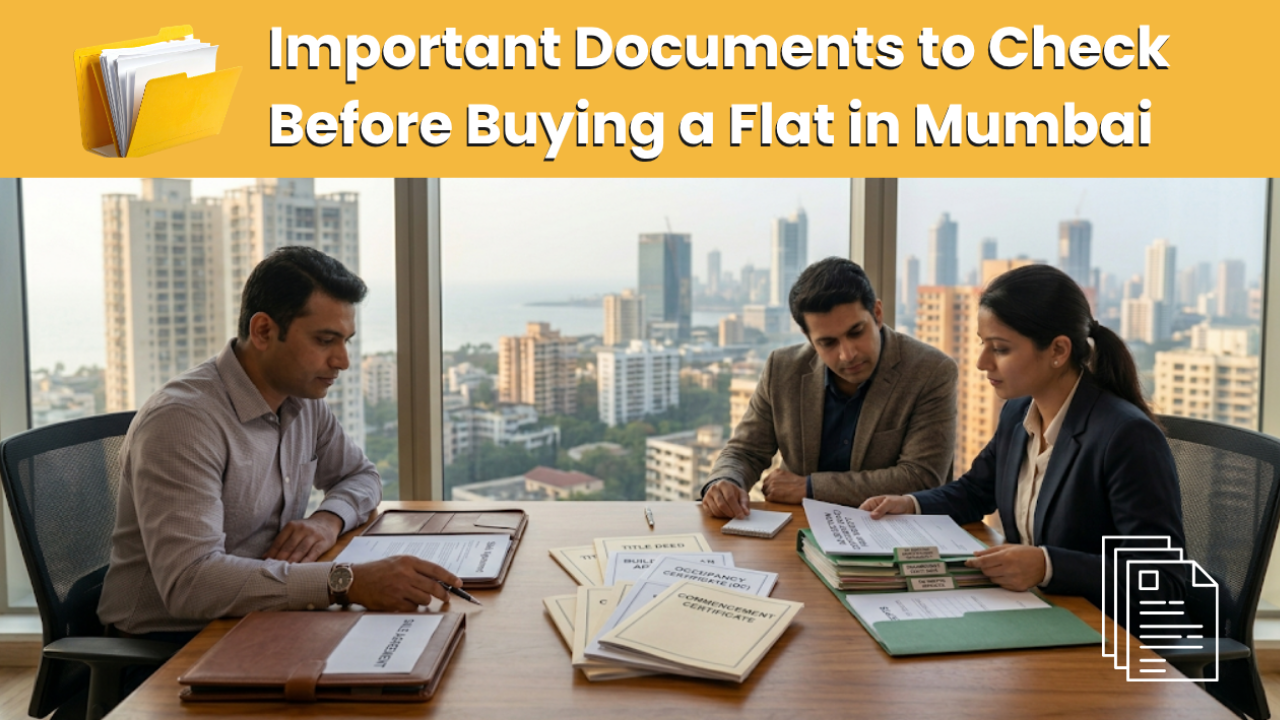
Important Documents to Check Before Buying a Flat in Mumbai (2026 Legal Checklist)
Buying a flat in Mumbai is one of the largest financial commitments most people ever make — and in a market this valuable, the paperwork matters as much as the property. A flat can look perfect on a site visit and still carry a disputed title, an unapproved floor, an unpaid loan or a missing occupancy certificate. Under Indian law the principle of caveat emptor — buyer beware — places the burden of checking squarely on you, not the seller. This guide sets out every important document to check before buying a flat in Mumbai, for both new and resale homes, and what each one actually proves. You will learn how to confirm clear ownership through the title deed, chain of agreements and Index II; how to verify legality through the sanctioned plan, commencement certificate and occupancy certificate; how to read a MahaRERA registration the way regulators intend in 2026; and how the encumbrance certificate, title search report and society NOC protect you from hidden liabilities. Verify these before paying anything beyond a nominal booking amount, and have a property lawyer review them too. The few thousand rupees and few days this takes can prevent disputes that cost years and lakhs to resolve.
The most important documents to check before buying a flat in Mumbai are the title deed and 20–30 year chain of ownership, the Index II, the encumbrance certificate, the approved building plan, commencement certificate and occupancy certificate (OC), and — for under-construction homes — the project’s MahaRERA registration. For resale flats in a society, also verify the share certificate and a society NOC confirming no pending dues. The title deed proves the seller’s ownership; the OC confirms the building is legal to occupy; and a property lawyer’s title search report ties it all together.
Updated June 2026 · By Dasadia Editorial Team · ~10 min read
Key Takeways: Important Documents to Check Before Buying a Flat
- The title deed plus a 20–30 year chain of agreements is the foundation — it proves the seller legally owns the flat and can sell it.
- The occupancy certificate (OC), issued by MCGM, confirms the building is legally fit to occupy; moving in without one risks penalties and resale problems.
- For under-construction homes, MahaRERA registration is mandatory for projects over 500 sq.m or with more than 8 apartments; since late 2025 every ad must carry a scannable RERA QR code.
- The encumbrance certificate (EC) reveals hidden loans, mortgages or charges; banks typically require around a 13-year EC.
- For resale flats in a society, the share certificate and a society NOC (no dues, transfer approved) are essential.
- Index II and the registered sale deed — not the share certificate — are the main legal proof of ownership.
- A property lawyer’s title search report is the most reliable way to confirm a clean, marketable title.
Why Verifying Documents Matters
Property transactions in Maharashtra involve several authorities — the Sub-Registrar, the municipal corporation, the housing society and your lender — and each leaves a paper trail. Verifying that trail confirms the seller truly owns the flat, the building was approved and completed legally, the property is free of debt, and you will not face obstacles at resale or during loan approval. Here is every key document at a glance before we examine each one.
Title & Ownership Records
Everything else in a property deal rests on clear ownership, so start here.
Title Deed — the single most important document; it establishes that the seller legally owns the flat and has the right to sell it. Confirm the title is clear and marketable, with no disputes or competing claims.
Chain of Agreements — the history of how the property passed from owner to owner. In Mumbai, buyers typically trace this for 20–30 years to confirm an unbroken, dispute-free chain.
Index II — issued by the Sub-Registrar after a sale is registered, it records the buyer, seller, property details and transaction value, and serves as official proof the transaction was registered. Retrieve registered documents and Index II via the IGR Maharashtra eSearch portal.
Property Card / 7–12 Extract — the land record. In urban Mumbai the Property Card records land ownership; elsewhere in Maharashtra the 7/12 extract serves the same purpose and helps establish whether the land is freehold or leasehold. Ensure the seller’s name matches these records and the latest tax receipts.
Mutation — after purchase, ownership must be updated (mutated) in municipal and land records; confirm there are no pending mutation disputes from earlier transfers.
Building Plan & Civic Approvals
A genuine seller can still be selling an illegal structure, so verify the building’s approvals independently.
Sanctioned (Approved) Building Plan — confirms the building’s layout and height were approved by the municipal authority; check that what is built matches what was sanctioned.
Commencement Certificate (CC) — the permit from the local authority allowing construction to begin per the sanctioned plan; construction started without it is illegal and can attract penalties.
Completion Certificate — issued once construction is finished in line with the approved plan.
Occupancy Certificate (OC) — issued by the Municipal Corporation of Greater Mumbai (MCGM/BMC) after inspection, certifying the building is safe and legally fit for occupation. It is effectively illegal to occupy a building without an OC, and its absence causes utility-connection issues, municipal penalties and resale difficulties.
Department NOCs — promoters must also hold no-objection certificates from the relevant departments (fire, water, sewage, electricity, and environment where applicable).
MahaRERA Registration: The 2026 Checks
For any under-construction or newly launched project, MahaRERA registration is non-negotiable. Registration is mandatory for projects larger than 500 square metres or with more than eight apartments. Verifying it on the official MahaRERA portal lets you confirm the developer’s details, approved plans, committed completion date and legal disclosures. Several 2026 protections are worth using actively.
QR code — since late 2025, every Mumbai property advertisement (print, hoarding or online) must display a scannable MahaRERA QR code; scan it to open the official project page. If a project is only ‘applied for’ RERA rather than ‘registered’, do not pay beyond a nominal booking fee.
Escrow rule — 70% of buyer funds must stay in a project-specific account to prevent diversion.
Quarterly Progress Reports — developers upload QPRs; in 2026 these include verified site photos, so compare physical progress against financial withdrawals.
Delay compensation — if a developer misses the committed completion date, buyers are entitled to interest at SBI MCLR + 2% for the delay period, and a 2025 SOP requires RERA-ordered refunds or interest to be paid within 60 days. A RERA number is a licence to sell, not a guarantee of quality — combine the portal check with a site visit.
Encumbrance & Financial Verification
Clean ownership means nothing if the flat carries hidden debt.
Encumbrance Certificate (EC) — issued by the Sub-Registrar, it confirms whether the property is free of loans, mortgages, liens or unpaid dues over a given period. Banks typically require around a 13-year EC; you can apply online via the Maharashtra land-records / IGR portal for a nominal fee, and should align the EC period with your lender’s requirement. Cross-check that survey numbers on the EC match the sale deed.
Title Search Report (TSR) — prepared by a property lawyer after examining historical records (commonly 30 years), it verifies ownership history, existing loans and any disputes. It is widely regarded as the most reliable way to confirm a clean title.
CERSAI & charges — a CERSAI search reveals any registered security interest (charge) against the property.
Property tax receipts & dues — confirm the latest municipal property tax is paid and check for any pending society maintenance or utility dues.
Society & Resale-Specific Papers
Most Mumbai flats sit within co-operative housing societies, which adds a layer of paperwork.
Share Certificate — confirms the owner is a registered member of the society, listing the society registration number, share numbers and flat number. Note: the share certificate proves membership, not ownership — the registered sale deed and Index II remain the legal proof of title.
Society NOC — for resale, the society issues a no-objection certificate confirming the seller has cleared maintenance and other dues and that it approves the ownership transfer.
Conveyance / Deemed Conveyance — check whether the society holds conveyance of the land and building from the original developer; where the builder has not conveyed it, members can pursue deemed conveyance, which affects long-term ownership security.
Agreement for Sale, Sale Deed & Registration
Finally, the documents that actually transfer the flat to you.
Agreement for Sale — sets out the full terms: price, payment schedule, possession date, carpet area and obligations. For under-construction homes this is the builder-buyer agreement.
Registered Sale Deed — the document that legally transfers ownership; it must be executed and registered with the Sub-Registrar to be valid.
Stamp duty & registration — in Mumbai, stamp duty is 6% for men and 5% for women (both inclusive of the 1% metro cess), plus a 1% registration fee capped at ₹30,000 for homes above ₹30 lakh. Charges apply on the higher of the agreement value or the ready-reckoner rate. On registration, the Sub-Registrar issues Index II.
Under-Construction vs Resale: What to Prioritise
The documents that matter most shift depending on whether you are buying a new, under-construction home or a resale flat. Use this as a quick focus guide.
Green Flags vs Red Flags
Green Flags (proceed)
- Clear, marketable title with an unbroken 20–30 year chain of agreements.
- Valid OC and a sanctioned plan matching the built structure.
- ‘Registered’ (not merely ‘applied’) MahaRERA status with a scannable QR code.
- A clean encumbrance certificate and a lawyer’s title search report.
- Society share certificate and NOC with all dues cleared.
Red Flags (pause or walk away)
- Seller pressures you to skip checks or pay large sums before document review.
- Project only ‘applied for’ RERA, or no QR code on advertising.
- Missing or pending occupancy certificate on a ready building.
- Mismatched survey numbers between the encumbrance certificate and sale deed.
- Unpaid loans, taxes or society dues, or an unclear power-of-attorney sale.
Common Mistakes to Avoid
- Relying on verbal assurances instead of verifying the title and chain of ownership.
- Skipping the OC check and moving into an unauthorised building.
- Treating an ‘applied for’ RERA number as if registration were complete.
- Not matching the seller’s name across the title deed, property card / 7–12 and tax receipts.
- Ignoring the encumbrance certificate and any CERSAI charges.
- Overlooking pending society maintenance dues on a resale flat.
- Not engaging a property lawyer for a title search report on a high-value purchase.
Frequently Asked Questions
What is the most important document to check before buying a flat in Mumbai?
Is RERA registration mandatory for all projects?
Can I buy a flat without an Occupancy Certificate?
What is an encumbrance certificate and why does it matter?
What is Index II?
What is the difference between a commencement, completion and occupancy certificate?
Is a share certificate proof of ownership?
How many years of ownership history should I check?
Which documents matter most for a resale flat?
What is the MahaRERA QR code?
What stamp duty and registration apply in Mumbai?
Should I hire a lawyer to check the documents?
Fact Check
- Title deed + registered sale deed / Index II are the main ownership proof — Verified, Mumbai Home Expert (2026).
- RERA mandatory for projects over 500 sq.m or more than 8 apartments — Verified, MahaRERA / Godrej Capital.
- MahaRERA QR code mandatory on Mumbai property ads since late 2025 — Verified, Mumbai Home Expert (2026).
- RERA delay compensation = SBI MCLR + 2%; refunds payable within 60 days (2025 SOP) — Verified, Mumbai Home Expert.
- Banks typically require ~13-year encumbrance certificate — Verified, RTI Wiki (2026).
- OC issued by MCGM; occupying without an OC is effectively illegal — Verified, Mumbai Home Expert / Narang Realty.
- Mumbai stamp duty 6% (men) / 5% (women) incl. metro cess + 1% registration capped ₹30,000 — Verified, IGR Maharashtra / 99acres.
Sources & References
Official government portals are listed first, followed by supporting 2026 market and legal sources. Documentation rules can change — verify current requirements on the official portals before any decision.
- MahaRERA — official RERA portal (Maharashtra)
- IGR Maharashtra — Dept. of Registration & Stamps (eSearch / Index II)
- MCGM (BMC) — Municipal Corporation of Greater Mumbai
- CERSAI — Central Registry of Securitisation (charges)
- Mumbai Home Expert — documents-to-check buyer checklist
- Mumbai Home Expert — MahaRERA 2026 checklist
- Sobha — documents required & registration process
- Narang Realty — documents to check before buying a flat
- Godrej Capital — RERA Maharashtra explained
- RTI Wiki — encumbrance certificate guide (2026)
- RERA Filing — what is a commencement certificate
- Visheshank — property documents checklist 2026
- 99acres — Mumbai stamp duty & registration (2026)
- Bajaj Finserv — Mumbai stamp duty guide
Disclaimer: For informational purposes only and not legal or financial advice. Property and RERA rules vary by transaction and location within Maharashtra. Verify documents and approvals on official government portals and consult a qualified property lawyer before any purchase.
The Bottom Line
In Mumbai, the smartest money you spend before buying a flat is on due diligence. Confirm clear ownership through the title deed, chain of agreements and Index II; confirm legality through the sanctioned plan, commencement certificate and occupancy certificate; confirm a clean financial record through the encumbrance certificate and a lawyer’s title search report; and for new homes, confirm a live MahaRERA registration with its 2026 protections. Buy only once each box is ticked — and treat any pressure to skip a check as your biggest red flag.
Looking at a Documented, RERA-Registered Home in Andheri East?
153 East by Dasadia Developers LLP is a freehold, MahaRERA-registered (PR1180002502968) residential project in J.B. Nagar, Andheri East, with project documentation available for review. Get the brochure with floor plans, pricing and amenities, or book a site visit. No pressure, only clarity.