


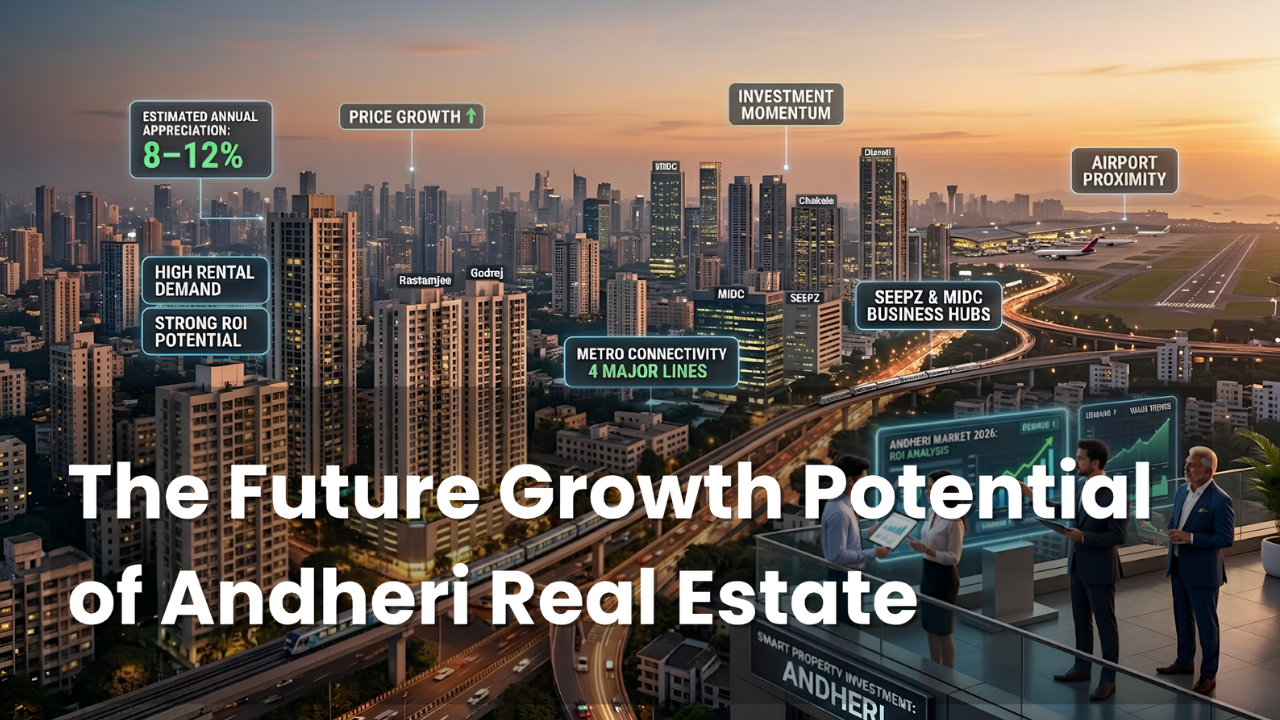
Andheri Real Estate Future Growth Potential: A 2026 Buyer's Guide
By the Dasadia Editorial Team · Updated June 2026
Few Mumbai suburbs pack as much into one postcode as Andheri. It sits at the meeting point of three operational metro lines, two airport terminals and some of the western suburbs’ densest job clusters — and in 2026 that convergence is finally being priced in. After years of being known mainly as a commuter and commercial hub, Andheri is entering a phase where infrastructure that spent a decade ‘under construction’ is now live, reshaping who wants to live here and what they are willing to pay.
This guide looks past the marketing at what the data actually says about Andheri’s growth runway: how prices have moved, where rental demand is strongest, which projects will move the needle next, and what ‘East versus West’ really means for a buyer today. Whether you are buying a first home or adding a rental asset, the aim is simple — to help you judge Andheri’s future on evidence, not on optimism.
Key Takeaways for Andheri Real Estate Future Growth Potential
- Andheri East residential asking prices average roughly ₹29,000–₹31,600 per sq ft in early 2026, while government-registered transaction rates sit closer to ₹20,000 per sq ft.
- Five-year price appreciation in Andheri East is around 17%, with steadier long-run growth than the more speculative pockets of the MMR.
- Rental yields near 4% — above the wider Mumbai average — are powered by airport, SEEPZ and BKC demand, making Andheri East a genuine rental powerhouse.
- The now fully-operational Metro Line 3 (Aqua Line) and the upcoming Line 7A airport link are the two biggest near-term value drivers.
- Andheri West trades at a clear premium (above ₹39,000 per sq ft) on lifestyle appeal; Andheri East offers better entry pricing and higher yield.
- Mumbai crossed 1.23 lakh property registrations in 2025 with record stamp-duty revenue, signalling durable end-user demand across the suburbs.
Why Andheri Keeps Outperforming
Andheri’s growth case rests on fundamentals that are hard to replicate elsewhere in Mumbai. The eastern belt is anchored by serious employment density — SEEPZ, the MIDC industrial estate and the commercial corridors around Chakala, Marol and J.B. Nagar — while the western side draws on the media, entertainment and retail economy around Lokhandwala and Veera Desai Road. That dual job base keeps both sale and rental demand structurally high.
Layered on top is geography: Andheri is one of the few large suburbs that touches both the domestic and international airport terminals, the Western Express Highway and three interchanging metro corridors. Add a steady supply of freehold plots and redevelopment-led new launches, and you have a market with both demand depth and fresh inventory — the two ingredients that sustain long-term appreciation rather than one-off spikes.
Source: 99acres • Square Yards • MMRDA
Connectivity & Infrastructure
Connectivity is the single clearest driver of Andheri’s re-rating. The Versova–Andheri–Ghatkopar corridor (Metro Line 1) has run since 2014, and Line 2A added east–west reach. The game-changer is Metro Line 3, the Aqua Line: Mumbai’s first fully underground line became operational end-to-end from Cuffe Parade to Aarey in October 2025, running 33.5 km and putting BKC, South Mumbai and both airport terminals within a single air-conditioned ride. At Andheri it interchanges with Lines 1, 2A and 7.
The next catalyst is Metro Line 7A, a short 3.17 km spur from Andheri (East) via Sahar Road to the international airport, targeted for completion around December 2026 and reported to be more than half built by early 2026. For a suburb whose premium has always rested partly on airport proximity, a dedicated metro link to the terminals is exactly the kind of upgrade that compresses commute times and lifts pricing.
Corridor
Status
What it unlocks
Metro Line 1 (Versova–Andheri–Ghatkopar)
Operational since 2014
East–west spine and metro interchange at Andheri
Metro Line 3 (Aqua Line)
Fully operational Oct 2025
One-ride access to BKC, South Mumbai and both airport terminals
Metro Line 7A (Andheri E–Sahar–CSMIA)
Target ~Dec 2026
Dedicated metro link to the international airport
Western Express Highway / airports
Operational
3–10 min road access to WEH and airport terminals
Source: MMRC (Aqua Line) • MMRDA (Line 7A) • MMMOCL
Price Trends & Appreciation
Andheri East’s residential asking prices average around ₹29,000–₹31,600 per sq ft in early 2026, depending on the data source, while government-registered transaction rates run closer to ₹20,000 per sq ft — the usual gap between headline asking prices and recorded deal values. Appreciation has been measured rather than frothy: roughly 8% over three years and about 17% over five years, which points to a stable, end-user-led market rather than a speculative one. Andheri West sits at a structural premium, averaging above ₹39,000 per sq ft on the strength of its lifestyle pull.
Metric
Andheri East
Andheri West
Average asking price (per sq ft)
~₹29,000–₹31,600
~₹39,000+
Govt. registered rate (per sq ft)
~₹20,000
~₹32,000
Average rental yield
~4%
~3%
5-year price appreciation
~17%
~20%
Figures are locality-level averages rounded for guidance; actual rates vary by building, floor and configuration.
Source: Square Yards • 99acres • Sobha (MMR trends)
Rental Demand & Yields
Rental demand is where Andheri East genuinely separates itself. With the airport, SEEPZ and BKC all within easy reach, the area attracts a steady stream of working professionals and frequent flyers, keeping occupancy high and voids low. Reported rental yields of roughly 4% — and around 4.2% for compact 1 BHK units — sit comfortably above the wider Mumbai average of about 3%. For an investor prioritising cash flow over trophy value, that yield premium, combined with reliable tenant demand, is the core of the Andheri East story.
Source: Square Yards • Aurum PropTech
Andheri East vs Andheri West: Which Should You Choose?
Both halves of Andheri are strong, but they suit different buyers. East leads on value and yield; West leads on lifestyle and premium pricing. The right pick depends on whether your priority is cash flow or capital preservation.
Pros of Andheri East
- Lower entry price per sq ft
- Higher rental yields (~4%)
- Direct airport, SEEPZ and BKC access
- Strong, steady end-user and tenant demand
Trade-offs to weigh
- West offers stronger lifestyle and retail appeal
- West sees higher headline price growth
- Commercial density can mean traffic at peak hours
- Premium West stock can preserve capital better
Typical Configurations in the Locality
Carpet areas vary widely by project and vintage, but the locality-level ranges below give a useful frame of reference when comparing options across Andheri.
Configuration
Typical carpet area
Who it suits
1 BHK
~400–500 sq ft
Compact homes & high-yield rental units
2 BHK
~550–750 sq ft
Most in-demand family configuration
3 BHK
~900–1,200 sq ft
Upgraders and larger families
4 BHK
~1,300 sq ft and above
Premium and combined-unit homes
Indicative ranges only — always confirm exact carpet areas and RERA details for any specific project.
Future Outlook: 2026–2030
The next four years look well supported. The completion of Metro Line 7A will hand Andheri East its own dedicated airport metro link, while the broader airport ecosystem — now reinforced by the opening of Navi Mumbai International Airport — keeps the suburb central to Mumbai’s aviation economy. Citywide connectors such as the Goregaon–Mulund Link Road are knitting the western and eastern suburbs closer together, widening Andheri’s catchment for both jobs and tenants.
On the demand side, Mumbai recorded over 1.23 lakh property registrations in 2025 and the strongest April performance in 14 years in 2026, underlining how durable end-user appetite has become. With a continuous redevelopment pipeline refreshing older stock, Andheri is positioned for steady, infrastructure-led appreciation rather than a single speculative surge — the kind of profile long-term buyers tend to prefer.
Source: MMRDA • Knight Frank / Business Standard
What This Means for Buyers
For buyers, the practical takeaway is to match the micro-market to the goal. If you want cash flow and a lower entry point, Andheri East’s yield and airport-driven tenant demand are hard to beat. If you are buying primarily to preserve and grow capital, Andheri West’s premium stock and lifestyle pull may suit you better. Across both, the smartest pricing signal is metro proximity — units near interchange stations have the clearest path to appreciation. Finally, avoid chasing momentum after a sharp run-up; the better risk-reward usually lies in the next phase of an infrastructure project, not the last.
Frequently Asked Questions
Is Andheri East a good place to invest in 2026?
Yes — for most investors it remains one of Mumbai’s stronger bets, thanks to airport and business-hub proximity, rental yields near 4% and steady, infrastructure-led price growth rather than speculative spikes.
What is the average property price in Andheri East?
Residential asking prices average roughly ₹29,000–₹31,600 per sq ft in early 2026, while government-registered transaction rates sit closer to ₹20,000 per sq ft. Exact figures depend on the building, floor and configuration.
What rental yield can I expect in Andheri?
Andheri East yields hover around 4%, with compact 1 BHK units reaching about 4.2% — above the wider Mumbai average of roughly 3%. Andheri West typically yields closer to 3%.
Which is better to invest in — Andheri East or Andheri West?
It depends on your goal. East offers a lower entry price and higher yield, making it ideal for cash-flow investors. West commands a premium and suits buyers focused on lifestyle and capital preservation.
How has Metro Line 3 affected Andheri property prices?
The fully operational Aqua Line gives Andheri a single-ride link to BKC, South Mumbai and both airport terminals, and it interchanges with Lines 1, 2A and 7 at Andheri. Improved connectivity of this kind typically supports both rental demand and pricing.
When will Metro Line 7A to the airport be ready?
Metro Line 7A — a 3.17 km link from Andheri (East) via Sahar Road to the international airport — is targeted for completion around December 2026 and was reported to be more than half built by early 2026.
Is Andheri East better for end-users or investors?
Both. End-users value the connectivity, schools, hospitals and workplaces nearby, while investors are drawn by the consistent tenant demand and above-average yields.
What stamp duty will I pay when buying in Andheri?
In Mumbai, stamp duty is 6% for male buyers and 5% for female buyers (a 1% concession), inclusive of the 1% metro cess, plus a registration charge of 1% capped at ₹30,000. Always verify current rates on the IGR Maharashtra portal before registering.
What is the price difference between Andheri East and West?
Andheri West averages above ₹39,000 per sq ft against roughly ₹29,000–₹31,600 in the East — a premium driven largely by lifestyle, retail and entertainment appeal.
Are property prices in Andheri still rising in 2026?
Yes, modestly and steadily. Andheri East has appreciated around 8% over three years and roughly 17% over five years, with continued upward movement supported by metro completions and strong registrations.
What size is a typical 2 BHK in Andheri?
Typical 2 BHK carpet areas in the locality range from about 550 to 750 sq ft, though exact sizes vary by project and vintage. Always confirm the RERA carpet area for any specific home.
Is now a good time to buy in Andheri, or should I wait?
With key metro lines now live and Line 7A nearing completion, much of the connectivity story is already in motion. Buyers focused on long-term use or yield generally benefit from acting on fundamentals rather than trying to time short-term dips.
Conclusion & Next Steps
Andheri’s future growth is not a gamble on a single project or promise — it is the cumulative effect of live metro lines, airport adjacency, deep job density and a steady redevelopment pipeline. East leans toward value and yield; West toward premium and lifestyle. For most buyers in 2026, the sensible next steps are to define your goal (use or investment), shortlist projects near metro interchanges, verify RERA carpet areas and approvals, and compare recorded transaction rates against asking prices before you commit.
Fact Check: Key Numbers Verified
- Andheri East asking price ~₹29,000–₹31,600 per sq ft; govt. rate ~₹20,000 per sq ft (Square Yards, 99acres).
- Andheri East 5-year appreciation ~17%; rental yield ~4% (99acres, Square Yards).
- Metro Line 3 (Aqua Line) fully operational end-to-end since October 2025 (MMRC).
- Metro Line 7A to CSMIA targeted ~December 2026, >50% built by early 2026 (MMRDA).
- Mumbai recorded over 1.23 lakh property registrations in 2025 with record stamp-duty revenue (Knight Frank / Business Standard).
- Mumbai stamp duty: 6% (male) / 5% (female), incl. 1% metro cess; 1% registration capped at ₹30,000 (IGR Maharashtra).
Sources & References
- Mumbai Metro Rail Corporation (MMRC) — Aqua Line / Line 3
- Mumbai Metropolitan Region Development Authority (MMRDA) — Line 7A
- Maha Mumbai Metro Operation Corporation (MMMOCL)
- IGR Maharashtra — stamp duty & registration
- Square Yards — Andheri East property rates
- 99acres — Andheri East price trends
- Sobha — Mumbai (MMR) price trends 2026
- Business Standard / Knight Frank — Mumbai registrations
- Aurum PropTech — Andheri East rates & trends
- NoBroker — Mumbai Metro lines guide
This article is for informational purposes only. All prices, rates, yields, stamp-duty figures and project timelines are indicative and drawn from publicly available sources as of June 2026; they change over time. Verify current figures on official portals such as IGR Maharashtra, MahaRERA, MMRC and MMRDA, and consult a qualified professional before making any property decision.
Explore 153 East by Dasadia Developers LLP
Looking for a thoughtfully designed address in the heart of J.B. Nagar, Andheri (East)? 153 East by Dasadia Developers LLP offers 1, 2, 3 & 4 BHK residences with curated amenities, moments from the metro, the Western Express Highway and both airport terminals. Get the brochure with floor plans, pricing and amenity details.