


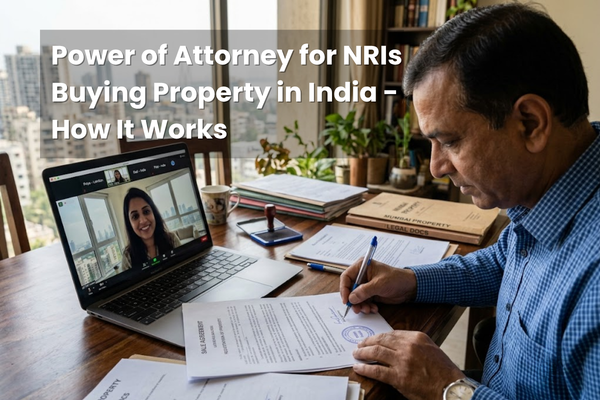
Power of Attorney for NRIs Buying Property in India: How It Works
Dasadia Editorial Team · Updated July 2026
For an NRI buying a home in India, a Power of Attorney is often the difference between a smooth purchase and an impossible one — because registration usually requires the buyer to be physically present, and few can fly back for every signature. Done right, a PoA lets a trusted person act in your place, safely and legally. Done carelessly, it is the single biggest vulnerability in a remote purchase. This guide explains exactly how a Power of Attorney works for NRI property buyers in 2026 — the types, the powers, the step-by-step execution from abroad, and the safeguards that protect you.
Key takeaways
- A Power of Attorney lets a trusted person in India act for an NRI who cannot attend the property registration in person.
- For buying a flat, use a Special PoA (one specific transaction), not a broad General PoA, which is riskier.
- Since the Supreme Court's Suraj Lamp ruling, no PoA can transfer title — only a registered sale deed does that.
- Execute it abroad by apostille (Hague Convention countries) or attestation at an Indian consulate (non-members like the UAE).
- Apostille or attestation only certifies origin — stamp duty is a separate step, paid in India.
- The PoA must be stamped within 90 days of reaching India, and registered at the sub-registrar for property matters.
- In Maharashtra, a PoA to a close relative attracts only nominal stamp duty (~₹500), versus a percentage of value for an outsider.
- Choose your attorney with great care, keep the powers specific, register the document, and revoke it once the deal is done.
Source: NRI Information · Raizada Associates
What is a Power of Attorney, and why NRIs need one
A Power of Attorney is a legal document by which one person — the ‘principal’ — authorises another, the ‘attorney’ or ‘agent’, to act on their behalf. For an NRI, it is often indispensable, because Indian property registration generally requires the buyer to appear in person at the sub-registrar’s office, and flying back for every signature is rarely practical. A PoA lets a trusted person in India stand in your place — signing the agreement, completing registration, making payments and taking possession. It is governed by the Powers of Attorney Act of 1882, together with stamp and registration laws, and while it is a powerful convenience, it is also, in the wrong hands, a dangerous one. Getting the type, the wording and the execution right is what turns it from a risk into a safeguard.
Source: Raizada Associates · Advocate Anakha
General vs Special PoA: which to use
The first decision is which kind of PoA to grant, and for a property purchase the answer is almost always the narrower one. A General Power of Attorney hands over broad authority to manage many affairs; a Special (or Specific) Power of Attorney is confined to a single, defined transaction. For buying a flat, a Special PoA is strongly preferred — it limits the attorney’s power to exactly what you intend, and greatly reduces the scope for misuse.
Note, too, that since the Supreme Court’s Suraj Lamp ruling, no PoA — general or special — can by itself transfer ownership; only a registered sale deed does that. A PoA merely authorises your attorney to sign and register that deed for you.
Source: Advocate Anakha · Raizada Associates
What powers to grant for buying property
A well-drafted PoA lists exactly what your attorney may do — no more, no less. For a purchase, the powers you will typically include are these.
- Signing the Agreement for Sale and the other purchase documents on your behalf.
- Appearing before the sub-registrar and completing the property registration.
- Making and receiving payments connected with the purchase.
- Coordinating with the bank and signing home-loan documents, if applicable.
- Taking possession of the property and dealing with the housing society.
- Handling mutation, utilities and related formalities after the purchase.
Source: Raizada Associates · NRI Information
How to execute a PoA from abroad: step by step
Executing a valid PoA from abroad follows a defined path, and skipping a step can see the document rejected at registration. The route differs slightly by country of residence, but the sequence is broadly this.
The whole process typically takes three to five weeks, allowing for consular appointments and international courier times.
Source: NRI Information · Jurigram
Apostille vs consular attestation: which applies to you
The one branch in the process is how your signature is authenticated abroad, and it depends on whether your country has signed the Hague Apostille Convention. If it has — as the United States, United Kingdom, most of Europe, Australia, Canada and Singapore have — you can sign before a local Notary Public and then obtain a single ‘apostille’ stamp from the designated authority (the Secretary of State in the US, the FCDO in the UK). If your country is not a member — which includes the UAE and most Gulf states, where many NRIs live — the apostille route is unavailable, and you must instead sign in person before an Indian embassy or consulate, which attests your signature. A useful practical tip: even in apostille countries, many NRIs still choose consular attestation, because some sub-registrars in India are more comfortable with it and less likely to raise objections. Either way, remember that attestation only certifies where the document came from — it is not the same as paying stamp duty in India, which comes next.
Source: Ministry of External Affairs · NRI Information
Stamping and registration in India
Once the attested PoA reaches India, two more steps make it fully usable, and both are easy to underestimate. First, stamping: the PoA must bear the correct stamp duty under the relevant state’s law, and this must be done — the document ‘adjudicated’ by the Collector of Stamps — within 90 days of its arrival in India. Miss that window and it becomes invalid for registration, forcing you to pay a penalty, often many times the duty, to regularise it. Second, registration: after the Suraj Lamp ruling and various state amendments, any PoA touching immovable property should be treated as compulsorily registrable at the sub-registrar where the property sits. In Maharashtra there is a welcome concession worth knowing: a PoA given to a close relative — a spouse, parent, sibling or child — for a property transaction attracts only nominal stamp duty, around ₹500, whereas one given to an outsider can be charged at a percentage of the property’s value. That is one more reason NRIs usually appoint a family member.
Source: Jurigram · NRI Information
Choosing your attorney and avoiding fraud
A PoA is only as safe as the person you give it to and the limits you place on it. In 2026, with identity theft in land records a genuine threat, these safeguards matter more than ever.
- Appoint only someone you deeply trust — ideally a close family member.
- Use a Special PoA limited to the one property and transaction, never a blanket General PoA.
- Spell out each power precisely, and require that any proceeds reach only your NRE or NRO account.
- Make it time-bound where possible, so the authority lapses once the purchase completes.
- Register the PoA, creating an official record that deters forgery and misuse.
- Link your land records to Aadhaar for transaction alerts, and keep signed copies of everything.
Source: Advocate Anakha · Jurigram
Revoking a Power of Attorney
A Power of Attorney is not permanent, and knowing how to end it matters as much as knowing how to make it. As the principal, you can revoke a PoA at any time — the main exceptions being one expressly made irrevocable, or one given as security for a debt. To revoke, you execute a Deed of Revocation, register it at the same sub-registrar where the original was registered, and then notify the attorney in writing, keeping proof of delivery, along with any banks, tenants or institutions that relied on it; publishing a notice in a local newspaper is a wise extra step for property PoAs. This matters because, under the law, a revocation is not effective against someone who acted in good faith without notice of it — so simply tearing up your copy is not enough. A PoA also ends automatically on the completion of its purpose, or on the principal’s death or loss of mental capacity.
Source: NRI Information · Advocate Anakha
The bottom line
A Power of Attorney is the bridge that lets an NRI buy a home in India without boarding a plane — but it is a bridge that must be built carefully. Choose a Special PoA over a general one, grant only the specific powers the purchase needs, and appoint someone you genuinely trust, ideally a close relative. Have it drafted by an Indian lawyer, authenticate it correctly for your country — by apostille or consular attestation — and then stamp and register it in India within the deadlines. Build in safeguards: direct any proceeds to your own account, register the document, and revoke it formally once the deal is done. Handled with this care, a PoA is a secure and routine tool; handled carelessly, it is the biggest weak point in a remote purchase. Given the stakes, sound legal advice is money very well spent.
Frequently asked questions
A legal document authorising a trusted person in India — the attorney — to act on the NRI’s behalf in a property transaction, such as signing the agreement, completing registration and taking possession, when the NRI cannot be present.
Because Indian property registration generally requires the buyer to appear in person at the sub-registrar. A PoA lets someone in India stand in for the NRI, avoiding the need to travel for every step.
A Special Power of Attorney, limited to the specific property and transaction. It is far safer than a broad General PoA, which carries a high risk of misuse and is often taxed heavily.
No. Since the Supreme Court’s Suraj Lamp ruling, only a registered sale deed transfers ownership. A PoA can authorise your attorney to sign and register that deed, but cannot itself transfer title.
Draft it (ideally via an Indian lawyer), sign it before a notary and apostille it, or sign before the Indian consulate for attestation, courier it to India, then stamp, adjudicate and register it within 90 days of arrival.
Apostille is a single certification available in Hague Convention countries (the US, UK, Europe and others). Consular attestation, done at an Indian embassy, is required for non-member countries such as the UAE and Gulf states.
No. Apostille or attestation only certifies the document’s origin. Stamp duty is a separate Indian tax, paid when the PoA is adjudicated in India within 90 days of arrival.
For any PoA relating to immovable property, yes — treat registration at the sub-registrar as compulsory, especially after the Suraj Lamp ruling and recent state amendments.
A PoA given to a close relative (spouse, parent, sibling or child) for a property transaction attracts only nominal stamp duty, around ₹500; one given to an outsider can be charged at a percentage of the property value.
Use a Special PoA, appoint a close relative, spell out powers precisely, direct any proceeds to your NRE/NRO account, register the PoA, link land records to Aadhaar for alerts, and revoke it once the deal is done.
Yes, at any time unless it is expressly irrevocable, by executing and registering a Deed of Revocation, then notifying the attorney and any parties who relied on it in writing.
Yes. The attorney must be physically present in India to perform the tasks, such as appearing before the sub-registrar. If both the NRI and the attorney are abroad, the PoA cannot be used for those steps.
Verified — key facts
- A PoA authorises an attorney to act for the NRI principal (Powers of Attorney Act, 1882); for property, a Special PoA limited to one transaction is strongly preferred over a General PoA.
- Suraj Lamp & Industries v. State of Haryana (2011-12): immovable property cannot be transferred by PoA — only a registered sale deed passes title; a PoA can authorise signing and registering that deed.
- Execution abroad: apostille (Hague members — US, UK, Europe, Canada, Australia, Singapore) or consular attestation at an Indian mission (non-members, incl. the UAE and Gulf states); attestation is often preferred even where apostille is available.
- After arrival in India, the PoA must be stamped/adjudicated within 90 days (else invalid, with penalties), and registered at the sub-registrar where the property is situated for property-related PoAs.
- Maharashtra: a property PoA to a close relative (spouse, parent, sibling, child) attracts nominal stamp duty (~₹500); to an outsider it can be a percentage of the property value.
- The attorney must be physically present in India to act; a typical timeline is 3-5 weeks; total government fees are roughly ₹3,000-8,000 plus lawyer drafting fees.
- Revocation: by a registered Deed of Revocation plus written notice to the attorney and all relying parties (a revocation is ineffective against those acting in good faith without notice); a PoA also ends on task completion, death, or mental incapacity.
Sources & references
- Ministry of External Affairs — apostille & attestation
- NRI Information — executing a Power of Attorney for India from abroad
- Raizada Associates — Special Power of Attorney for NRI property
- Advocate Anakha — Power of Attorney for NRIs: risks & fraud prevention
- Jurigram — Power of Attorney for property: NRI guide
Disclaimer: This article is for informational purposes only and is not legal advice. Power of Attorney law, apostille and attestation procedures, stamp duty, registration requirements and revocation rules are set by law, vary by state and country of residence, and can change (including under recent state amendments). A poorly drafted or executed PoA can lead to loss of property or litigation. Always have your PoA drafted and reviewed by a qualified property lawyer, and verify current requirements with the relevant Indian mission and sub-registrar, before executing or relying on it.
An NRI planning to buy in Andheri East?
Explore 153 East by Dasadia Developers LLP — a freehold, MahaRERA-registered residential address in J.B. Nagar, Andheri East, minutes from the metro, Western Express Highway and the international airport. MahaRERA registration no. PR1180002502968. Get the brochure with floor plans, pricing and amenities, or book a site visit with our team.