


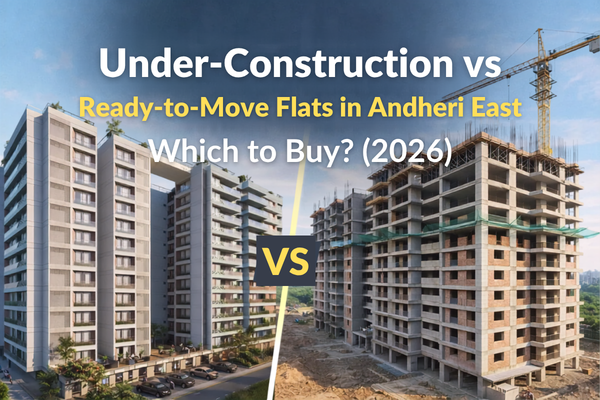
Under-Construction vs Ready-to-Move Flats in Andheri East: Which to Buy? (2026)
Dasadia Editorial Team · Updated July 2026
Andheri East offers plenty of both: shiny new under-construction launches and ready-to-move flats you can occupy tomorrow. On the surface, under-construction looks cheaper and ready-to-move looks simpler — but the real answer depends on your budget, your timeline and how much risk you can carry. Add in GST, tax rules and the rent you keep paying while you wait, and the ‘cheaper’ option is not always cheaper. This 2026 guide compares the two head to head, so you can decide which fits your situation in Andheri East.
Key takeaways
- Under-construction flats usually carry a base price 10–30% lower than a comparable ready-to-move unit.
- But under-construction attracts 5% GST (1% for affordable homes under ₹45 lakh), while ready flats with an Occupancy Certificate attract none.
- Once you add GST and the rent paid over a 2–4 year wait, the 'cheaper' under-construction option can cost much the same.
- Under-construction offers staged, construction-linked payments and higher appreciation potential, but carries delay risk.
- Ready-to-move offers immediate possession, rental income from day one and no construction risk — at a higher upfront price.
- Tax favours ready homes: full interest deduction from year one, versus deferred pre-construction interest for under-construction.
- Always compare total outlay — base price plus GST plus stamp duty plus carrying cost — not the headline price alone.
- In Andheri East, both are live in 2026: new metro-led launches for patient buyers, ready stock for those who want in now.
Under-construction vs ready-to-move: the difference
The distinction is simple but consequential. An under-construction flat is one you buy before the building is finished — often at launch or mid-construction — with possession handed over later, once the developer completes the project and obtains its Occupancy Certificate. A ready-to-move flat is already complete, with that Occupancy Certificate in hand, so you can register it and move in almost immediately. That single difference — whether the home exists yet — ripples through everything else: the price you pay, the taxes you owe, how and when you pay, the risks you take on, and the tax benefits you can claim. Worth noting is a third category — a resale flat, bought from an existing owner rather than the developer — which, like a ready-to-move home, carries no GST. Understanding each is the key to choosing well.
Head-to-head comparison
Here is how the two stack up across the factors that matter most to a buyer.
Price, GST and the true cost gap
This is where most decisions are won or lost. Under-construction flats usually carry a base price 10 to 30% lower than a comparable ready-to-move unit, because the ready price bakes in the developer’s holding costs, profit and the convenience of immediate possession. But the sticker gap is not the whole story. Under-construction attracts 5% GST (1% for affordable homes under ₹45 lakh), while a ready flat with an Occupancy Certificate attracts none — so a slice of that discount goes straight back to tax. On a ₹1 crore under-construction flat, GST can add up to around ₹5 lakh, and once you also count the rent you keep paying for two to four years while you wait — often ₹9 to ₹14 lakh on a home like this — the ‘cheaper’ under-construction option can end up costing much the same as the ready one. The right comparison is always total outlay — base price plus GST plus stamp duty plus carrying cost — not the headline price alone. One nuance worth knowing: GST is charged on the construction value, with a one-third abatement for the land, so the effective rate on the total price is a little lower than the headline 5% — and because developers cannot claim input tax credit, that tax is already built into the quoted base price.
Source: HomeFirst · IGR Maharashtra
Payment, possession and risk
Beyond price, the two differ most in cash flow, timing and risk. Under-construction wins on cash flow: you pay in stages tied to construction — plans like 20:80 or construction-linked schedules — so you are not committing the full amount at once, and your loan disburses in tranches with only pre-EMI interest until possession. The cost is time and uncertainty: possession typically lands one to four years out, and you carry the risk of delays, plan deviations or, in rare cases, a stalled project. Ready-to-move flips this: you pay a larger sum upfront but move in immediately, inspect the exact flat, view and neighbourhood, and can even speak to existing residents before buying. RERA has narrowed the trust gap on under-construction by mandating registration, official timelines and escrowed funds, but a ready home still carries the least construction risk of all.
Appreciation and tax treatment
Two more factors can tip the balance. On appreciation, under-construction offers more upside: buying early, before completion, means you capture the value the project gains as it is built and the area develops — powerful in a growing micro-market. A ready flat has most of that appreciation already priced in. Tax runs the other way. For a ready, self-occupied home you claim the home loan interest deduction — up to ₹2 lakh a year under Section 24(b) in the old regime — from the very first year. For an under-construction flat you cannot claim interest during construction; the accumulated ‘pre-construction’ interest is instead claimed in five equal instalments from the year you take possession, and the full ₹2 lakh benefit needs the build to complete within five years. Deferred, and capped, but not lost — so weigh the appreciation upside against the delayed tax relief.
Source: Income Tax Department · HomeFirst
Which should you buy?
The right pick comes down to your timeline, cash flow and appetite for risk. Match yourself to the lists below.
Choose under-construction for
- A lower entry price and staged, construction-linked payments that are easier on cash flow.
- Greater appreciation potential from buying early in a growing micro-market.
- A longer, flexible timeline — you do not need to move in immediately.
- Some choice in fittings, layout or a preferred floor and view.
- The comfort of RERA timelines and escrow protections on a registered project.
Choose ready-to-move for
- Immediate possession — move in, or start earning rent, from day one.
- Zero GST, and a home you can inspect exactly before you buy.
- No construction-delay risk and no rent-plus-EMI double burden.
- Full home loan tax benefits from the very first year.
- Certainty on the actual flat, view, neighbourhood and society.
The Andheri East angle (2026)
In Andheri East specifically, both options are live in 2026. The post-2024 upcycle brought a wave of new under-construction launches, many riding the boost from the now-operational Metro Line 3, which offer lower entry prices and appreciation potential for buyers who can wait. At the same time, Andheri East is an established, high-demand pocket with genuine ready-to-move stock — attractive if you want to move in or start earning its roughly 4% rental yield straight away, with tenant demand from the airport, SEEPZ, MIDC and BKC on tap. For an investor chasing capital growth with a flexible timeline, under-construction can make sense; for an end-user or income-focused buyer who values certainty, ready-to-move is often the stronger fit. Either way, the pocket’s connectivity and deep resale market support both routes. Whichever you choose, treat the RERA-registered possession date and the project’s approvals as the facts that matter, and confirm them on the MahaRERA portal rather than relying on marketing timelines.
The bottom line
There is no universal winner — only the right fit for you. Choose under-construction if you want a lower entry price, staged payments and higher appreciation potential, and you can comfortably wait and carry some risk. Choose ready-to-move if you need a home now, want zero GST and full tax benefits from year one, and prefer to see exactly what you are buying. Whichever way you lean, compare total outlay rather than the headline price, insist on a RERA-registered project, and verify the Occupancy Certificate and approvals before you pay. In Andheri East’s deep, well-connected market, both paths can work — the best choice is simply the one that matches your timeline, budget and appetite for risk. Take your time, run the full numbers, and buy the home that suits your life today rather than the label on the listing.
Frequently asked questions
It depends on your situation. Under-construction offers a lower price and higher appreciation potential but a wait and some risk; ready-to-move offers immediate possession, no GST and rental income from day one at a higher upfront cost. Families needing a home now often prefer ready; investors with flexible timelines may prefer under-construction.
Typically 10 to 30% lower on base price than a comparable ready-to-move unit in the same locality. After adding 5% GST and the rent paid while you wait, the effective saving usually narrows considerably.
5% without input tax credit for homes priced above ₹45 lakh, and 1% for affordable housing (under ₹45 lakh and up to 60 sq m carpet area in metros like Mumbai). Ready-to-move flats with an Occupancy Certificate attract no GST.
No. A completed flat with a valid Occupancy or Completion Certificate is treated as immovable property and is outside GST, so you pay only stamp duty and registration charges.
Ready-to-move, in the short run. You can claim the home loan interest deduction (up to ₹2 lakh under Section 24(b), old regime) from year one. For under-construction, pre-construction interest is claimed in five equal instalments only after possession.
Mainly construction delays, deviations from the promised plan or, rarely, a stalled project. RERA reduces this risk through registration, official timelines and escrowed funds — but choosing a developer with a strong on-time record still matters.
Often, yes. Buying early lets you capture the value a project gains as it is built and the area develops. A ready flat has most of that appreciation already priced into its cost.
Yes. Banks readily finance RERA-registered under-construction projects, disbursing the loan in construction-linked stages, with you paying pre-EMI interest until possession.
Typically one to four years, depending on the project’s stage when you buy. The RERA-registered possession date is the one to rely on — check it on the MahaRERA portal.
For ready homes, the Occupancy Certificate, Encumbrance Certificate, approved plan and property tax receipts. For under-construction, the MahaRERA registration, approvals and the developer’s delivery track record. Confirm total costs, including GST, before paying.
Yes. A ready flat earns rent from day one, whereas an under-construction flat generates no income until possession. For income-focused investors, that difference is significant.
If you need to move in and want certainty and full tax benefits, ready-to-move is usually simpler. If you have a flexible timeline, a tighter upfront budget and can carry some risk, a RERA-registered under-construction flat can offer better value and appreciation.
Verified — key facts
- GST (2026): 5% on under-construction (no ITC), 1% on affordable housing (≤₹45 lakh, ≤60 sq m metro), 0% on ready-to-move with an OC (NoBroker / HomeFirst).
- Under-construction base prices are typically 10-30% lower than comparable ready-to-move units in the same locality.
- Effective gap narrows after 5% GST and 2-4 years of rent paid while waiting (often ₹9-14 lakh on a ₹1 crore flat).
- Tax: ready, self-occupied homes claim interest (up to ₹2 lakh, Section 24(b), old regime) from year one; under-construction pre-construction interest is claimed in 5 instalments post-possession (Income Tax Department).
- Under-construction offers staged, construction-linked payments and higher appreciation potential; ready offers immediate possession and ~4% rental income from day one.
- RERA (MahaRERA) mandates registration, official timelines and escrowed funds, reducing under-construction risk.
- Compare total outlay — base price + GST + stamp duty (6%/5% + 1% registration in Mumbai) + carrying cost — not the headline price.
Sources & references
Disclaimer: This article is for informational purposes only and is not financial, legal or tax advice. GST rates, tax rules, prices and cost figures are indicative, current at the time of writing, and change over time; the illustrations use stated assumptions and will differ for your property. Verify current GST and tax treatment, project approvals and the Occupancy Certificate or MahaRERA registration on official portals, and consult a qualified professional, before making any decision.
Looking to buy in J.B. Nagar, Andheri East?
Explore 153 East by Dasadia Developers LLP — a freehold residential address in J.B. Nagar, Andheri East, minutes from the metro, Western Express Highway and the airport. MahaRERA registration no. PR1180002502968. Get the brochure with floor plans, pricing and amenities, or book a site visit with our team.