


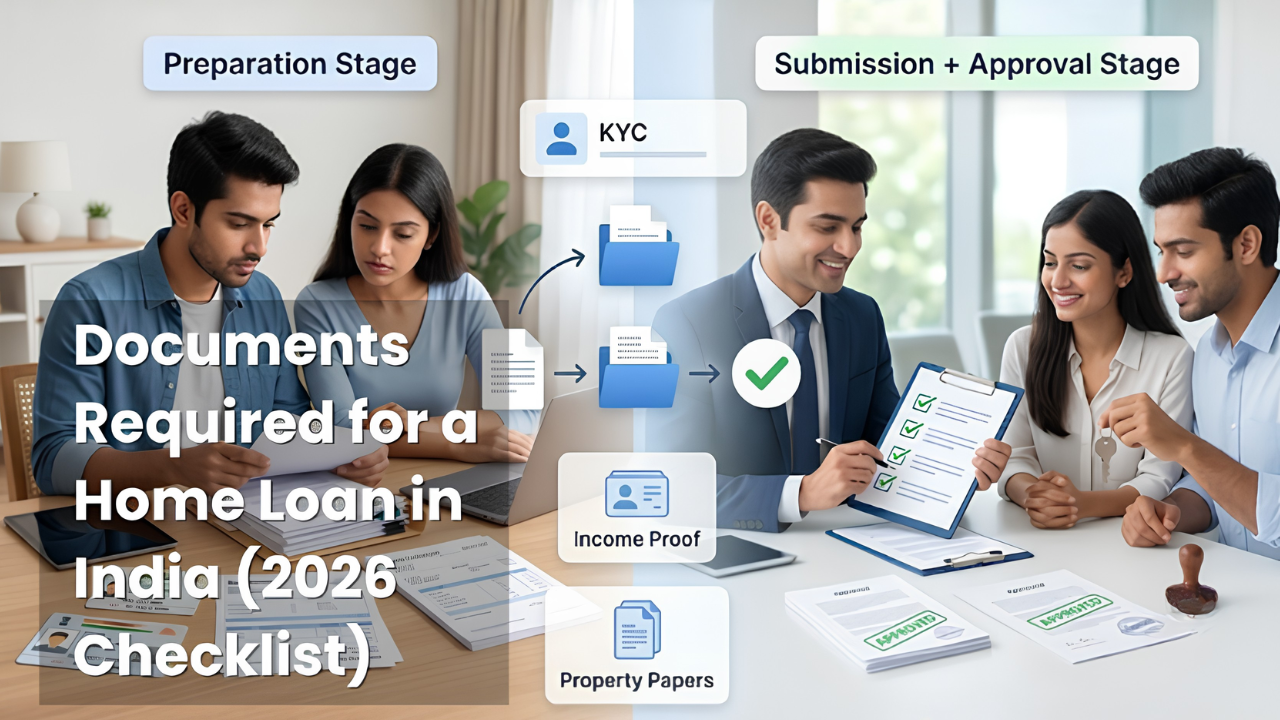
Documents Required for a Home Loan in India (2026 Checklist)
Dasadia Editorial Team · Updated July 2026
Incomplete or mismatched paperwork is the single most common reason home loan applications stall. A home loan is a long, large commitment, so a lender checks three things before sanctioning it: who you are, how much you earn, and what you are buying. That is why the documents fall neatly into four buckets — KYC, income proof, bank statements and property papers — with a few extras depending on whether you are salaried, self-employed or an NRI. This 2026 checklist walks through each, so you can submit a complete file the first time.
Key takeaways
- Home loan documents fall into four groups: KYC (identity, address, age), income proof, bank statements and property papers.
- PAN is mandatory for every applicant; Aadhaar doubles as identity and address proof.
- Salaried applicants need salary slips, Form 16 and 6 months' bank statements; the self-employed need 3 years' ITR, audited financials and business proof.
- Key property documents are the registered sale agreement, the title deed, the Encumbrance Certificate and the approved building plan.
- Under-construction purchases also need the project's RERA registration, builder approvals and payment receipts.
- NRIs add a passport and visa, overseas income proof, NRE/NRO statements and often a Power of Attorney.
- Each co-applicant submits their own identity, address and income documents alongside the shared property papers.
- A complete, consistent file can cut approval time from about 15–20 days to 7–10 — so gather everything before you apply.
Source: BankBazaar · HomeFirst
Basic and KYC documents every applicant needs
These establish your identity, address and age, and are required from every applicant — salaried, self-employed or NRI. Under RBI norms, a lender must verify your identity before it can process a loan, and your PAN ties the whole file to your tax record and credit history. Keep both photocopies and originals ready, and make sure the spelling of your name and your address read the same on every document, since even small mismatches trigger queries. This is also where a lender’s fraud checks begin, so an expired ID, a cropped scan or a name that doesn’t match across papers is often enough on its own to hold up the file.
- A completed, signed home loan application form with two or three recent passport-size photographs.
- PAN card — mandatory for every applicant, and linked to your tax record and CIBIL score.
- Aadhaar card — accepted as both identity and address proof.
- Identity proof (any one): PAN, Aadhaar, passport, voter ID or driving licence.
- Address proof (any one): Aadhaar, a recent utility bill, rent agreement, passport or property tax receipt.
- Age proof (any one): passport, PAN, voter ID, driving licence or your 10th-standard certificate.
- A processing-fee cheque, and — where the lender asks — a statement of your assets and liabilities.
Source: Income Tax Department · BankBazaar
Income documents: salaried vs self-employed
Income proof is how a lender judges your ability to repay, and it is where the two applicant types differ most. Salaried borrowers prove a steady monthly income; the self-employed prove consistent profits over several years, which is why the paperwork is heavier and the income tax returns non-negotiable. Banks average your declared income over the relevant years, so understating income to save tax will directly shrink the loan you qualify for. Lenders also weigh how long you have earned that income — a longer, unbroken track record of salary or profits reassures them of stability, which is why employment or business-continuity proof sits alongside the raw numbers.
Source: BankBazaar · HomeFirst
Property and legal documents
Because the property is the lender’s security, its legal papers are scrutinised as closely as your income — and a bank will not proceed without clear title. Alongside the documents below, the lender usually arranges its own legal opinion on the title chain and a technical valuation of the property. For a resale flat, the title and Encumbrance Certificate are the two most important papers; for an under-construction one, the RERA and builder approvals matter most. These legal checks are also where deals most often slow down, because a break in the title chain or an unclear approval can take weeks to resolve — which is why buyers who choose a lender-approved, RERA-registered project tend to sail through fastest.
- Sale agreement or agreement to sale — the registered agreement between you and the seller or builder.
- Title deed and chain of ownership, going back up to 30 years for a resale property.
- Encumbrance Certificate (EC) from the sub-registrar, confirming no existing mortgage or legal claim.
- The approved, sanctioned building plan, and the Occupancy Certificate for a ready property.
- Latest property tax receipts, plus the share certificate and an NOC for a society flat.
- For an under-construction or builder purchase: the project's RERA registration, builder approvals (NA order, IOD, commencement certificate), the builder-buyer agreement and payment receipts.
Source: MahaRERA · BankBazaar
Extra documents for NRIs and co-applicants
NRIs and co-applicants supply everything above, plus a few additions. NRI files carry extra checks because the income is earned abroad, so lenders want clear overseas employment and income evidence, an Indian NRE or NRO account to route disbursals and EMIs, and usually a Power of Attorney for someone in India to sign on the applicant’s behalf. A co-applicant simply repeats the personal set — their own KYC and income documents — because their income and credit are being assessed too. Lenders also tend to apply a slightly tighter repayment ratio to NRI applicants and convert foreign income into rupees at conservative rates, so complete, well-documented income evidence directly affects the loan you are offered.
- A valid passport and visa, including the residence-visa page.
- Overseas employment proof — work permit, employment contract or labour contract — and a salary certificate in English.
- Overseas salary slips (3–6 months) and overseas bank statements (about 6 months).
- NRE/NRO account statements in India for the last 6–12 months.
- A Power of Attorney, if someone in India will sign the documents on your behalf.
- For self-employed NRIs: business proof such as a trade licence or sponsor agreement.
- For every co-applicant: their own identity, address and income documents, alongside the shared property papers.
Source: Bajaj Finserv · HomeFirst
How lenders check and hold your documents
Knowing what happens to your papers helps you prepare the right versions. For the initial application and doorstep verification, most lenders accept self-attested photocopies or scanned uploads, and many now let you begin the application entirely online. Originals are examined later, during the property legal review, when the bank commissions an independent legal opinion on the title chain and a technical valuation of the property. Once the loan is disbursed, the lender keeps your original property documents — the title and sale deeds — as security for the full tenure, returning them only after the loan is cleared. So keep clean scans ready for submission, and store your originals safely until they are called for. If you are buying with a home loan, it is worth asking the lender early which documents it will retain and for how long, so there are no surprises at disbursal.
Source: RBI · BankBazaar
What if you're missing a document?
Gaps are not always fatal, but they change the picture. A salaried applicant without salary slips can often still apply using an employer-issued salary certificate, Form 16 and bank statements that show regular salary credits. Missing income tax returns is harder: salaried borrowers may substitute Form 16 and statements for smaller loans, but for the self-employed, ITR is the primary proof and cannot be skipped — so filing for the last year or two before applying is worth it. There is no genuine ‘no-document’ home loan, since every lender must verify your identity, income and property; that said, existing customers and some digital or NBFC lenders offer lighter documentation, usually at a slightly higher rate.
Source: BankBazaar · HomeFirst
Document mistakes that delay or derail approval
Most home loan delays come down to paperwork, not eligibility. A missing document simply pauses your file until you provide it, while inconsistencies invite deeper scrutiny. Each query restarts a round of review, so catching these before you submit is far faster than fixing them mid-process.
- Submitting an incomplete set — a single missing document is the most frequent cause of delay.
- Mismatched details across your PAN, Aadhaar and bank records.
- Blurred, cropped or expired copies of your ID and financial documents.
- Income understated on your ITR through aggressive tax planning, which lowers your eligible loan.
- Large, unexplained cash deposits in your bank statements, which raise questions about your income.
- Overlooking property red flags — a missing Occupancy or Encumbrance Certificate can stall the loan outright.
Source: HomeFirst · BankBazaar
Tips to get your documents application-ready
A little preparation is the fastest route to a smooth sanction. Getting the file right the first time can shorten approval from two to three weeks to about seven to ten days. Think of it as assembling one clean, consistent file rather than a loose pile of separate papers.
- Gather the full set before you apply, and check it against your lender's list.
- Keep both self-attested photocopies (or scans) and the originals — lenders review originals during the legal check.
- Make sure your name and address read identically across every document.
- File your income tax returns consistently — most lenders want two to three years, and no ITR often means no loan.
- Buy from a RERA-registered, lender-approved project to speed up the property checks.
- Confirm the exact checklist with your chosen lender, since requirements vary slightly from bank to bank.
Source: BankBazaar · HomeFirst
The bottom line
Home loan paperwork looks daunting, but it follows a simple logic: prove who you are, how much you earn, and that the property is legally sound. Assemble your KYC, income and property documents before you apply, keep the details consistent across every paper, and confirm the final list with your lender. A complete, accurate file is the single biggest thing you can do to turn a slow, stressful application into a quick approval. And once the loan is sanctioned, keep copies of everything you submitted — you will need them again for tax filing and, eventually, to reclaim your original property papers.
Frequently asked questions
KYC documents (PAN, Aadhaar, identity, address and age proof, photographs and the application form), income proof (salary slips or ITR plus bank statements) and property papers (sale agreement, title deed, Encumbrance Certificate and approved building plan).
The last three months’ salary slips, Form 16, six months’ bank statements showing salary credits, and an employment or appointment letter — along with standard KYC and the property documents.
The last three years’ income tax returns with income computation, CA-audited profit-and-loss and balance-sheet statements, six to twelve months’ business bank statements, and business-registration proof — plus KYC and property documents.
Yes. PAN is compulsory for every applicant as it links your file to your tax record. Aadhaar alone is not enough, since address and income proof are also required.
Salaried applicants can sometimes substitute salary slips, Form 16 and bank statements. For the self-employed, ITR is the primary income proof and is mandatory. Filing returns consistently, even below the taxable limit, strengthens your case.
The registered sale agreement, the title deed and chain of ownership, the Encumbrance Certificate, the approved building plan, and — for a ready property — the Occupancy Certificate. Under-construction purchases add RERA registration and builder approvals.
Standard KYC and property papers, plus a valid passport and visa, overseas employment and salary proof, NRE/NRO bank statements, and usually a Power of Attorney for someone in India to sign on their behalf.
Yes. Each co-applicant submits their own identity, address and income documents, because their income and credit are assessed too, along with the common property documents.
Self-attested photocopies or scans are accepted for the initial application and verification. Originals are checked during the property legal review, and original property documents are held by the lender until the loan is fully repaid.
Usually the last six months for salaried applicants and six to twelve months for self-employed applicants, so the lender can confirm steady income and repayment capacity.
A home loan runs 15 to 30 years, so the lender verifies three things before committing: your identity, your income and ability to repay, and the property’s clear legal title. Documentation is how each is confirmed.
Submit a complete, consistent document set upfront and buy from an approved, RERA-registered project. A full file can cut processing from about 15–20 days to 7–10.
Verified — key facts
- Home loan documents fall into four buckets: KYC, income proof, bank statements and property papers (HomeFirst / BankBazaar).
- PAN is mandatory for every applicant; Aadhaar serves as identity and address proof (Income Tax Department).
- Salaried: 3 months' salary slips, Form 16, 6 months' bank statements; ITR often needed for larger loans.
- Self-employed: 3 years' ITR, CA-audited P&L, 6–12 months' business bank statements, business-registration proof.
- Property: sale agreement, title deed (up to 30-yr chain for resale), Encumbrance Certificate, approved plan, OC for ready homes.
- NRIs: passport and visa, overseas employment and salary proof, NRE/NRO statements, and often a Power of Attorney.
- A complete document set can cut approval from ≈ 15–20 days to ≈ 7–10; missing or mismatched papers are the top cause of delay.
Disclaimer: This article is for informational purposes only and is not financial or legal advice. Document requirements are indicative and vary by lender, applicant type (salaried, self-employed, NRI), property and prevailing regulation, and change over time. Always confirm the exact checklist with your chosen bank or housing finance company, and consult a qualified professional, before applying.
Buying a home in Andheri East?
Explore 153 East by Dasadia Developers LLP — a freehold residential address in J.B. Nagar, Andheri East, minutes from the metro, Western Express Highway and the airport. MahaRERA registration no. PR1180002502968. Get the brochure with floor plans, pricing and amenities, or book a site visit with our team.