


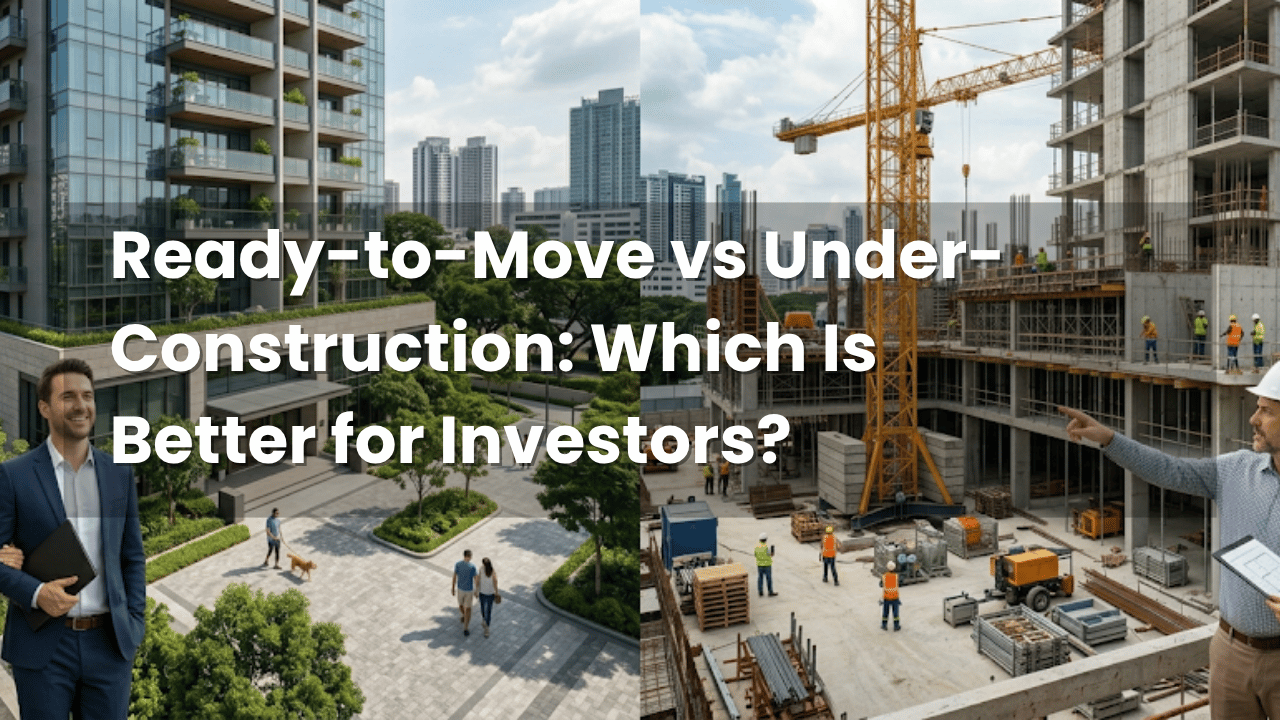
Ready-to-Move vs Under-Construction: Which Is Better for Investors?
Dasadia Editorial Team · Updated June 2026
It is the question almost every property investor faces: buy a ready-to-move (RTM) flat you can rent out tomorrow, or an under-construction (UC) project that costs less today and may appreciate while it is being built? Both can be smart — but for different investors. A ready flat gives you immediate rent, zero GST and no delay risk; an under-construction unit offers a lower entry price, staggered payments and a longer runway for capital growth, at the cost of patience and execution risk.
This guide compares the two on the factors that actually move an investor’s returns — price, GST, rental income, appreciation, risk and tax — and helps you decide which fits your goal, timeline and risk appetite.
Key Takeaways
- Ready-to-move flats (with an Occupancy Certificate) attract no GST; under-construction flats attract 1% (affordable) or 5% (other) GST.
- RTM gives immediate rental income and zero delay risk; UC offers a lower entry price and staggered, construction-linked payments.
- Under-construction units in growth corridors can appreciate faster during the build; RTM in established areas appreciates more steadily.
- RTM lets you inspect the actual unit and quality; UC is bought on plans, so the developer's track record is everything.
- Stamp duty and registration apply to both; only GST differs by construction status.
- Choose RTM for immediate income and certainty; choose UC for a longer horizon, lower entry and higher appreciation potential.
What Is a Ready-to-Move Property?
A ready-to-move property is a completed home that has received its Occupancy Certificate (OC) and can be occupied — or rented out — immediately. For an investor, the appeal is certainty: you can physically inspect the actual flat, its finish and the building’s amenities before you pay, there is no waiting period, and rental income can begin almost at once. Because the transaction is treated as the sale of immovable property once an OC exists, no GST applies. The trade-off is price: ready inventory usually commands a premium, and in saturated locations the easy appreciation may already be priced in.
Source: Brickfi · The Propertist
What Is an Under-Construction Property?
An under-construction property is one still being built, to be delivered at a future date. Investors are drawn to it for two reasons: the entry price is typically lower per square foot than a comparable ready unit, and payments are staggered through a construction-linked plan, easing the cash-flow burden. If the location grows during the build — a new metro line, an expressway, an employment hub — the property can appreciate meaningfully before you even take possession. The catch is that you are buying on plans and promises: there is no rental income during construction, and you carry the risk of delays, so the developer’s credibility and RERA compliance matter enormously.
Source: NoBrokerage · 100acress
Ready-to-Move vs Under-Construction: Key Differences
Here is the comparison at a glance:
Source: Adani Realty · Skandhanshi
The Cost Angle: Price, GST and Payment
The most concrete difference is tax. GST applies only while a property is under construction; once an Occupancy Certificate is issued, the sale is exempt. The current rates:
On a ₹50 lakh under-construction flat at 5%, that is an extra ₹2.5 lakh of GST over the price — a real cost that narrows the entry-price advantage. Set against that, UC payments are staggered across the build, while RTM usually needs the full amount (or full loan) upfront. Stamp duty and registration apply equally to both, so they do not tilt the decision.
Source: CBIC (GST) · NoBroker
The Income and Appreciation Angle
For a rental investor, timing of income is decisive. A ready flat can be let immediately, so rent starts covering your EMI from day one and your capital is working at once. An under-construction unit earns nothing until possession — you carry the EMI (or pre-EMI) with no offsetting rent during the build.
Appreciation tilts the other way. Under-construction units in emerging, infrastructure-led corridors have historically appreciated faster during the build than ready stock in saturated zones — some Mumbai-region growth pockets have seen materially higher annual appreciation than established areas — though this is location-dependent and not guaranteed. Ready properties in prime, supply-constrained locations tend to appreciate more steadily. In short: RTM favours income now, UC favours growth later.
Source: Adani Realty · 100acress
The Risk Angle: Delays and What-You-See
The biggest risk in an under-construction purchase is execution — delays, cost overruns or quality falling short of the renders. RERA has tightened developer accountability, but delays still happen, and they raise your holding cost (EMI without rent) and push back your returns. A ready property removes this uncertainty: what you see is what you get, the construction quality is visible, and possession is immediate. This is why passive, income-focused investors often prefer RTM, while growth investors who can absorb timeline risk lean towards UC — provided they back a credible, RERA-compliant developer with a record of on-time delivery.
Tax and Loan Differences
Home loans are available for both, but UC loans disburse in stages tied to construction progress, while a ready property is usually financed in one go. The tax treatment of interest also differs: interest paid during the construction period of an under-construction property (‘pre-construction interest’) cannot be claimed right away — it is deductible in five equal annual instalments starting from the year construction is completed, under Section 24(b). With a ready property, your interest and rental-income tax benefits begin immediately. For investors who let out the property, rental income is taxable in both cases, with the usual deductions available. Confirm current provisions with the Income Tax Department or a tax advisor.
Source: Income Tax Department · NoBrokerage
Pros and Cons for Investors
Ready-to-move — pros
- Immediate rental income and immediate possession.
- No GST, and no construction-delay risk.
- You inspect the actual unit and quality before buying; stronger liquidity.
Ready-to-move — trade-offs
- Higher entry price; appreciation may already be priced in.
- Larger upfront payment and little scope for customisation.
Under-construction — pros
- Lower entry price and staggered, construction-linked payments.
- Higher appreciation potential in growth corridors during the build.
Under-construction — trade-offs
- GST of 1–5%, no rent during construction, and delay/execution risk.
- You buy on plans, so quality and timeline depend on the developer.
Which Suits Which Investor?
There is no universally ‘better’ option — only the better fit for your profile:
- Choose ready-to-move if you want rental income from day one, value certainty, want to avoid GST and delay risk, or have a shorter horizon.
- Choose under-construction if you have a 3–4 year (or longer) horizon, want a lower entry price and staggered payments, and are targeting appreciation in a growth corridor.
- Either way, weigh your cash flow: UC eases upfront outgo but means EMI without rent; RTM needs more upfront but pays you back immediately.
- Match the choice to your risk appetite — RTM for lower risk, UC for higher potential return with more uncertainty.
Source: Adani Realty · CEY One
Due Diligence for Both Options
- Verify RERA registration, status and approvals on the official MahaRERA portal (for Maharashtra) before paying anything.
- For ready property, confirm the Occupancy Certificate and inspect the actual unit and amenities.
- For under-construction, scrutinise the developer's track record of on-time, on-quality delivery and the project's completion timeline.
- Check a clear title and that the property is free of encumbrances, ideally with a lawyer.
- Run the full numbers — price, GST (for UC), stamp duty, registration, expected rent and appreciation — before committing.
Verified Key Facts
- Ready-to-move flats with an OC (and resale) attract 0% GST: Verified (CBIC; The Propertist).
- Under-construction GST is 1% (affordable) or 5% (other residential), with no ITC since April 2019: Verified (CBIC; NoBroker).
- On a ₹50 lakh UC flat at 5%, GST adds about ₹2.5 lakh to the cost: Verified (author calculation).
- Affordable housing for 1% GST means ≤₹45 lakh with carpet-area limits (60 sqm metro / 90 sqm non-metro): Verified (TradeBrains).
- Pre-construction loan interest is deductible in 5 equal instalments from the year of completion (Section 24): Verified (Income Tax Department).
- Stamp duty and registration apply to both RTM and UC regardless of GST: Verified (The Propertist).
Frequently Asked Questions
It depends on your goal. Ready-to-move suits investors who want immediate rental income, certainty, no GST and no delay risk. Under-construction suits those with a longer horizon who want a lower entry price, staggered payments and higher appreciation potential in growth corridors.
No. A ready-to-move flat that has received its Occupancy Certificate is treated as a sale of immovable property and attracts no GST. Resale flats are also exempt. Only under-construction properties attract GST.
1% for affordable housing (up to ₹45 lakh with carpet-area limits) and 5% for other residential units, both without input tax credit. Commercial under-construction property attracts 12% with ITC.
They typically launch at a lower price per square foot than completed units in the same micro-market, and payments are staggered through construction. The trade-off is GST, no rental income during the build, and delay risk.
Under-construction units in emerging, infrastructure-led corridors have historically appreciated faster during the build, while ready properties in prime, supply-constrained areas appreciate more steadily. Appreciation is location-dependent and not guaranteed.
Yes. Loans are available for both, but for under-construction the bank disburses in stages linked to construction progress, whereas a ready property is usually financed in one disbursal.
It is the home-loan interest paid during the construction period of an under-construction property. It cannot be claimed immediately — it is deductible in five equal annual instalments starting from the year construction is completed, under Section 24(b).
The main risks are construction delays, cost overruns and quality falling short of what was promised. Delays raise your holding cost (EMI without rent). Backing a credible, RERA-compliant developer with an on-time delivery record reduces this risk.
Yes. Because the property is complete and occupiable, you can let it out almost immediately, so rent can start offsetting your EMI from the outset — a key advantage for income-focused investors.
No. Stamp duty and registration are state-level charges that apply to both ready-to-move and under-construction purchases. Only GST differs, based on whether the property is still under construction.
Verify the project’s RERA registration and approvals, study the developer’s delivery track record, review the completion timeline, confirm a clear title, and budget for GST and possible delays before committing.
Yes. Resale properties are completed and attract no GST, the same as ready-to-move flats with an Occupancy Certificate. Only stamp duty and registration apply.
Conclusion and Next Steps
Ready-to-move and under-construction are not better or worse in the abstract — they are tools for different investment goals. RTM hands you income, certainty and zero GST at a higher price; UC offers a cheaper entry, staggered payments and a longer appreciation runway in exchange for patience and execution risk. The right choice flows from your horizon, cash flow and risk appetite, not from a blanket rule.
Next step: for any shortlist, compare the all-in cost (price plus GST for UC, stamp duty and registration for both), the expected rent and when it starts, and the appreciation case — then verify the project on the official MahaRERA portal and check the developer’s delivery record before you commit.
Sources and References
- CBIC — GST on real estate / construction services
- MahaRERA — official portal (project verification)
- Income Tax Department — Section 24 / pre-construction interest
- NoBroker — GST: under-construction vs ready-to-move
- The Propertist — GST on under-construction flats 2026
- Adani Realty — RTM vs UC property in Mumbai
- Brickfi — is under-construction worth it in 2026
- 100acress — ready-to-move vs under-construction
- TradeBrains — how much GST on an under-construction flat 2026
- CEY One — ready-to-move vs under-construction guide
Disclaimer
This article is for informational purposes only and does not constitute financial, investment, legal or tax advice. GST rates, tax provisions, appreciation trends and other figures are indicative as of June 2026 and may change. Always verify current GST and tax rules with the CBIC and Income Tax Department, verify a project on the official MahaRERA portal, and consult qualified professionals before making any investment decision.
Comparing Your Options in Andheri East?
153 East by Dasadia Developers LLP is a MahaRERA-registered (PR1180002502968) residential project in J.B. Nagar, Andheri East — a well-connected micro-market close to business hubs and the metro — offering 1–4 BHK homes across a range of configurations. Get the brochure with floor plans and details, or arrange a site visit, and verify every approval on the official MahaRERA portal.