


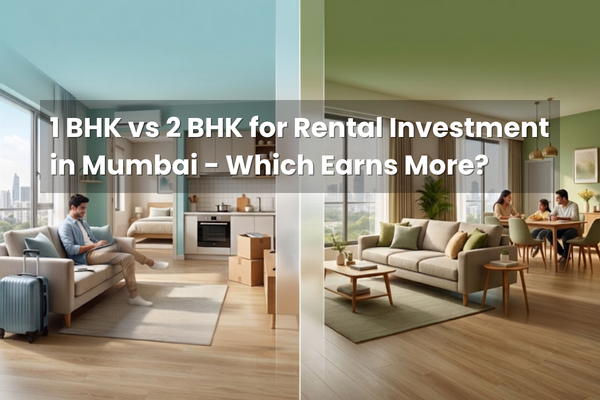
1 BHK vs 2 BHK for Rental Investment in Mumbai: Which Earns More?
Dasadia Editorial Team · Updated July 2026
If you are buying in Mumbai to earn rent, one question comes up again and again: 1 BHK or 2 BHK? A 2 BHK obviously fetches more rent — but it also costs far more, and ‘more rent’ is not the same as ‘more return’. The honest answer turns on what you are optimising for: yield per rupee, absolute income, tenant stability, or resale. This 2026 guide compares the two head to head for a rental investor, with real Mumbai numbers, so you can pick the configuration that actually earns more for you.
Key takeaways
- A 2 BHK earns more rent in absolute rupees; a 1 BHK usually earns a higher yield — more return per rupee invested.
- In Andheri East, 1 BHKs yield roughly 4.5-5% versus about 4-4.3% for 2 BHKs, because rents don't rise in step with prices.
- On a fixed budget, two 1 BHKs can out-earn one 2 BHK on total rent — and spread your vacancy risk across two units.
- 1 BHKs draw Mumbai's deepest tenant pool and let fast, but tenants churn more often.
- 2 BHKs attract families and sharers who stay longer, giving lower churn, plus stronger resale liquidity and often better appreciation.
- Mumbai's yields are modest (~4%) but paired with low vacancy, reliable rent and deep liquidity — certainty over headline returns.
- Calculate yield on about 10 months of rent, not 12, to allow for vacancy; a vacant flat earns nothing.
- Location near job hubs, metro and campuses drives rental demand and value more than the configuration alone.
Yield vs rent: the core distinction
Start with the distinction that trips up most investors: rent is not return. Rental yield — the annual rent as a percentage of the property’s price — is the truer measure of what a rental earns, and here compact units have a structural edge. Rents do not rise in step with prices: a 2 BHK might cost roughly double a 1 BHK but rarely rents for double, so the smaller unit usually posts the higher yield. Across Mumbai, 1 BHK apartments consistently out-yield larger homes, because their lower purchase value is paired with steady, salary-driven demand. So when someone asks which ‘earns more’, the answer splits: a 2 BHK earns more rent in absolute rupees, but a 1 BHK typically earns more per rupee invested. Two adjustments keep this honest: net yield runs about a percentage point below gross once maintenance, property tax and management are counted, and one-time costs such as stamp duty and registration add to your entry price on both.
Source: Global Property Guide · Sobha
Head-to-head comparison
Here is how the two configurations compare across the factors that matter to a rental investor, on 2026 Andheri East data.
The numbers: yield, rent and the fixed-budget test
Put real figures on it. In a job-hub suburb like Andheri East, a 1 BHK around ₹1.1 crore rents for roughly ₹42,000 a month — a gross yield of about 4.6% — while a 2 BHK near ₹2.1 crore rents for about ₹74,000, a yield closer to 4.2%. The 1 BHK’s edge looks small per unit, but it compounds on a fixed budget. Take ₹2.2 crore: you could buy one 2 BHK earning ₹74,000 a month, or two 1 BHKs earning ₹42,000 each — ₹84,000 combined. That is about ₹10,000 more every month, some ₹1.2 lakh more a year, from the same capital, and your vacancy risk is spread across two units rather than riding on one. The catch is that two flats mean two tenants, two sets of paperwork and more hands-on management. Whether that extra ₹1.2 lakh a year is worth doubling your admin is a personal call — some investors happily take it, others prize the simplicity of a single, larger tenant.
Source: Square Yards · 99acres
Tenant demand, vacancy and churn
Who rents each — and how often they move — matters as much as the yield. A 1 BHK draws from Mumbai’s deepest tenant pool: single professionals, young couples, students and bachelors, so it lets quickly and rarely stays empty for long. The trade-off is churn — these tenants move more often, meaning more frequent re-letting, brokerage and touch-up costs. A 2 BHK appeals to families and sharing professionals, a smaller pool that can take longer to fill, but who tend to settle for years, giving you lower churn and steadier occupancy. Experienced landlords add a sober note: a vacant flat earns nothing, so calculate yield on about ten months of rent, not twelve, to keep your expectations honest. A little spent well on furnishing pays back either way — a modular kitchen and fitted wardrobes lift the rent, while over-the-top interiors rarely recover their cost.
Source: Sobha · Vibe Realty
Appreciation, liquidity and resale
On capital growth and exit, the picture tilts back toward the 2 BHK. Because it appeals to both families buying to live and investors buying to let, a 2 BHK draws from a wider buyer pool, which supports stronger resale liquidity, faster sales and often better appreciation — end-user demand tends to drive prices more durably than pure investor demand. A 1 BHK is highly liquid too, thanks to its low ticket size and the sheer number of buyers who can afford it, but its appreciation is more demand-led and can be steadier than spectacular. In short, the 1 BHK’s strength is income and affordability; the 2 BHK’s is stability and capital growth. In supply-constrained pockets where redevelopment drives new stock, that broad, family-led demand also tends to protect a 2 BHK’s price through softer patches in the market.
Source: Sobha · Vibe Realty
Which should you buy?
It comes down to what you are optimising for — income and yield, or stability and growth. Match yourself to the lists below.
Choose a 1 BHK if
- Rental yield and monthly cash flow are your top priority.
- You want a lower entry price and the option to diversify across two units.
- You are buying near a job hub, metro or campus with deep bachelor and couple demand.
- You value fast letting and easy resale, and can accept a little more churn.
- You are an NRI or hands-off owner wanting a smaller, easy-to-manage asset.
Choose a 2 BHK if
- You want higher absolute rent and more stable, longer-term family tenants.
- Capital appreciation and resale liquidity matter as much as yield.
- You prefer to manage one property and one tenant rather than two.
- You are targeting corporate leases or family renters who stay for years.
- You may use the home yourself later, giving it end-use as well as rental value.
The Mumbai and Andheri angle
Two things make Mumbai a special case. First, its yields are modest by national standards — around 4% versus 5%-plus in some cities — but it compensates with exceptionally low vacancy, reliable rent collection and deep liquidity, so investors trade a little yield for a lot of certainty. Second, location decides everything: units near job hubs, metro stations and campuses let fastest and hold value best. Andheri East is a prime example — its airport, SEEPZ, MIDC and BKC demand keeps both 1 and 2 BHKs in constant use, with 1 BHKs posting the higher yield and 2 BHKs the steadier tenancies. Whichever you choose, buy close to work and transit, and the rent tends to take care of itself. It also helps to match the unit to the tenant you want: 2 BHKs suit corporate leases and settled families, while well-located 1 BHKs increasingly attract co-living and serviced-apartment operators too.
Source: 99acres · Global Property Guide
The bottom line
So which earns more? On yield — return per rupee — the 1 BHK usually wins, and on a fixed budget two 1 BHKs can out-earn a single 2 BHK on rent while spreading your vacancy risk. On absolute rent, tenant stability, resale liquidity and appreciation, the 2 BHK has the edge, with the bonus that you might live in it one day. For a pure income investor who does not mind managing more, the 1 BHK is often the sharper rental play; for one who wants stability, growth and simplicity, the 2 BHK is hard to beat. Match the configuration to your goal, buy near a job hub, budget for some vacancy, and either can be a sound Mumbai investment. The mistake to avoid is chasing a headline yield in the wrong location — in Mumbai, a well-placed flat of either size beats a cheap one nobody wants to rent.
Frequently asked questions
A 2 BHK earns more rent in absolute terms, but a 1 BHK usually earns a higher yield — more return per rupee invested. On a fixed budget, two 1 BHKs can out-earn a single 2 BHK on total rent.
The 1 BHK, typically. Because rents don’t rise in step with prices, the cheaper unit usually posts the higher percentage yield — often around 4.5-5% versus 4-4.3% for a 2 BHK in Andheri East.
Yes, especially for income. It has the deepest tenant pool, low vacancy, easy resale and the highest yield of the common configurations — though tenants tend to churn more often.
For stability, appreciation and resale liquidity, often yes; for pure yield and cash flow, the 1 BHK usually wins. The right answer depends on your investment goal.
Roughly ₹40,000-56,000 a month for a 1 BHK and ₹70,000 or more for a 2 BHK, varying by building, furnishing and exact location. Figures are indicative.
Two 1 BHKs usually earn more total rent and a higher yield, and diversify vacancy risk, but require managing two tenants and two properties. One 2 BHK is simpler and offers more stable, longer tenancies.
A 1 BHK lets faster because demand is deeper, but a 2 BHK’s family tenants tend to stay longer, so churn is lower. Spreading capital across two 1 BHKs also diversifies vacancy.
A 2 BHK often appreciates better, as it draws both family end-users and investors. A 1 BHK’s appreciation is solid but more demand-led. Location tends to matter more than configuration.
Around 4% gross is typical for well-located Mumbai property, higher than the city’s premium pockets. Mumbai’s low vacancy and liquidity offset its modest headline yields.
Multiply the monthly rent by 12 and divide by the property’s price, then multiply by 100. For realism, use about ten months of rent to allow for vacancy, and subtract costs for a net figure.
Yes. Their low ticket size and large tenant and buyer pool make them quick to let and liquid to resell, which is a key part of their appeal to investors.
Compact 1 BHKs are popular with NRIs for being affordable, easy to lease and low-maintenance. A 2 BHK suits an NRI wanting a family-grade asset with appreciation and possible future self-use.
Verified — key facts
- 1 BHK and compact units consistently out-yield larger homes in Mumbai, as rents don't scale with prices (Sobha / Brigade / Vibe Realty).
- Representative Andheri East (2026): 1 BHK ≈ ₹1.1 cr renting ≈ ₹42,000/month (yield ≈ 4.6%); 2 BHK ≈ ₹2.1 cr renting ≈ ₹74,000/month (yield ≈ 4.2%) (99acres / Square Yards, computed).
- Fixed-budget test (₹2.2 cr): two 1 BHKs earn ≈ ₹84,000/month vs one 2 BHK ≈ ₹74,000 — about ₹1.2 lakh a year more, with diversified vacancy (computed).
- 2 BHKs offer a wider buyer and tenant pool, stronger resale liquidity, lower churn and often better appreciation (Sobha).
- Mumbai yields (≈ 4%) are modest but paired with low vacancy, reliable rent and strong liquidity (Global Property Guide / market sources).
- Practical rule: calculate yield on ≈ 10 months of rent, not 12, to allow for vacancy; net yield ≈ 1% below gross.
- Location near job hubs, metro and campuses drives rental demand and value more than configuration alone.
Disclaimer: This article is for informational purposes only and is not financial or investment advice. Prices, rents and yields are indicative, drawn from public 2025–26 sources, and vary by property, building, furnishing and timing; the worked examples use stated assumptions and will differ for your property. Property investment carries risk, including vacancy and market movement. Verify current rates and yields, and consult a qualified professional, before making any decision.
Investing in Andheri East? Explore 153 East
Explore 153 East by Dasadia Developers LLP — a freehold residential address in J.B. Nagar, Andheri East, minutes from the metro, Western Express Highway and the airport, in a pocket with strong, salary-driven rental demand. MahaRERA registration no. PR1180002502968. Get the brochure with floor plans, pricing and amenities, or book a site visit with our team.